The Critical Role of Gear Oil in Axle Swaps and Rebuilds
When replacing the rear differential—whether you are swapping in a low-mileage junkyard unit, upgrading to a heavy-duty Dana 60 for off-road use, or meticulously rebuilding a stock GM 10-bolt—the hardware is only half the battle. The lifeblood of your new or refurbished axle assembly is the gear oil. The extreme sliding forces inherent in hypoid ring and pinion gearsets generate immense localized heat and shear stress. Using the incorrect fluid specification during a differential swap can lead to rapid gear wear, catastrophic bearing failure, and limited-slip clutch chatter within the first few hundred miles.
In this comprehensive comparison and buyer's guide, we break down the exact differential fluid types, API service classifications, viscosity grades, and friction modifier requirements you need to know. We will also provide real-world torque specifications and fluid capacities to ensure your rear differential replacement is completed to factory-engineered standards.
Decoding API Service Classifications: GL-4 vs. GL-5
The American Petroleum Institute (API) categorizes gear oils based on their extreme pressure (EP) additive packages and intended application. Understanding the difference between GL-4 and GL-5 is paramount when sourcing fluid for your axle.
API GL-5: The Hypoid Gear Standard
Almost all modern automotive and light-truck rear differentials utilize hypoid gearsets, where the pinion gear intersects the ring gear below the centerline. This geometry creates a severe sliding action rather than a pure rolling action. GL-5 gear oils are heavily fortified with sulfur-phosphorus EP additives that chemically react with the metal surfaces under extreme pressure to form a sacrificial tribofilm. This prevents metal-on-metal welding and micropitting. According to the American Petroleum Institute (API), GL-5 is the mandatory specification for hypoid differentials operating under high-speed, high-torque conditions.
API GL-4: Manual Transmissions and Yellow Metals
GL-4 contains roughly half the sulfur-phosphorus additives of GL-5. While this makes it safe for 'yellow metals' (brass, bronze, and copper synchronizers found in manual transmissions), it does not provide adequate shear protection for a rear differential's hypoid gears. Never use GL-4 in a standard rear axle unless explicitly directed by an OEM for a specific transaxle or vintage application with bronze thrust washers.
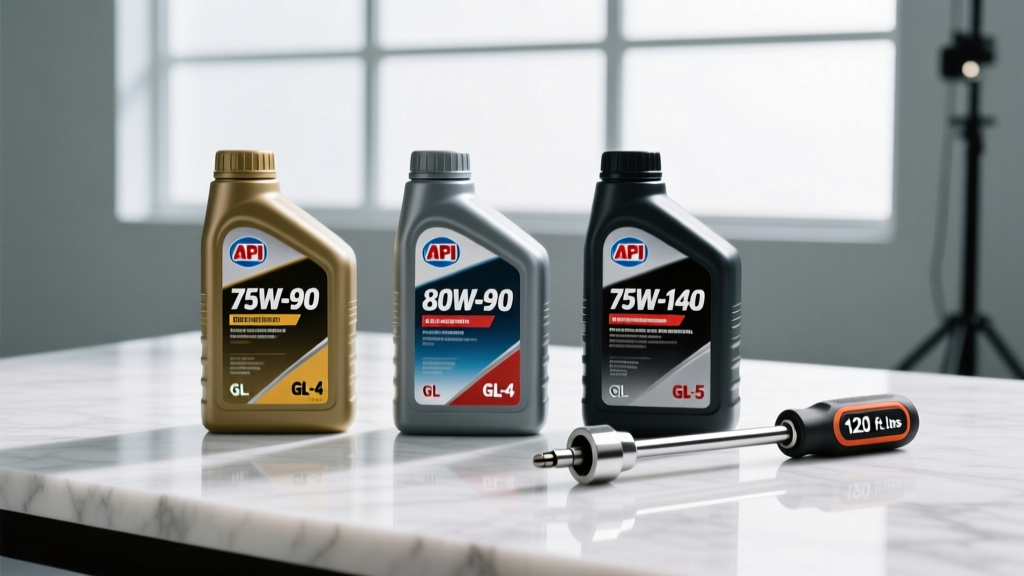
Viscosity Grades Explained: 75W-90 vs. 80W-90 vs. 75W-140
Gear oil viscosity is governed by the SAE International J306 Standard. The 'W' denotes winter (cold-flow) performance, while the second number represents the kinematic viscosity at 100°C (212°F). Selecting the right viscosity depends on your climate, towing habits, and differential cooling capacity.
| Viscosity Grade | Base Stock Type | Best Application | Operating Temp Range |
|---|---|---|---|
| 75W-90 | Full Synthetic (PAO/Ester) | Daily drivers, cold climates, fuel economy optimization, standard towing. | -40°C to 120°C |
| 80W-90 | Conventional Petroleum | Moderate climates, budget rebuilds, light-duty stock replacements. | -26°C to 110°C |
| 75W-140 | Full Synthetic | Heavy towing, commercial use, off-road crawling, track/competition use. | -40°C to 150°C+ |
Expert Insight: If you are replacing the rear differential on a 3/4-ton truck used for towing 10,000+ lb trailers, bypass the standard 75W-90 and fill it with 75W-140. The thicker 140-weight film maintains hydrodynamic separation in the pinion bearings when differential temperatures exceed 250°F under heavy load.
Synthetic vs. Conventional Base Stocks: A 2026 Market Perspective
As we navigate the 2026 automotive aftermarket, the price gap between conventional and synthetic gear oils has narrowed, making full synthetics the undisputed choice for differential replacements.
- Conventional Gear Oil ($8 - $12 per quart): Refined from crude oil, these fluids contain naturally occurring paraffins that thicken in cold weather, causing gear 'whine' on startup until the fluid warms. They also suffer from rapid shear degradation, meaning the fluid physically thins out over time due to the grinding action of the gears.
- Full Synthetic Gear Oil ($16 - $25 per quart): Engineered from Polyalphaolefin (PAO) and ester base stocks, synthetics possess uniform molecular structures. They offer superior shear stability, meaning a 75W-90 synthetic will remain a true 90-weight even after 50,000 miles of punishing use. They also feature significantly lower pour points, ensuring immediate lubrication to the pinion bearings during sub-zero cold starts.
The Friction Modifier Variable for Limited-Slip Differentials (LSD)
When replacing the rear differential, you must identify the type of limited-slip carrier installed. This dictates whether a friction modifier is required.
Clutch-Type LSDs (Require Modifier)
Carriers like the Ford Traction-Lok, Eaton Posi, and Auburn LSD use stacks of carbon-fiber or steel clutch packs to transfer torque. Without a specialized friction modifier (typically 4 to 8 oz per axle), these clutches will bind and release abruptly during low-speed cornering, causing a violent 'chatter' or 'judder' that can shatter the carrier cross-pins. Always use the OEM-recommended modifier, such as Ford XL-3 or GM EOS (Engine Oil Supplement).
Gear-Type and Locking Differentials (NO Modifier Needed)
If your replacement differential features a Torsen (helical gear), Eaton Truetrac, or a Detroit Locker, do not add a friction modifier. These units rely on gear binding or mechanical locking mechanisms; adding a friction modifier will reduce the bias ratio and severely compromise the unit's torque-transfer capabilities.
OEM Torque Specifications and Fluid Capacities
Proper sealing and fill levels are critical after replacing the rear differential. Overfilling can cause fluid to foam and blow past the axle seals, while underfilling will starve the pinion bearings. Always measure torque with a calibrated inch-pound or foot-pound torque wrench.
| Axle Model | Fluid Capacity | Cover Bolt / Fill Plug Torque | Gasket Type |
|---|---|---|---|
| Ford 8.8-inch | 2.5 - 3.0 Pints | Fill Plug: 15 lb-ft (Rubber), 30 lb-ft (Metal) | Silicone RTV or Pre-cut |
| GM 8.5 / 8.6 10-Bolt | 2.0 - 2.5 Pints | Cover Bolts: 22 lb-ft | RTV Silicone (Black/Grey) |
| Dana 44 (Jeep/Truck) | 3.0 - 3.5 Pints | Cover Bolts: 25 lb-ft / Fill Plug: 25-35 lb-ft | Lube-Locker or RTV |
| Chrysler 8.75 | 3.5 Pints | Fill Plug: 25 lb-ft | RTV Silicone |
Pro-Tip: When filling the differential, the fluid level should be exactly flush with the bottom edge of the fill plug hole. If your vehicle is lifted or modified, ensure the vehicle is sitting level on jack stands, not on an inclined driveway, to achieve an accurate fill level.
2026 Buyer’s Guide: Top Gear Oil Recommendations
Based on independent shear-stability testing and real-world drivetrain telemetry, here are the top three gear oils to use when replacing the rear differential this year.
1. Amsoil Severe Gear 75W-90 (Part # SVG)
Price: ~$21.99 / Quart
Best For: Heavy towing, off-road, and extreme temperature environments.
Amsoil's Severe Gear line utilizes an ultra-high viscosity index PAO base stock fortified with an aggressive EP additive package. It is specifically engineered to resist thermal runaway in differentials that lack cooling fins or auxiliary fluid coolers. It exceeds API GL-5 and MT-1 specifications.
2. Red Line Synthetic 75W90 (Part # 57904)
Price: ~$24.50 / Quart
Best For: High-performance street cars, track use, and shock-load resistance.
Red Line utilizes a proprietary blend of polyol ester base stocks. Esters are naturally polar, meaning they electromagnetically cling to the ring and pinion gear teeth, providing exceptional boundary lubrication during the split-second shock loads of hard launches or aggressive cornering. Note: This specific part number already contains the necessary friction modifiers for clutch-type LSDs.
3. Mobil 1 Synthetic Gear Lube 75W-90 (Part # 104361)
Price: ~$16.50 / Quart
Best For: Daily drivers, stock replacements, and budget-conscious synthetic upgrades.
Mobil 1 offers a highly accessible, cost-effective full synthetic that meets the API GL-5 standard. It provides excellent cold-weather flow characteristics and reliable wear protection for standard commuting and light-duty truck applications. You will need to purchase a separate bottle of friction modifier if your axle utilizes a clutch-type LSD.
Final Thoughts on Differential Maintenance
Replacing the rear differential is a significant investment in your vehicle's drivetrain longevity and capability. Do not compromise that investment by filling the housing with the cheapest fluid on the shelf. By matching the correct API GL-5 specification, selecting the appropriate SAE viscosity for your operating environment, and carefully managing friction modifiers for your specific carrier type, you will ensure your ring and pinion gears operate silently and reliably for hundreds of thousands of miles. Always double-check your torque specs, use high-quality RTV or reusable gaskets, and verify the fluid level before putting the vehicle back on the pavement.