The Acoustic Signature of the Rear Axle
A rear differential is a symphony of rotating mass, hypoid gear mesh, and fluid dynamics. When operating correctly, it is virtually silent. When it fails, or when it is modified for extreme traction, it speaks volumes. For automotive technicians and off-road enthusiasts in 2026, diagnosing rear axle noise requires more than just a stethoscope; it demands an intimate understanding of internal component geometry, bearing preload tolerances, and the specific traction devices installed.
Before tearing down a differential housing, a systematic road test and auditory analysis must be performed. However, the diagnostic tree changes dramatically if the vehicle is equipped with a traction-enhancing device. This brings us to a fundamental question frequently posed by truck owners experiencing binding, clunking, or unusual drivetrain feedback: what is a rear differential locker, and how does it alter the baseline acoustic profile of the axle?
The Core Question: What Is a Rear Differential Locker?
To diagnose noise accurately, we must define the hardware. A standard open differential allows the left and right axle shafts to rotate at different speeds, which is essential for cornering but detrimental to traction. A limited-slip differential (LSD) uses clutch packs or helical gears (like a Torsen) to bias torque while still allowing some slip.
So, what is a rear differential locker? A true locking differential—whether automatic (like a Detroit Locker) or selectable (like an ARB Air Locker or Eaton E-Locker)—forces both axle shafts to turn at the exact same RPM, effectively locking them together as a single solid shaft. This maximizes traction in low-grip environments but introduces immense stress to the axle components and fundamentally changes how the differential behaves, shifts, and sounds during operation.
Auditory Diagnostics: Mapping Differential Noises
Diagnosing gear and bearing noise requires isolating the sound by load state (drive vs. coast) and vehicle maneuver. Below is a master diagnostic matrix for rear differential noise troubleshooting.
| Noise Profile | Trigger Condition | Probable Culprit | Estimated Repair Cost (Parts) |
|---|---|---|---|
| High-Pitched Whine | Deceleration (Coast) | Pinion bearing preload loss / Coast-side gear wear | $150 - $300 (Bearing Kit) |
| Deep Howl | Acceleration (Drive) | Drive-side ring & pinion wear / Improper gear mesh | $250 - $500 (R&P Set) |
| Constant Rumble | All speeds, pitch rises with RPM | Carrier bearing failure / Pitted roller races | $80 - $150 (Carrier Bearings) |
| Sharp Clunk | Shifting from Reverse to Drive | Excessive backlash / Worn spider gears / Locker engagement | $50 - $1,200 (Varies by Locker) |
| Chatter / Binding | Low-speed tight turns | LSD clutch pack degradation / Locked axle binding | $40 - $120 (Friction Modifier/Fluid) |
Drive vs. Coast Side Gear Noise
Hypoid ring and pinion gears have distinct drive and coast sides. If the noise occurs under heavy acceleration (drive side) but quiets down when you lift off the throttle, the gear mesh pattern is likely biased too far toward the toe of the gear, or the pinion depth is incorrect. Conversely, a whine that screams during engine braking (coast side) often indicates a pinion bearing that has lost its rotational preload, allowing the pinion gear to deflect away from the ring gear under load.
Locker-Specific Noise Profiles
When a customer asks what a rear differential locker is doing to their drivetrain, they are usually reacting to the inherent mechanical realities of locking mechanisms. Here is how to diagnose noises specific to popular locker types.
1. Automatic Lockers (Detroit / No-Spin)
Automatic lockers replace the internal spider gears with a set of interlocking dog clutches and heavy-duty springs. They are notorious for the "Detroit Clunk."
- The Clunk: During transitions from acceleration to deceleration, or during slight steering adjustments, the dog clutches disengage and re-engage. This creates a loud, metallic clunk and a sensation of the rear end "steering" itself. This is normal operation, not a failure.
- Diagnostic Tip: If the clunk is accompanied by severe driveline vibration, check the axle shafts for twisting and the U-joints for accelerated wear, as lockers transmit 100% of shock loads directly to the shafts.
2. Selectable Air Lockers (ARB)
ARB Air Lockers use an internal O-ring seal and an external air compressor to engage a locking collar. According to ARB USA, proper air pressure management is critical for engagement.
- Hissing / Delayed Engagement: If you hear a hiss from the differential cover or compressor runs continuously, the internal rotating air seal (O-ring) on the carrier has failed, or the solenoid valve is contaminated with moisture.
- Grinding on Engagement: If the locker grinds when activated while the vehicle is moving, the driver is engaging the locker under load. Selectable lockers must only be engaged when the wheels are turning at the exact same speed (straight line, low traction).
3. Electromagnetic Lockers (Eaton E-Locker)
Found in many modern OEM applications (like the Chevy Colorado ZR2 or Dodge Ram), the Eaton E-Locker uses an electromagnetic coil to push a locking collar into the side gear.
- Actuator Whine / Clicking: A rapid clicking or whining from the differential cover usually indicates a failing actuator motor or a damaged wiring harness near the axle tube. The motor struggles to push the collar against the spring tension.
- Diagnostic Tip: Use a multimeter to check resistance at the connector. Eaton specifies a coil resistance typically between 2.5 and 3.5 ohms. An open circuit means the internal coil wire has snapped due to heat and vibration.
Precision Measurement: Teardown Specs and Tolerances
If road testing confirms internal mechanical failure, the differential must be torn down. Guesswork leads to premature failure. You must adhere to strict OEM and aftermarket tolerances. Below are benchmark specifications for the ubiquitous GM 8.5-inch 10-bolt and Ford 8.8-inch axles, frequently upgraded with Spicer / Dana or Yukon gear sets.
Pro-Tip for 2026: Modern synthetic gear oils have higher thermal stability, but aluminum differential housings (common in modern light-duty trucks) expand faster than iron. Always set backlash on the tighter end of the spec if the vehicle will see sustained highway towing.
GM 8.5" 10-Bolt Setup Specs
- Pinion Bearing Preload: 15 to 25 in-lbs (rotating torque with new bearings, no carrier installed).
- Pinion Nut Torque: 150 to 250 ft-lbs (used only to achieve the rotating preload; never use torque alone as a metric for preload).
- Ring Gear Backlash: 0.006" to 0.010" (measured at 3 equidistant points on the ring gear).
- Carrier Bearing Preload: 0.004" to 0.008" side bearing shim adjustment.
Ford 8.8" Setup Specs
- Pinion Bearing Preload: 8 to 14 in-lbs (rotating torque).
- Ring Gear Backlash: 0.008" to 0.012".
- Differential Case Bolt Torque: 70 to 85 ft-lbs (always use red Loctite 271 on these bolts to prevent catastrophic ring gear separation under locker-induced shock loads).
Fluid Dynamics: Viscosity, Heat, and Additives
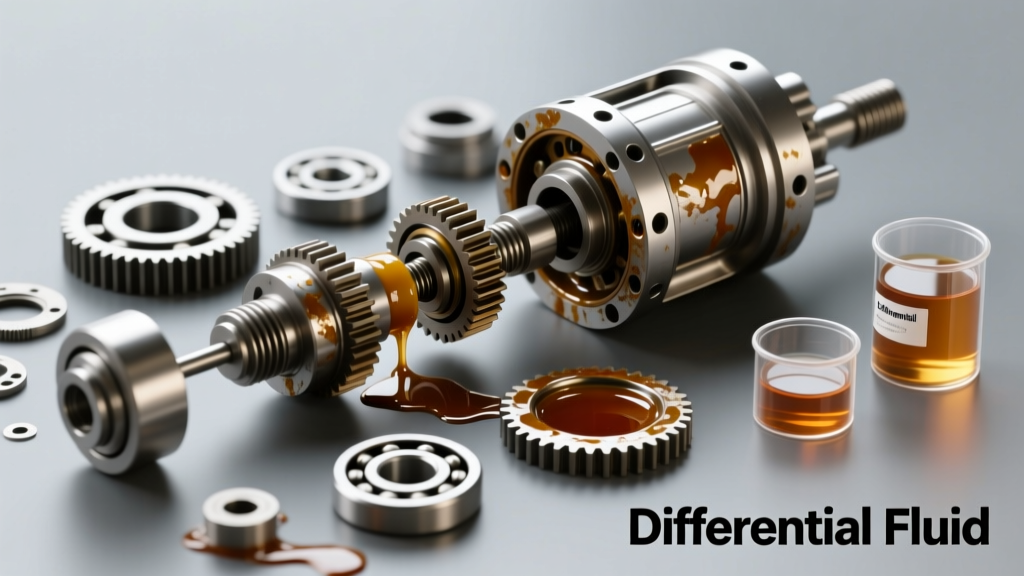
The final step in any differential noise diagnosis and repair is the fluid fill. Gear oil is not merely a lubricant; it is a structural component that cushions the hypoid gear sliding action.
Viscosity Selection
For standard street driving and light towing, a high-quality 75W-90 Full Synthetic (like Amsoil Severe Gear or Mobil 1) is sufficient. However, if the vehicle is equipped with a rear differential locker and is subjected to heavy off-road use, rock crawling, or sustained towing over 5,000 lbs, stepping up to a 75W-140 is mandatory. The thicker film strength of the 140-weight oil prevents metal-on-metal contact during the extreme shock loads generated by locked axles.
The Friction Modifier Trap
This is where many DIYers and junior technicians fail. Limited-slip differentials (clutch-type) require a friction modifier (usually 4-8 oz) to prevent clutch chatter during turns. Locking differentials (Detroit, ARB, Eaton) do NOT use friction modifiers. Adding a friction modifier to a locker or an open differential degrades the oil's film strength, leading to accelerated ring and pinion wear and increased operating temperatures. Always read the manufacturer's fluid specification before pouring.
Conclusion
Understanding what a rear differential locker is—and how it interacts with the ring, pinion, and bearings—is the cornerstone of advanced axle diagnostics. By isolating the noise by load state, understanding the acoustic signatures of specific traction devices, and adhering to exact torque and backlash specifications, you can accurately diagnose rear differential noise and ensure a bulletproof drivetrain for the trails and highways ahead.