The Hidden Cause of Axle Seal Failures
When a differential pinion seal or axle shaft seal begins weeping gear oil, the standard shop protocol is often to replace the seal and top off the fluid. However, if the root cause is internal crankcase pressure or gear oil aeration, the new seal will fail within 5,000 miles. This is where pressure differential testing and a strict adherence to differential gear oil specifications intersect to save fleet owners and daily drivers hundreds of dollars in misdiagnosed repairs. In this comprehensive cost analysis, we break down the true expenses of axle diagnostics, fluid specifications, and the financial impact of choosing the correct API GL-5 lubricants for your drivetrain.
What is Pressure Differential Testing in Axle Assemblies?
Hypoid gear sets in modern differentials generate immense friction and heat. Under heavy load or towing conditions, internal axle temperatures can easily exceed 220°F (104°C). As the air inside the axle housing heats up, it expands. Simultaneously, the churning of the ring gear whips the gear oil into a foam, further increasing internal volume and pressure. If the axle breather tube is clogged with mud, debris, or ice, this pressure has nowhere to escape. The internal PSI rises until it overcomes the spring tension of the axle seals, forcing gear oil past the sealing lips.
Pressure differential testing involves attaching a low-pressure manometer to the axle breather port to measure the delta between internal axle pressure and atmospheric pressure. A healthy axle should never exceed 1.5 to 2.0 PSI of positive pressure differential. Readings above 3.0 PSI indicate a blocked breather or severe fluid aeration, meaning a seal replacement without addressing the pressure issue is a guaranteed waste of money.
Diagnostic Cost Breakdown: Testing vs. Guessing
Many mechanics skip the manometer test, leading to repeat repairs. Below is a cost analysis of proper pressure differential testing compared to the cost of repeat seal failures on a standard semi-floating rear axle.
| Service / Procedure | Dealership Cost | Independent Shop | DIY Cost |
|---|---|---|---|
| Manometer Pressure Test | $115 - $145 | $85 - $110 | $45 (Tool Purchase) |
| Axle Breather Valve Replacement | $65 - $90 | $45 - $70 | $8 - $22 (Part) |
| Pinion Seal Replacement (No Test) | $350 - $500 | $250 - $380 | $40 - $85 (Part) |
| Repeat Seal Failure (Wasted Labor) | $500+ | $350+ | $0 (Time Loss) |
As the data illustrates, investing in a $45 DIY manometer or an $85 independent shop diagnostic fee prevents the sunk costs of repeat seal replacements.
Differential Gear Oil Specifications: Viscosity and Foaming
If your pressure differential testing reveals that the breather is clear, yet internal pressure is still spiking, the culprit is likely gear oil aeration. Aeration occurs when the lubricant foams under high shear, creating compressible air pockets that expand rapidly with heat. This is heavily dictated by your chosen differential gear oil specifications.
The SAE International J306 Standard classifies gear oil viscosity. The most common specifications for modern truck and SUV axles are SAE 75W-90 and SAE 80W-90. However, the base oil chemistry (synthetic vs. conventional) drastically alters the fluid's resistance to foaming and pressure buildup.
The Chemistry of API GL-5
According to the American Petroleum Institute (API), GL-5 gear oils contain high levels of Extreme Pressure (EP) additives, typically sulfur-phosphorus compounds. These are mandatory for hypoid gears because the sliding friction between the pinion and ring gear would instantly weld conventional oils. However, cheaper conventional GL-5 oils often lack advanced anti-foaming agents. When subjected to the churning action of a ring gear, conventional oils trap microscopic air bubbles, leading to the exact pressure spikes that blow out axle seals.
Fluid Cost Analysis: Synthetic vs. Conventional (2026 Pricing)
When budgeting for a differential service, it is tempting to opt for conventional 80W-90 to save a few dollars upfront. However, a lifecycle cost analysis reveals that full synthetic 75W-90 provides superior protection against aeration, extends drain intervals, and improves fuel economy by reducing parasitic drag.
| Fluid Specification | Average Price per Gallon | Service Interval | Cost per 1,000 Miles | Aeration Resistance |
|---|---|---|---|---|
| Conventional 80W-90 GL-5 | $28 - $36 | 30,000 - 40,000 Miles | $0.90 - $1.20 | Moderate (Prone to foaming) |
| Synthetic Blend 75W-90 GL-5 | $38 - $48 | 50,000 Miles | $0.76 - $0.96 | Good |
| Full Synthetic 75W-90 GL-5 | $52 - $68 | 60,000 - 100,000 Miles | $0.52 - $1.13 | Excellent (High shear stability) |
| Limited Slip Friction Modifier | $14 - $18 (per 4oz) | As needed / With Fluid | N/A | N/A |
Note: If your vehicle is equipped with a clutch-type Limited Slip Differential (LSD), you must add a friction modifier (e.g., Motorcraft XL-3 or GM 10-9508) to prevent clutch chatter, which adds roughly $15 to your total fluid cost.
Real-World Axle Applications: Capacities and Torque Specs
To maximize your drivetrain ROI, you must pair proper pressure diagnostics with exact fluid specifications and precise assembly torque. Below are two of the most common heavy-duty axles on the road, complete with OEM part numbers and service data.
GM 10.5-Inch 14-Bolt Axle (Semi-Floating & Full-Floating)
The legendary GM 14-bolt axle is a staple in heavy-duty towing. Because of its massive ring gear and deep sump, it holds a significant volume of fluid, making the cost of synthetic gear oil more pronounced.
- Fluid Capacity: 3.5 to 4.0 Quarts (depending on cover design)
- OEM Fluid Recommendation: ACDelco 75W-90 Synthetic (Part # 10-9394)
- Cover Bolt Torque: 20 lb-ft (Use a star pattern to prevent warping the thin steel cover)
- Fill Plug Torque: 18 lb-ft
- Breather Valve Part #: GM 15794430 (Replace if pressure differential testing exceeds 2.0 PSI)
Dana 80 Heavy-Duty Axle
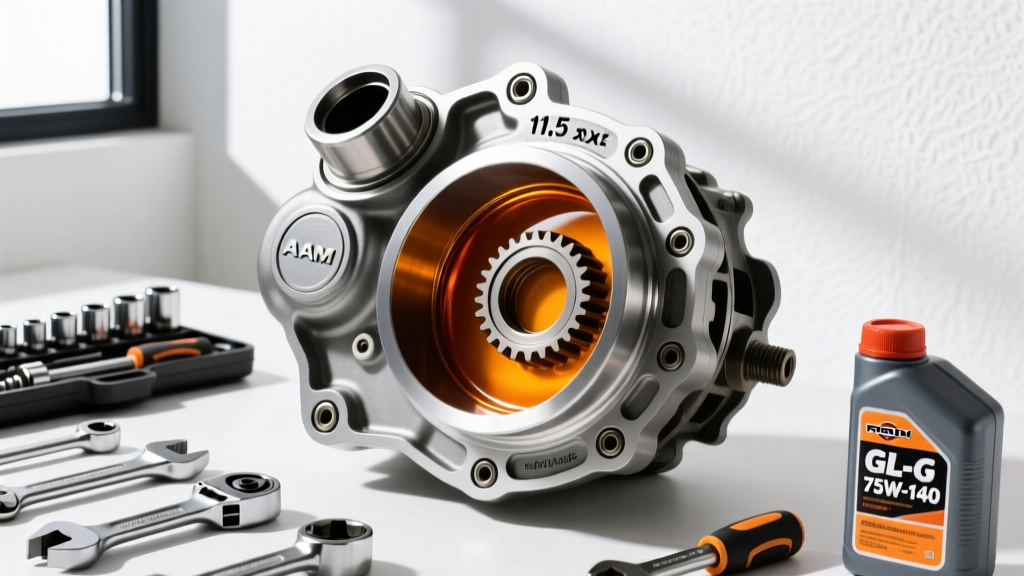
Found in late-90s to modern Ford Super Duty and Dodge Ram dual-rear-wheel (DRW) trucks, the Dana 80 operates under extreme thermal loads. Dana Spicer Service Manuals explicitly warn against using fluids without adequate anti-foaming characteristics due to the aggressive churning of the 11.25-inch ring gear.
- Fluid Capacity: 7.4 Quarts (Dry fill), ~6.0 Quarts (Service fill)
- OEM Fluid Recommendation: SAE 75W-140 Full Synthetic for severe towing, or 75W-90 for standard duty.
- Fill Plug Torque: 25 - 30 lb-ft (3/4-inch NPT threaded plug)
- Cover Bolt Torque: 30 - 35 lb-ft
- Breather Valve Part #: Dana 39408 (Features a check-valve design to prevent water ingestion during river crossings)
Conclusion: Maximizing Drivetrain ROI
Ignoring the physics of internal axle pressure is a costly mistake. By incorporating pressure differential testing into your diagnostic routine, you eliminate the guesswork associated with chronic axle seal leaks. Furthermore, treating differential gear oil specifications as a critical engineering parameter rather than an afterthought ensures that your hypoid gears remain lubricated, cool, and free of aerated pressure spikes. While full synthetic 75W-90 GL-5 gear oils and precision manometer testing require a slightly higher initial investment, the reduction in parasitic drag, extended service intervals, and elimination of repeat seal failures yield a massive long-term return on investment for any vehicle owner.