The Jatco CVT Dilemma: Rebuild or Replace?
When a Nissan Continuously Variable Transmission (CVT) fails, owners and technicians are immediately faced with a critical financial and mechanical crossroads. Nissan’s Jatco-built CVTs—specifically the ubiquitous JF011E (RE0F10A) found in 2007-2017 Altima, Rogue, and Sentra models, and the newer chain-driven JF016E (RE0F10D)—are notorious for specific failure modes. These include push-belt slippage, stepper motor degradation, and valve body solenoid wear. When metal shavings appear in the transmission pan, the core question becomes: should you invest in a Nissan CVT transmission rebuild kit and attempt an overhaul, or is a remanufactured unit the smarter financial move?
In this 2026 cost analysis, we strip away the guesswork. We will compare the exact parts, labor, machine shop requirements, and long-term ROI of rebuilding versus replacing your Jatco CVT, utilizing real-world pricing and OEM specifications.
Cost Breakdown: Nissan CVT Transmission Rebuild Kit vs. Remanufactured
The sticker price of a rebuild kit is often misleading. A master overhaul kit only covers soft parts (gaskets, seals, O-rings, and friction clutches). It does not include the hard parts that typically fail in a Nissan CVT. Below is a comprehensive cost comparison based on average 2026 independent shop rates ($120–$150/hour) and OEM/aftermarket parts pricing.
| Cost Category | Rebuild (Using Kit + Hard Parts) | Remanufactured Unit (Swap) |
|---|---|---|
| Base Transmission / Kit | $350 - $450 (Master Overhaul Kit) | $2,800 - $3,600 (Reman Unit) |
| Hard Parts (Belt/Chain, Pulleys) | $800 - $1,400 (Luk Belt, Sheaves) | Included |
| Valve Body / Stepper Motor | $450 - $750 (If replacement needed) | Included & Dyno-Tested |
| Fluid (Nissan NS-2 / NS-3) | $120 (10.5L Dry Fill) | $120 (10.5L Dry Fill) |
| Machine Shop (Pulley Resurfacing) | $150 - $300 | N/A |
| Labor (R&R and Rebuild vs. Swap) | $1,800 - $2,400 (15-18 Hours) | $720 - $1,050 (6-8 Hours) |
| Core Charge | N/A | $500 (Refundable) |
| Estimated Total (Out the Door) | $3,670 - $5,420 | $4,340 - $5,270 (Net: $3,840 - $4,770) |
| Warranty Coverage | Shop Dependent (Usually 90 Days - 1 Yr) | 3 Years / 100,000 Miles (Standard) |
Deep Dive: What is Actually in a Nissan CVT Rebuild Kit?
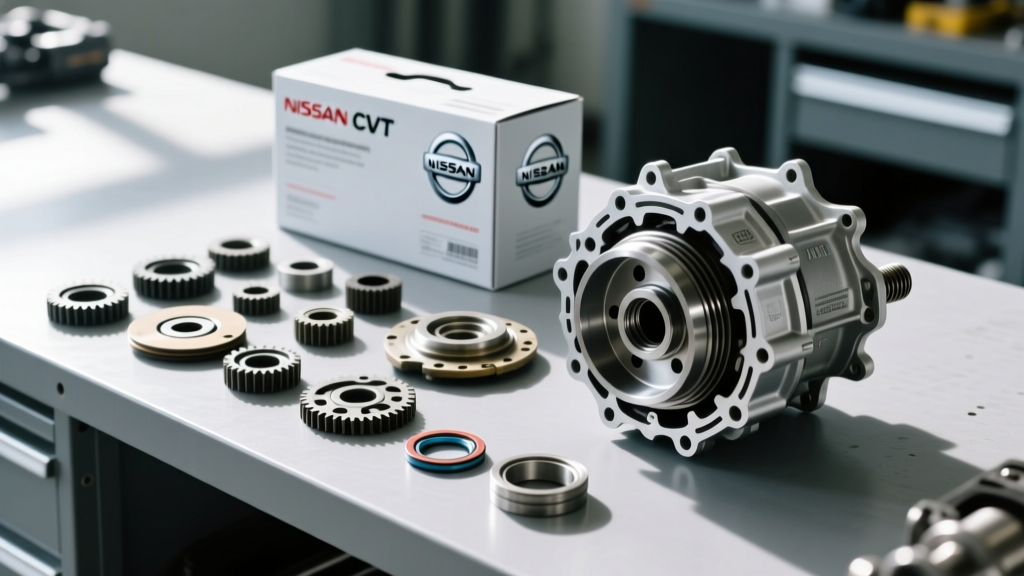
When you order a master Nissan CVT transmission rebuild kit from suppliers like Precision International or TransGo, you are receiving the components necessary to reseal the unit and rebuild the clutch packs. For a JF011E, this includes:
- Pan Gasket & Case Seals: RTV is often used on the case halves, but kits include O-rings for the oil pump and internal stator supports.
- Clutch Pack Frictions & Steels: For the forward and reverse brake clutches. (Note: CVTs do not use traditional gearsets; they use these clutches solely for forward/reverse engagement and torque converter lockup).
- Piston Seals & Lip Seals: Critical for maintaining the hydraulic pressure required to clamp the primary and secondary pulleys.
- Filter / Strainer: Essential for catching micro-debris from the stepper motor and clutch wear.
Critical Caveat: The rebuild kit does not include the Luk push-belt (Part # 3490302 for the JF011E) or the Luk chain assembly for the JF016E. Because 90% of catastrophic Nissan CVT failures involve belt slip and subsequent sheave scoring, purchasing hard parts is mandatory, effectively doubling or tripling the initial kit investment.
The Hidden Costs of Rebuilding a Jatco CVT
Rebuilding a continuously variable transmission is vastly different from rebuilding a traditional planetary automatic like the GM 4L60E or Ford 6R80. The tolerances are microscopic, and the hydraulic requirements are extreme.
Machine Shop Requirements
When a CVT belt slips, it grinds against the primary and secondary pulley sheaves. If you attempt to install a new $400 Luk push-belt onto scored sheaves, the new belt will be destroyed within 500 miles. The sheaves must be sent to a specialized machine shop for resurfacing. If the pitting exceeds 0.05mm in depth, the pulleys cannot be machined and must be replaced outright, adding $600 to $900 to your parts bill.
Valve Body and Stepper Motor Calibration
The JF011E utilizes a stepper motor (Nissan OEM Part # 31942-1XF00) to control the line pressure to the pulleys. If the motor is weak, the pulleys fail to clamp the belt with the necessary force (typically 120-140 psi at the primary pulley and 40-60 psi at the secondary under load). Furthermore, when reassembling the valve body, torque specifications are incredibly low. The valve body to case bolts must be torqued to exactly 8 Nm (71 in-lbs). Overtorquing will warp the aluminum valve body casting, causing internal cross-leaks and immediate failure upon startup.
Why Remanufactured CVTs Often Win the ROI Battle
Given the hidden costs of hard parts and machine shop work, the financial gap between a rebuild and a remanufactured unit narrows significantly. However, the true advantage of a remanufactured CVT lies in quality control and warranty.
"A reputable remanufacturer doesn't just swap parts; they dyno-test the assembled CVT. The unit is hooked to a dynamometer that simulates engine torque and vehicle load, verifying that the primary and secondary hydraulic circuits hold pressure without bleeding off, and ensuring the ratio changes smoothly from 2.63:1 to 0.37:1."
Facilities like JASPER Engines & Transmissions and other Tier-1 remanufacturers completely dismantle the torque converter, cut it open, replace the internal clutch linings, and weld it back together before dynamic balancing. This is a process virtually impossible to replicate in a standard local repair bay without specialized $20,000+ torque converter equipment.
Furthermore, accessing reliable diagnostic data and proprietary relearn procedures is vital. According to Nissan TechInfo, after any CVT teardown or fluid service, the Transmission Control Module (TCM) must undergo a strict fluid temperature-based calibration and clutch point relearn. Remanufactured units are often shipped with baseline TCM maps that make this relearn process significantly smoother compared to a locally rebuilt unit with mixed aftermarket hard parts.
Expert Verdict: Which Route Should You Take?
When to use the Nissan CVT transmission rebuild kit:
Opt for the rebuild kit only if your transmission has been diagnosed with a specific, isolated soft-part failure. Examples include a leaking axle seal, a degraded pan gasket, a failed forward clutch pack (resulting in no forward engagement but perfect reverse), or a faulty stepper motor. In these scenarios, the belt and pulleys remain undamaged, and a teardown is justified.
When to choose a Remanufactured Unit:
If your diagnostic reveals a P0868 (Secondary Pressure Low), P1778 (Step Motor Function), or if you drop the transmission pan and find an abundance of metallic glitter and shredded belt fragments, do not attempt a rebuild. The cost of the required Luk hard parts, combined with the high risk of machine shop rejection of the pulleys, makes the rebuild route a financial gamble. In 2026, installing a remanufactured unit with a 3-year/100,000-mile warranty provides superior long-term ROI, predictable pricing, and peace of mind for the vehicle owner.
For further technical specifications, torque values, and diagnostic flow charts, always consult the official TransGo instructional sheets or OEM service manuals before turning a single wrench on a Jatco CVT.