The True Cost of Taming the Coyote: 2026 Mustang GT Clutch Analysis
When evaluating the mustang gt clutch replacement cost, owners must look far beyond the sticker price of a replacement disc. The 5.0L Coyote V8, producing up to 480 horsepower and 415 lb-ft of torque in the latest S650 generation (and significantly more with forced induction), places immense thermal and mechanical stress on the driveline. Whether you are driving an S197, S550, or the newest S650 chassis, understanding the financial and mechanical nuances of your specific transmission is critical to avoiding catastrophic drivetrain failure or paying for unnecessary dealership labor.
In this comprehensive 2026 cost guide, we break down exact part numbers, labor rates, hidden hydraulic fees, and precise torque specifications for the Getrag MT-82 and Tremec TR-3160 transmissions found in the Mustang GT lineup.
Generational Transmission Differences & Part Selection
The Mustang GT has undergone significant manual transmission revisions over the last decade. Your chassis generation dictates not only the cost of the clutch kit but also the complexity of the installation.
S197 II (2011-2014) & S550 (2015-2023): The Getrag MT-82 Era
The MT-82 is a 6-speed manual transmission designed by Getrag. While robust in stock applications, it is notorious for its internal Concentric Slave Cylinder (CSC) failures and synchro wear under high-RPM shifts. When replacing the clutch in these generations, you are almost always required to replace the CSC, as reusing an old hydraulic actuator is a guaranteed path to a second teardown.
- OEM Replacement: Ford Performance M-7560-A50 Clutch Kit (approx. $450)
- Upgraded Single Disc: Exedy Mach 400 or Centerforce DYAD (approx. $650 - $850)
- High-Horsepower Twin Disc: McLeod RXT (approx. $1,200+)
S650 (2024-Present): The Tremec TR-3160 & T-56 Magnum XL
Ford finally abandoned the MT-82 for the S650 generation. The standard Mustang GT now utilizes the Tremec TR-3160 6-speed, while the 500-hp Dark Horse uses the heavy-duty T-56 Magnum XL. These transmissions feature an external slave cylinder setup (on the TR-3160) and vastly improved shift rail geometry. Parts are currently more expensive due to market novelty, but labor times are slightly reduced due to the elimination of the internal CSC bleeding nightmare.
2026 Cost Breakdown: Parts, Labor, and Machine Shop Fees
Below is a realistic pricing matrix based on 2026 national average labor rates ($130-$180/hour) and current aftermarket pricing. This table assumes a standard GT model without aftermarket supercharger kits.
| Cost Category | Budget / OEM Route | Performance / Aftermarket Route | Notes & Caveats |
|---|---|---|---|
| Clutch Kit (Disc, PP, Bearing) | $450 (Ford Perf. M-7560-A50) | $750 (Exedy Mach 400) | Twin-disc kits will push this to $1,200+ |
| Flywheel (Resurface vs. Replace) | $125 (Machine Shop Resurface) | $450 (Ford Performance Steel) | MT-82 dual-mass flywheels cannot be resurfaced; must be replaced. |
| Hydraulics (CSC / Slave) | $180 (Sachs OEM CSC) | $350 (McLeod External Conversion) | Mandatory for MT-82. External conversions require custom lines. |
| Fluids & Misc Hardware | $60 (Motorcraft XT-11-QDC) | $90 (Tremec MTL-1 + ARP Bolts) | Never reuse MT-82 flywheel bolts (yield design). |
| Professional Labor (R&R) | $650 (Independent Specialist) | $950 (Ford Dealership) | Dealerships often book 8+ hours; specialists do it in 4-5. |
| Total Estimated Cost | $1,465 | $2,590+ | Prices vary by region and shop overhead. |
Hidden Costs That Catch Owners Off Guard
Many enthusiasts budget strictly for the clutch kit and labor, only to be hit with supplementary charges once the transmission is on the jack. Be prepared for the following:
1. The Pilot Bearing and Rear Main Seal
With the transmission removed, you have direct access to the engine's rear main seal and the crankshaft pilot bearing. If your Mustang has over 80,000 miles, spending $40 on a Motorcraft rear main seal and $15 on a pilot bearing now will save you a $900 labor bill later. A failing pilot bearing will cause input shaft misalignment, destroying your new clutch disc and transmission input bearings.
2. Driveshaft Flange Seal & Hardware
To drop the MT-82 or TR-3160, the driveshaft must be disconnected from the rear differential pinion flange. The pinion seal often weeps upon reassembly if not carefully handled. Budget $25 for a new Ford Performance pinion seal and a fresh set of flange bolts, as the factory bolts are coated with a proprietary threadlocker that degrades upon removal.
3. Alignment and NVH Calibration
Because the rear subframe and suspension components are often manipulated to gain clearance for the transmission jack, a rear-end alignment (specifically checking thrust angle and toe) is highly recommended to prevent premature tire wear and driveline vibration.
Expert Torque Specifications & Fluid Requirements
Whether you are tackling this in your home garage or verifying your mechanic's work, adhering to factory torque specifications is non-negotiable. The MT-82 and Tremec transmissions utilize specific yield-torque bolts that stretch during installation.
| Component | MT-82 (S197/S550) | Tremec TR-3160 (S650 GT) |
|---|---|---|
| Flywheel to Crankshaft | 59 lb-ft + 90° (Yield - Replace Bolts) | 74 lb-ft (Use Loctite 262) |
| Pressure Plate to Flywheel | 22 lb-ft (Star Pattern) | 25 lb-ft (Star Pattern) |
| Bellhousing to Engine Block | 35 lb-ft | 40 lb-ft |
| Driveshaft Flange Bolts | 85 lb-ft | 85 lb-ft |
| Transmission Fluid Capacity | 2.7 Liters (2.85 Quarts) | 2.9 Liters (3.06 Quarts) |
| Factory Fluid Spec | Motorcraft XT-11-QDC (DCT Fluid) | Tremec MTL-1 (75W-85 GL-4) |
Expert Note on MT-82 Fluid: It sounds counterintuitive, but Ford explicitly engineered the MT-82 to run on Dual Clutch Transmission (DCT) fluid (XT-11-QDC). Using standard 75W-90 GL-4 gear oil in an MT-82 will cause stiff shifts, synchro grinding, and premature wear due to the specific friction modifiers required by the Getrag carbon synchros.
DIY vs. Professional Installation: Is the Savings Worth It?
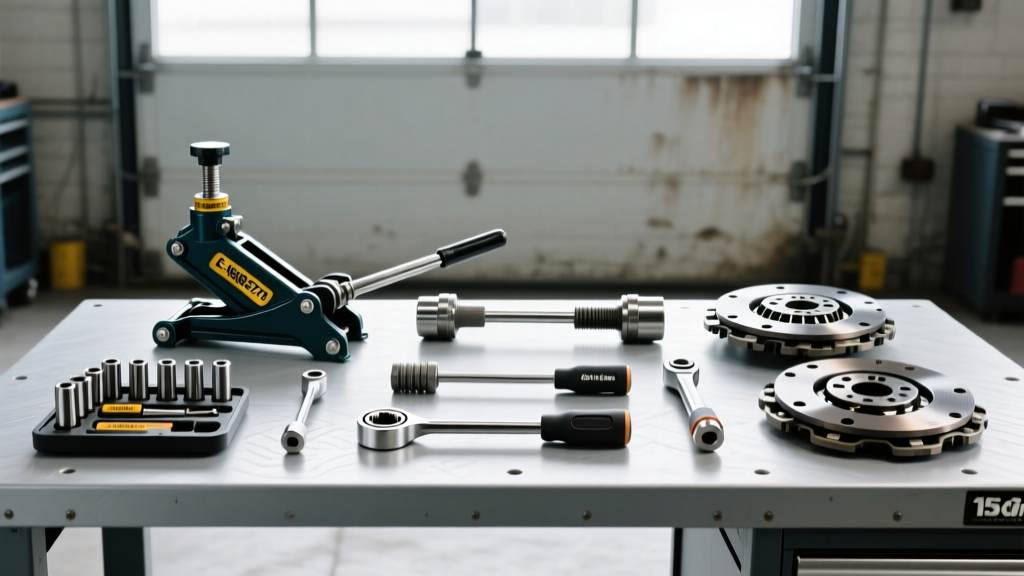
A competent DIY mechanic can save $600 to $900 in labor by performing a Mustang GT clutch replacement at home. However, this is not a beginner-friendly job. You will need a high-lift transmission jack and, crucially, the OTC 308-093 Transmission Jack Adapter. The MT-82 has an awkward center of gravity and an irregular pan shape; attempting to balance it on a standard flat jack plate almost always results in damaged shift forks or a cracked bellhousing.
Furthermore, bleeding the MT-82's internal hydraulic system requires a specific vacuum bleeding procedure or a pressure bleeder to ensure no air is trapped in the remote slave cylinder. If you lack a Motive Products power bleeder and the requisite metric line wrenches (specifically a 15mm and 18mm crowfoot for the hydraulic quick-disconnect), the frustration and potential for hydraulic failure heavily outweigh the financial savings.
Choosing the Right Shop
If you opt for professional installation, avoid generalist mechanics. Seek out a dedicated Mustang or performance shop. Specialists possess the proprietary alignment pins required to mate the MT-82 bellhousing to the Coyote block without binding the input shaft, and they are intimately familiar with the reverse lockout solenoid wiring harness, which is easily crushed between the transmission and block by inexperienced technicians.
Final Verdict: Budgeting for Your Build
Ultimately, the mustang gt clutch replacement cost in 2026 ranges from a manageable $1,400 for a stock-replacement refresh at an independent shop, to over $2,500 for a high-capacity twin-disc upgrade with external hydraulic conversions. Always purchase your clutch kit from authorized distributors like Ford Performance or reputable manufacturers like McLeod Racing to avoid counterfeit friction materials. By budgeting for the hidden hydraulic and flywheel costs upfront, you ensure your Coyote's power makes it to the pavement reliably for years to come.