The Evolution of High-Horsepower RZR Clutching
As we navigate the 2026 off-road season, the Polaris RZR platform—particularly the XP Turbo and Pro R models—continues to dominate the dunes and mud bogs. However, pushing these machines beyond 200 wheel-horsepower and stuffing 32-inch or larger tires under the fenders requires serious drivetrain modifications. This is where the 'Mother Clutcher' style setup enters the conversation. Among UTV enthusiasts and tuning shops, the Mother Clutcher RZR configuration refers to an extreme high-stall, high-spring-rate primary clutch kit designed to clamp down on the drive belt with immense force, preventing slip under massive torque loads.
But there is a catch. The extreme spring rates (often exceeding 160/280 lb/in) and aggressive helix angles place unprecedented stress on the Continuously Variable Transmission (CVT) components. When preventive maintenance is neglected, this aggressive setup can mask early warning signs of wear, leading to catastrophic CVT belt slip, glazed sheaves, and blown belts. Understanding the symptoms and executing a strict diagnostic protocol is essential for keeping your high-horsepower RZR on the trail and out of the garage.
Identifying CVT Slip Symptoms in High-Stall Setups
Diagnosing slip in a heavily modified RZR is fundamentally different from a stock machine. The high-stall nature of a Mother Clutcher setup delays engagement, meaning the engine revs higher before the machine begins to move. This can easily be mistaken for normal operation by an untrained driver. However, true CVT slip presents specific auditory, tactile, and thermal indicators.
Auditory and Tactile Warning Signs
- RPM Flare Under Load: The most definitive symptom. When climbing a steep dune or pulling through deep mud, watch your tachometer. If the RPMs climb rapidly (e.g., from 6,500 to 8,200 RPM) without a proportional increase in ground speed, the primary sheave is failing to grip the belt sidewalls.
- Low-Speed Engagement Chatter: A harsh, shuddering vibration between 8 and 15 mph indicates that the clutch weights are sticking or the belt is slipping and grabbing repeatedly at the bottom of the primary sheave.
- The 'Rubber Burn' Olfactory Test: A distinct, acrid smell of burning aramid fibers and ozone emanating from the CVT housing vent is a guaranteed indicator of severe belt slip and thermal degradation.
Thermal Degradation Indicators
CVT belts rely on a specific coefficient of friction. When slip occurs, kinetic energy is converted into heat. Belt temperatures can easily exceed 400°F (204°C) during a slip event, melting the resin binding the Kevlar cords. If your RZR features a digital CVT temperature gauge, consistent readings above 180°F during normal trail riding indicate inadequate clamping force or poor airflow due to a clogged CVT intake.
The Physics of the Mother Clutcher Spring and Belt Deflection
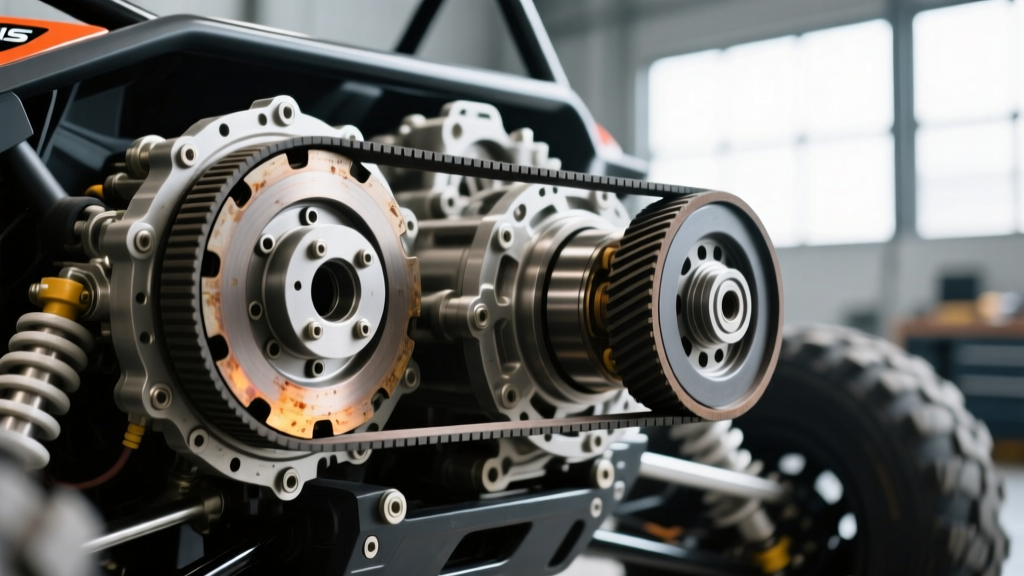
To diagnose the root cause of the slip, you must understand the physics at play. The primary clutch uses centrifugal force to push the movable sheave inward, clamping the belt. The secondary clutch uses a helix and torsion spring to apply reverse pressure. In a Mother Clutcher RZR build, the primary spring is exceptionally stiff to keep the belt high in the sheave at low speeds, preventing the belt from riding too deep and slipping under turbo boost.
Expert Insight: According to drivetrain engineers at Elevated Performance Industries (EPI), mismatching a high-rate primary spring with a stock secondary torsion spring is the leading cause of belt slip in turbocharged UTVs. The secondary must apply enough reverse clamping force to match the primary's aggression.
| Setup Type | Primary Spring Rate (Start/Finish) | Secondary Torsion Spring | Target Belt Deflection |
|---|---|---|---|
| Stock XP Turbo | 80/160 lb/in | OEM 45/110 | 1.25' - 1.50' |
| Mother Clutcher (Mud/Tires) | 140/240 lb/in | 60/140 (Heavy Duty) | 1.10' - 1.35' |
| Mother Clutcher (Dune/HP) | 160/280 lb/in | 70/150 (Extreme) | 1.00' - 1.25' |
Step-by-Step Diagnosis: Why Is Your RZR Slipping?
When slip is suspected, do not immediately throw a $180 OEM Polaris drive belt (Part #3211205) at the problem. Follow this diagnostic sequence to identify the mechanical failure point.
1. Primary Clutch Sheave Wear and Tolerances
Remove the primary clutch using a dedicated 3/4'-16 TPI clutch puller tool (Cost: ~$45). Disassemble the clutch and clean the sheave faces with isopropyl alcohol. Never use harsh brake cleaners, as they can degrade the UHMW plastic buttons and internal grease.
Place a machinist's straight edge across the sheave face. Use a feeler gauge to measure the gap. If the wear groove exceeds 0.015 inches in depth, the sheave is out of spec. The belt will ride too deep, altering the drive ratio and causing slip under high load. Resurfacing or replacing the movable sheave (Part #1323399, ~$220) is mandatory.
2. Secondary Clutch Helix and Roller Wear
The secondary clutch is often the forgotten culprit in a Mother Clutcher setup. The extreme pressure from the heavy primary spring forces the secondary helix to work overtime. Inspect the UHMW plastic buttons on the helix. If they are grooved, flat-spotted, or missing, the secondary will bind, failing to apply consistent reverse pressure on the belt. Replacement buttons cost less than $15 and should be swapped at every belt change.
3. Belt Deflection and Alignment Checks
Improper belt deflection is the fastest path to a blown belt. With the vehicle in park and the engine off, rotate the secondary clutch counter-clockwise to take up all slack. Measure the sag on the top span of the belt. For high-horsepower Mother Clutcher setups, target a deflection between 1.00' and 1.25'. If the deflection is greater than 1.5', the belt is stretched or the secondary spring is fatigued.
Preventive Maintenance Protocol for Aggressive Clutch Kits
Preventing slip requires a rigorous maintenance schedule. The extreme forces generated by turbocharged RZRs demand more frequent attention than the factory manual suggests. Consult the RZR Forums XP Turbo technical archives for community-verified longevity data on these specific setups.
Critical Torque Specifications
Reassembling the CVT requires precision. A loose primary clutch will wobble, destroying the belt sidewalls in under 50 miles.
- Primary Clutch Retaining Bolt (M12 x 1.25): Torque to 120 ft-lbs (163 Nm). Apply a fresh drop of Red Loctite 272 to the threads. Do not reuse old Loctite.
- Secondary Clutch Retaining Bolt (M10): Torque to 60 ft-lbs (81 Nm) using Blue Loctite 243.
- Clutch Cover Bolts: Torque to 84 in-lbs in a star pattern to ensure the seal seats evenly, preventing water ingestion during river crossings.
The 30-PSI Blowout Rule
CVT dust is highly abrasive and acts like lapping compound on the sheave faces. After every ride, blow out the CVT housing with compressed air. Warning: Never exceed 30 PSI, and never allow the air to spin the clutch freely. Spinning the primary clutch at high RPMs via compressed air turns the stator into an unregulated generator, which can fry your RZR's voltage regulator and ECU.
When to Replace: Belt and Spring Lifecycle Data
Even the best-maintained Mother Clutcher RZR setup will consume belts. The aramid cords inside the belt suffer from cyclic fatigue. For a tuned XP Turbo or Pro R making over 200 WHP, expect a belt lifecycle of 800 to 1,200 miles. If you are riding in extreme mud or deep sand, halve that expectation.
Furthermore, clutch springs suffer from 'sag' or heat cycling. A spring that started at 160/280 lb/in may degrade to 140/250 lb/in after a year of hard dune riding. If you notice your engagement RPM dropping by 300-400 RPM over the course of a season, your primary spring has fatigued and must be replaced to prevent low-RPM slip.
Conclusion: Respecting the Drivetrain
Running a Mother Clutcher setup on your Polaris RZR is a necessity for big-tire, high-horsepower builds, but it is not a 'set it and forget it' modification. By monitoring belt deflection, adhering to strict torque specs, and recognizing the subtle symptoms of CVT slip before they turn into smoke, you can ensure your drivetrain survives the abuse. Treat your CVT with the same respect you give your engine's internals, and it will deliver power to the ground reliably, ride after ride.