When shopping for a new crossover or scheduling maintenance at the dealership, you will frequently hear service advisors and marketers throw around two major automotive terms: powertrain and drivetrain. While often used interchangeably by casual drivers, these terms represent entirely different mechanical systems. If you own or are researching the popular rugged crossover, understanding the Mazda CX-50 drivetrain versus its broader powertrain is critical for predicting repair costs, understanding warranty coverage, and performing accurate maintenance.
In this beginner-friendly explainer, we will use the Mazda CX-50 as our primary case study to deconstruct exactly what makes up these systems, how they interact, and what you need to know about maintaining them in 2026 and beyond.
The Core Distinction: Powertrain vs. Drivetrain
Think of your vehicle as a human body. The powertrain is the entire muscular and skeletal system responsible for generating and transferring energy. It encompasses every component that creates power and routes it to the road. The drivetrain, on the other hand, is strictly the limb system—the specific gears, shafts, and axles that deliver that power to the wheels after it has left the engine and transmission.
To put it simply: The powertrain includes the engine, the transmission, and the drivetrain. The drivetrain is just a subset of the powertrain. When a dealership advertises a 'Powertrain Warranty,' it covers your engine and transmission alongside your axles and differentials. However, when diagnosing a mechanical fault, knowing whether an issue lies in the power generation side (engine/transmission) or the power delivery side (drivetrain) will drastically change your repair bill.
Deconstructing the Mazda CX-50 Powertrain
The powertrain of the Mazda CX-50 is centered around Mazda's renowned Skyactiv technology. Whether you opt for the naturally aspirated 2.5L engine or the punchy 2.5L Turbo (which generates up to 256 horsepower and 320 lb-ft of torque on premium fuel), the powertrain includes the engine block, the fuel delivery system, the exhaust, and the transmission.
The Skyactiv-Drive 6-Speed Automatic
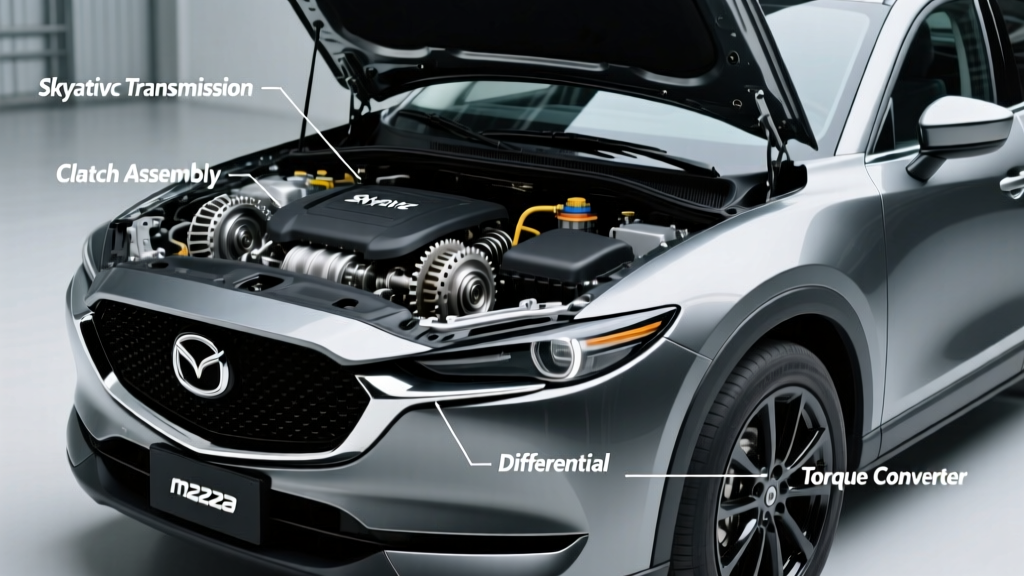
Mazda pairs the CX-50 engines with the FW6A-EL 6-speed automatic transmission. Unlike many modern competitors that have shifted to Continuously Variable Transmissions (CVTs), Mazda utilizes a traditional torque-converter automatic with a multi-plate lock-up clutch. This provides a direct, engaging driving feel. According to Car and Driver, this transmission's ability to handle the turbocharged engine's massive low-end torque without slipping is a major hallmark of the CX-50's powertrain durability.
Because the transmission is a core powertrain component, internal failures—such as worn clutch packs, solenoid pack failures, or torque converter shudder—are classified as powertrain repairs. These are highly complex, requiring the removal of the transmission and specialized rebuilding, often costing between $3,500 and $5,500 out of warranty.
Inside the Mazda CX-50 Drivetrain: The i-Activ AWD System
Now we move to the specific components that make up the Mazda CX-50 drivetrain. This vehicle utilizes Mazda's i-Activ All-Wheel-Drive (AWD) system. While it operates primarily as a front-wheel-drive vehicle to save fuel, the drivetrain components are responsible for routing power to the rear wheels when slip is detected.
Key Drivetrain Components
- Power Transfer Unit (PTU): Bolted to the front of the transmission, the PTU acts as a transfer case. It takes rotational power from the transmission's output shaft and redirects it 90 degrees toward the rear of the vehicle.
- Propeller Shaft (Driveshaft): The CX-50 uses a two-piece driveshaft featuring a rubber flex coupling and a center support bearing. This shaft carries torque from the PTU to the rear of the vehicle.
- Rear Differential: Mounted on the rear subframe, this gear set takes the rotational force from the driveshaft and splits it left and right to the rear wheels.
- CV Axles (Half-Shafts): Both the front and rear wheels are driven by Constant Velocity (CV) axles, which feature inner and outer joints protected by rubber boots, allowing the suspension to articulate while delivering power.
If you hear a rhythmic clunking from underneath the vehicle during acceleration, or experience a binding sensation during tight turns, you are likely dealing with a drivetrain issue—such as a failing PTU, a worn center driveshaft bearing, or a dry rear differential—not an engine or transmission fault.
Real-World Repair Costs: Drivetrain vs. Powertrain Failures
Understanding the boundary between these systems is crucial when your vehicle is out of warranty. Below is a comparison of common failures, their system classification, and estimated 2026 repair costs for the CX-50 platform.
| Component | System | Common Failure Mode | Estimated Repair Cost |
|---|---|---|---|
| Engine Timing Chain | Powertrain | Stretch / Tensioner failure | $1,800 - $2,500 |
| Transmission Valve Body | Powertrain | Solenoid wear / Harsh shifting | $1,200 - $1,800 |
| Power Transfer Unit (PTU) | Drivetrain | Internal bearing / Gear wear | $1,500 - $2,200 |
| Propeller Shaft | Drivetrain | Center bearing collapse / U-joint | $800 - $1,300 |
| Front CV Axle | Drivetrain | Torn boot / Joint clicking | $350 - $600 (per side) |
| Rear Differential | Drivetrain | Fluid starvation / Ring & pinion | $1,000 - $1,600 |
As noted by Mazda USA, the i-Activ system is heavily reliant on proper lubrication. Neglecting drivetrain fluid changes is the number one cause of premature PTU and rear differential failure in modern AWD crossovers.
DIY Maintenance: Fluids, Capacities, and Torque Specs
For the DIY enthusiast, maintaining the Mazda CX-50 drivetrain and powertrain requires specific fluids and adherence to precise torque specifications. Unlike older vehicles where a generic 75W-90 gear oil would suffice, modern AWD systems demand exact chemical formulations to protect the clutch packs inside the PTU and the hypoid gears in the differential.
Drivetrain Fluid Specifications
- PTU (Transfer Case): Requires Mazda Genuine Long Life Gear Oil G7 (75W-85 GL-4). Capacity is approximately 380 ml (0.4 quarts). Expert Tip: The PTU sits near the hot exhaust and transmission; many experts recommend draining and filling this every 30,000 miles to prevent heat-related degradation.
- Rear Differential: Requires Mazda Genuine Long Life Gear Oil G7 (75W-85 GL-5). Capacity is approximately 500 ml (0.53 quarts). Change every 60,000 miles under normal driving, or 30,000 miles if frequently towing or driving in mud/snow.
- Front Axle Nut Torque: If you are replacing a CV axle, the front axle nut must be torqued to 173 lb-ft (235 Nm) and staked properly to prevent the bearing from loosening.
Powertrain Fluid Specifications
- Transmission (FW6A-EL): Requires Mazda FZ Automatic Transmission Fluid. This is a specific low-viscosity fluid designed for Skyactiv-Drive fuel economy. Do not substitute with generic Dexron VI. A standard drain and fill requires roughly 3.5 to 4.0 quarts, while a dry fill is 7.6 quarts.
- Rear Differential Drain Plug Torque: 30 lb-ft (40 Nm). Always replace the crush washer to prevent slow leaks that can lead to catastrophic gear failure.
Warranty Implications: Why the Distinction Matters
Mazda's standard new-vehicle limited warranty covers 3 years/36,000 miles, while the Powertrain Limited Warranty extends to 5 years/60,000 miles. Because the drivetrain is a subset of the powertrain, components like the PTU, driveshaft, and differentials are covered under the 5-year powertrain umbrella.
However, third-party extended warranty providers often draw a hard line between the two. Some budget 'Drivetrain-Only' policies will cover your axles and differential but will deny a claim if your transmission's torque converter fails. Conversely, 'Powertrain' policies cover it all. Always read the fine print of your warranty contract. Furthermore, wear items like CV boots, U-joints, and transmission fluid are never covered under warranty, as they are classified as routine maintenance items regardless of whether they belong to the drivetrain or powertrain.
Final Thoughts
Whether you are navigating rocky trails or commuting through city traffic, your Mazda CX-50 relies on the seamless integration of its powertrain and drivetrain. By understanding that the powertrain creates the power and the drivetrain delivers it, you can better diagnose issues, communicate effectively with your mechanic, and perform the precise maintenance required to keep your i-Activ AWD system running flawlessly for hundreds of thousands of miles.