Beyond the Gear Oil: The Science of the Limited Slip Differential Friction Modifier
If you own a rear-wheel-drive truck, a classic muscle car, or a modern off-road SUV equipped with a clutch-based limited slip differential (LSD), you have likely experienced the dreaded "clutch chatter" during low-speed cornering. This shuddering vibration is not just an annoyance; it is a symptom of destructive stick-slip friction tearing at your differential's internal clutch packs. As we navigate the 2026 automotive aftermarket, selecting the correct limited slip differential friction modifier is just as critical as choosing the right 75W-90 API GL-5 gear oil.
Unlike standard open differentials that rely purely on gear mesh lubrication, clutch-type LSDs (such as the Ford Traction-Lok, GM Eaton Positraction, and Spicer Trac-Lok) utilize alternating steel and friction-material discs. When cornering, the inside wheel must slow down while the outside wheel speeds up. Without a specialized friction modifier, the static friction coefficient between the clutch discs overcomes the kinetic friction, causing them to grab, slip, grab, and slip in rapid succession. This is the "stick-slip" phenomenon.
The Tribology of Clutch Chatter
To understand why a dedicated modifier is required, we must look at the Stribeck curve and boundary lubrication. Standard API GL-5 gear oils contain extreme pressure (EP) additives like zinc dialkyldithiophosphate (ZDDP) and sulfur-phosphorus compounds designed to protect hypoid gear teeth under immense shearing loads. However, these EP additives do not adequately manage the friction materials used in LSD clutch packs.
A high-quality limited slip differential friction modifier utilizes long-chain polar molecules (typically synthetic esters or specialized fatty acids). These molecules are chemically attracted to the steel surfaces of the clutch plates, forming a microscopic, sacrificial tribofilm. This film artificially lowers the static friction coefficient to closely match the kinetic friction coefficient, allowing the clutches to slip smoothly and progressively during cornering without chattering. For deeper insights into gear oil boundary lubrication, refer to the API Gear Oil Classifications documentation.
Additive vs. Pre-Mixed: Which Route Should You Take?
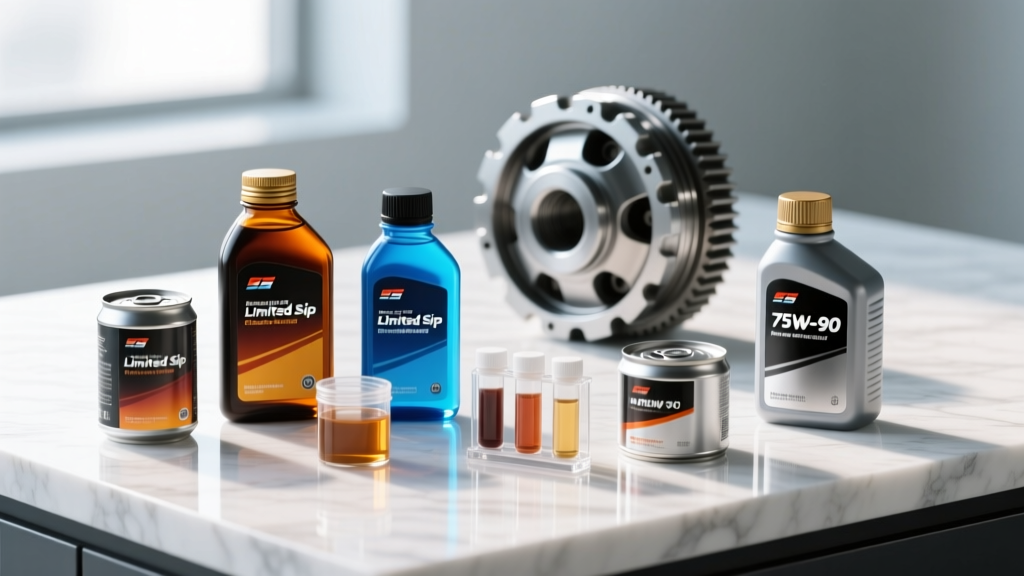
When servicing your axle in 2026, you face a primary decision: use a standalone friction modifier additive poured into standard GL-5 gear oil, or buy a pre-mixed synthetic LSD gear oil. Both have distinct advantages depending on your axle's specific wear state and capacity.
| Method | Pros | Cons | Best Application |
|---|---|---|---|
| Standalone Additive | Precise dosage control; highly cost-effective; allows use of any premium GL-5 base oil. | Requires manual mixing; risk of over/under-dosing if axle capacity is unknown. | OEM-style rebuilds, older axles with unknown wear, custom racing setups. |
| Pre-Mixed LSD Fluid | Convenient; perfectly balanced chemistry; no measuring required. | More expensive per quart; modifier concentration is fixed and cannot be adjusted for worn clutches. | Factory-sealed axles, routine maintenance on newer vehicles, daily drivers. |
Top Friction Modifier Additives: 2026 Buyer's Breakdown
If you opt for the standalone additive route—which professional drivetrain builders overwhelmingly prefer for its tunability—here is how the top contenders stack up.
1. Motorcraft XL-3 (Friction Modifier Additive)
- Part Number: XL-3
- Chemistry: Synthetic Ester Base
- OEM Equivalency: Ford EST-M2C154-A, Chrysler MS-5620
- Average Price: $11.50 - $13.00 (4 oz bottle)
Motorcraft XL-3 remains the gold standard for Ford 8.8-inch and 9.75-inch axles. Ford's Traction-Lok differentials are highly sensitive to friction coefficients, and XL-3 was engineered specifically for the carbon-fiber and paper-based clutch materials used in Dearborn's axles. It is exceptionally effective at silencing chatter in high-mileage Explorer and F-150 rear ends.
2. Red Line Limited Slip Friction Modifier
- Part Number: 20205
- Chemistry: Proprietary Ester / Polymer Blend
- OEM Equivalency: Universal (Exceeds GM 1052271, Ford EST-M2C154-A)
- Average Price: $14.00 - $16.50 (4 oz bottle)
Red Line's modifier is a favorite in the motorsport and off-road communities. Because it utilizes a highly stable ester base, it resists thermal degradation better than conventional fatty-acid modifiers. If you are running a Dana 60 or a GM 14-bolt semi-float in a rock-crawling or drag-racing application where differential temperatures routinely exceed 250°F, Red Line's thermal stability is worth the premium. Consult Red Line Oil Technical Information for specific dosage charts based on axle spline count.
3. ACDelco Limited Slip Axle Lubricant Additive
- Part Number: 10-4004 (or 88900401)
- Chemistry: Organic Friction Modifiers
- OEM Equivalency: GM Spec 1052271 / 88900401
- Average Price: $9.50 - $12.00 (4 oz bottle)
For GM trucks and muscle cars equipped with the Eaton Positraction (G80 locking or standard LSD), ACDelco's formulation is mandatory for warranty compliance and optimal performance. GM's cone-clutch and disc-clutch designs require a slightly different slip profile than Ford's clutches, and the ACDelco additive provides the exact kinetic bite required for smooth G80 engagement.
Crucial Application Guide: Does Your Differential Actually Need It?
A common mistake made by DIY mechanics is dumping friction modifier into an axle that does not require it. Over-modifying a differential can cause the clutches to slip excessively under heavy load, leading to premature wear and power loss. Furthermore, gear-based LSDs do not contain friction clutches at all.
Expert Warning: Never add a friction modifier to a Torsen (Torque-Sensing) or Eaton Truetrac differential. These units operate entirely on helical gear meshing and worm-drive principles. Adding a friction modifier to a Truetrac will reduce the gear's bias ratio, effectively neutering the differential's limited-slip capabilities. For these units, use only a high-quality, straight API GL-5 75W-90 synthetic gear oil. See the Eaton Truetrac Aftermarket Guide for confirmation.
Who Needs the Modifier?
- Ford 8.8 / 9.75 Traction-Lok: YES (Clutch-based)
- GM 8.5 / 8.6 / 9.5 Eaton Positraction: YES (Clutch/Cone-based)
- Dana 44 / 60 Spicer Trac-Lok: YES (Clutch-based)
- ZF / BMW M-Variable LSD: YES (Requires specific SAF-XJ fluid or specialized modifier)
- Eaton Truetrac / Torsen T-1 / T-2: NO (Helical gear-based)
- Open Differentials: NO
The Drivetrain Builder's Service Procedure
Proper installation of the modifier is just as important as the product you choose. The most frequent cause of post-service chatter is poor mixing. Because friction modifiers are highly viscous and dense, simply pouring them on top of the gear oil will result in the additive pooling at the bottom of the differential housing, leaving the upper clutch packs starved.
Step-by-Step Dosage and Fill Protocol
- Determine Capacity: A standard Ford 8.8 rear axle holds approximately 2.5 to 3.75 pints (depending on the differential cover). A GM 10-bolt holds roughly 2.1 quarts.
- Calculate Dosage: The general rule of thumb is 4 oz of modifier per 1.5 quarts of gear oil. Do not exceed the manufacturer's recommended volume, or the differential will slip under hard acceleration.
- Pour Modifier First: With the differential drained and the fill plug removed, inject the friction modifier directly into the fill hole before adding the gear oil. The incoming stream of heavy 75W-90 gear oil will forcefully push the modifier down and naturally agitate the mixture as the housing fills.
- Fill to the Weep Point: Add your API GL-5 gear oil until it reaches the bottom of the fill hole threads and begins to weep out.
- Torque and Test: Reinstall the fill plug to the exact torque specification. Drive the vehicle in a parking lot, performing 10 to 15 tight, slow-speed figure-eights. This forces the clutch packs to slip and circulates the newly mixed fluid through the friction material pores.
Drain and Fill Plug Torque Specifications
Over-torquing differential plugs is a notorious cause of stripped threads, especially on aluminum aftermarket differential covers. Adhere strictly to these specifications:
- Ford 8.8-inch (3/8" Square Fill Plug): 33 lb-ft (45 Nm). Note: Many factory 8.8 axles lack a dedicated drain plug; the stamped steel cover must be dropped, requiring a new cork gasket or a precise bead of RTV silicone.
- GM 8.5/8.6-inch 10-Bolt (15mm Hex): 24 lb-ft (33 Nm).
- Dana 44 (3/8" Square or 1/2" Hex): 25-35 lb-ft depending on exact housing casting and plug material.
- Chrysler 8.25 / 9.25 (1/2" Hex or 3/8" Square): 25-30 lb-ft.
Final Verdict for 2026
When sourcing a limited slip differential friction modifier, avoid generic, unbranded "universal" additives found in bargain bins. The chemical stability of the esters directly dictates the lifespan of your clutch packs. For Ford applications, Motorcraft XL-3 remains unbeatable for OEM compliance. For GM platforms, stick to ACDelco 10-4004. If you are building a high-heat, heavy-duty, or motorsport Dana axle, invest in Red Line's Limited Slip Modifier for its superior thermal shear stability. By matching the chemistry to your specific differential architecture, you will eliminate chatter, maximize traction, and extend the service life of your drivetrain by tens of thousands of miles.