The Jeep JL Platform: A New Era for Dana 44 Axles
When discussing off-road capability, the Jeep Wrangler JL (2018-present) represents a massive engineering leap over its JK predecessor. However, as enthusiasts push the boundaries with 35-inch and 37-inch mud-terrain tires, the factory drivetrain faces immense stress. Whether you are dealing with a catastrophic ring gear failure on the trail or proactively upgrading for better low-speed crawling, understanding the differential replacement cost and the physics of gear ratio selection is mandatory for any JL owner.
Unlike older generations, the JL utilizes the 'Next-Gen' Dana 44 axles—specifically the M210 front and M220 rear. These axles feature wider track widths, 32-spline axle shafts (up from the JK's 30-spline), and larger ring gears. While robust, they are not immune to failure when subjected to extreme torque multiplication. This model-specific repair guide breaks down the exact costs, performance mathematics, and installation nuances of the JL Dana 44 platform.
Deconstructing the Differential Replacement Cost
If you have stripped a ring gear or shattered a carrier, you are immediately faced with a critical financial decision: do you replace the entire differential assembly, or do you tear it down and regear? In 2026, shop labor rates averaging $150 to $185 per hour heavily influence this decision matrix.
Scenario A: Complete Crate Axle Replacement
If the differential housing is bent, or if the internal bearing journals are scored beyond repair, a full replacement is your only safe option. According to Mopar Parts catalogs, a complete rear M220 assembly (Part #68396454AA) typically retails between $3,200 and $4,100. When you factor in 4 to 6 hours of labor for removal, installation, and fluid filling, the total differential replacement cost for a single crate axle lands between $3,800 and $5,200. While expensive, this route guarantees factory tolerances and comes with a dealer-backed warranty.
Scenario B: Ring and Pinion Regear
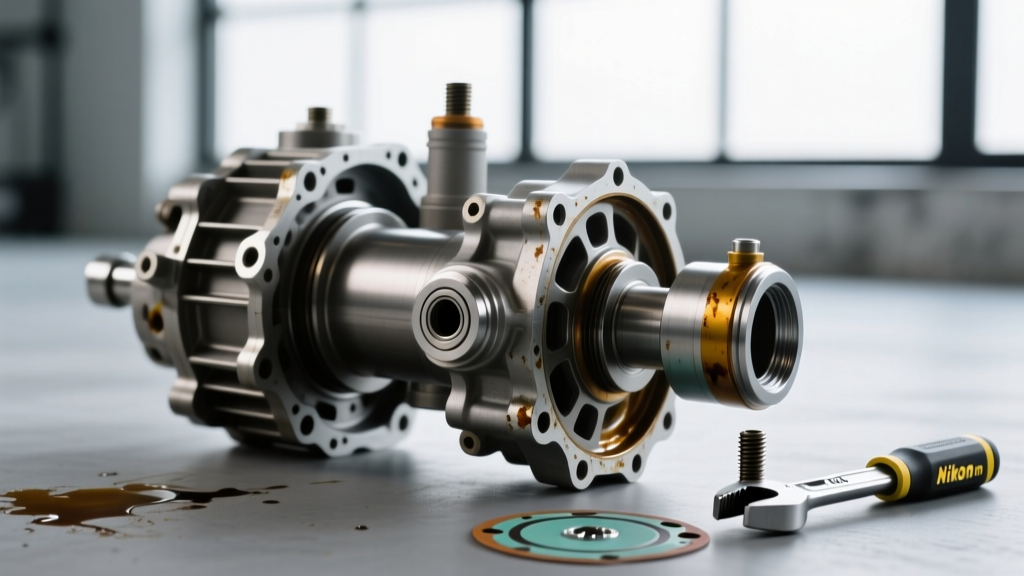
If your housing and carrier bearings are in good health, regearing is the more economical and performance-oriented route. A high-quality master overhaul kit from Dana Spicer, including Timken bearings, races, and shims, costs around $350 to $500. A matched ring and pinion set (e.g., 4.56 ratio) adds another $300 to $450. Because setting up a Dana 44 M220 requires specialized dial indicators and bearing pullers, expect a reputable 4x4 shop to bill 10 to 14 hours of labor per axle. Total regear cost per axle: $1,800 to $2,600.
Expert Insight: Never reuse the original crush sleeve or pinion nut when regearing an M220. The M220 uses a specific torque-to-yield pinion nut that must be replaced to achieve the correct bearing preload (typically 18-22 in-lbs of rotational drag).
Gear Ratio vs. Performance: The Mathematical Reality
Upgrading your gear ratio is not just about restoring lost highway RPMs; it fundamentally alters the performance envelope of your Wrangler. The JL's factory ratios (usually 3.45 or 3.73) are optimized for fuel economy and stock 31-inch tires. When you install heavier, larger-diameter tires, the effective gear ratio drops, causing the ZF 8-speed transmission to constantly hunt for gears and the engine to lug under load.
Below is a performance matrix detailing how different gear ratios interact with common tire sizes and the JL's 4:1 Rock-Trac transfer case.
| Tire Size | Stock 3.45 | 4.10 Ratio | 4.56 Ratio | 4.88 Ratio |
|---|---|---|---|---|
| 33-inch | 2,100 RPM (Sluggish) | 2,500 RPM (Optimal) | 2,750 RPM (Towing) | 2,950 RPM (Over-revving) |
| 35-inch | 1,980 RPM (Lugging) | 2,350 RPM (Good) | 2,600 RPM (Optimal) | 2,800 RPM (Aggressive) |
| 37-inch | 1,870 RPM (Unusable) | 2,200 RPM (Sluggish) | 2,450 RPM (Good) | 2,650 RPM (Optimal) |
| Crawl Ratio (4:1 T-Case) | 55.1:1 | 65.6:1 | 72.9:1 | 78.0:1 |
For a daily-driven JL on 35-inch tires, the 4.56 ratio is widely considered the golden standard. It restores the factory RPM curve, keeps the 2.0L Turbo or 3.6L Pentastar in its optimal powerband, and provides a massive 72.9:1 crawl ratio in 4-Low for technical rock crawling.
Model-Specific Installation: Torque Specs and Quirks
The M220 rear differential features several design quirks that differentiate it from traditional Dana 44s. The ring gear is larger (220mm vs the traditional 215mm), and the pinion bearing preload relies on a precise crush sleeve elimination spacer or a strictly torqued OEM sleeve. Furthermore, the JL's electronic locking differential requires careful handling of the internal actuator wiring harness during teardown to prevent costly short circuits.
Crucial Torque Specifications for the M220
When performing a gear swap or carrier replacement, adherence to factory torque specifications is non-negotiable. Use a calibrated torque wrench and verify settings before applying them to fasteners.
- Ring Gear Bolts (M12 x 1.25): 105 lb-ft (Apply Loctite 272 Red threadlocker)
- Bearing Cap Bolts: 85 lb-ft (Ensure caps are aligned with factory indexing marks)
- Pinion Nut (New OEM Crush Sleeve): 250-320 lb-ft (Stop immediately when rotational drag hits 18-22 in-lbs)
- Differential Cover Bolts (M8): 25 lb-ft (Use a criss-cross star pattern)
- Axle Shaft Retainer Nuts: 65 lb-ft
TCM Calibration and the ZF 8HP Transmission
One of the most frequently overlooked aspects of a JL differential gear swap is the integration with the ZF 8HP transmission. The ZF 8-speed relies heavily on the Transmission Control Module (TCM) to calculate shift pressure, shift points, and torque converter lockup based on the programmed axle ratio and tire circumference.
If you change your differential from a 3.45 to a 4.56 ratio and fail to update the Powertrain Control Module (PCM), the transmission will shift erratically, the speedometer will read incorrectly, and you risk burning up the clutch packs due to improper line pressure calculations. According to Quadratec technical guides, JL owners must use an OBD-II programming tool like AlfaOBD, a Tazer JL Mini, or a dealer-level WiTech scan tool to flash the new gear ratio code and tire size into the vehicle's CAN bus network before driving the vehicle.
Fluid Specifications and the 500-Mile Break-In
The final, and arguably most critical, step in the differential replacement and regearing process is fluid selection and the break-in procedure. New ring and pinion gears generate immense friction and heat as the contact patterns wear into one another. Running the wrong fluid, or failing to perform a break-in fluid change, will result in premature pitting and whining.
Fluid Capacities and Part Numbers
- Rear M220 Capacity: ~2.0 Liters
- Front M210 Capacity: ~1.6 Liters
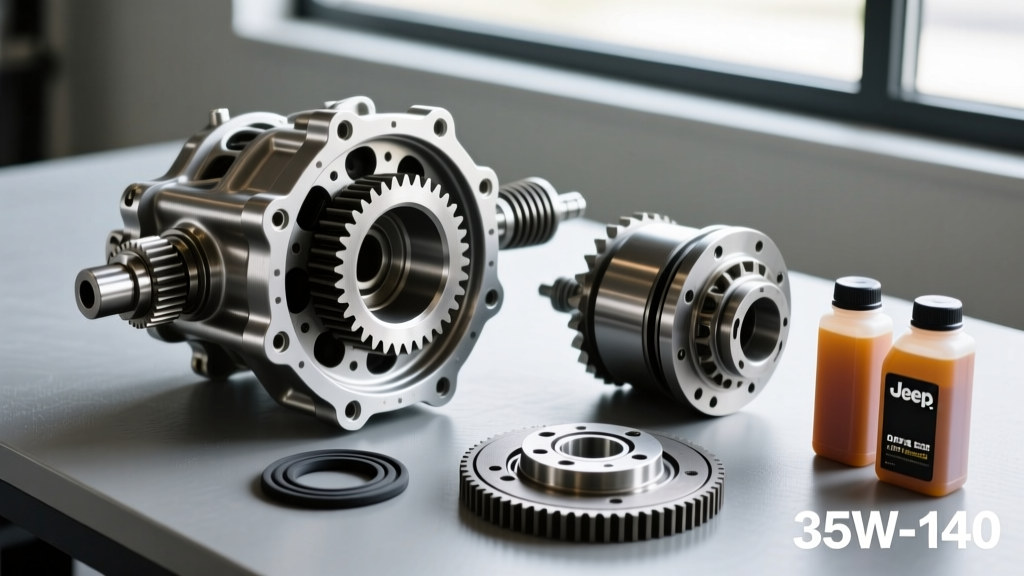
- Recommended Fluid: Mopar 75W-140 Synthetic Gear Oil (Part #68218655AA) or an equivalent API GL-5 rated synthetic like Amsoil Severe Gear.
The Friction Modifier Edge Case
Pay close attention to your specific JL trim. If your Wrangler is equipped with the Trac-Lok limited-slip differential (common on Sport and Sahara models with the Max Tow package), you must add 2.5 oz of Mopar Friction Modifier (Part #4318060AD) to prevent chatter during tight turns. However, if you are driving a Rubicon equipped with the electronic Tru-Lok locking differentials, do not add friction modifier. The Tru-Lok is a mechanical locker that does not utilize clutch packs, and adding modifier can reduce the fluid's shear stability under extreme loads.
The Break-In Protocol
After installation, fill the differentials to the bottom of the fill plug hole. Drive the vehicle on the highway for 15-20 miles to bring the gear oil up to operating temperature (approx. 160°F). Allow the axles to cool completely. Repeat this heat-cycle process 4 or 5 times over the first 100 miles. Avoid sustained speeds over 65 MPH and avoid towing during the first 500 miles. At the 500-mile mark, drain the fluid entirely. You will likely notice a metallic sheen on the drain plug magnet—this is normal molybdenum coating and micro-lapping material. Refill with fresh 75W-140 synthetic, and your newly geared Dana 44s are ready for a lifetime of reliable service.