The Jeep Wrangler JK (2007-2018) is a legendary platform for off-roading and overlanding, but its drivetrain harbors a well-documented thermal weakness. When you subject a JK to hot climate driving—whether crawling through the Mojave Desert in 110°F ambient heat or towing a camper through an Arizona summer—transmission temperatures can quickly spiral out of control. Upgrading your Jeep JK transmission cooler is not just a preventative measure; in extreme environments, it is a critical requirement for drivetrain survival.
The Thermal Reality of JK Drivetrains in High Heat
To understand why an auxiliary cooler is mandatory for hot climates, we must look at the specific transmissions equipped in the JK generation. The 2007-2011 models utilize the 42RLE 4-speed automatic, while the 2012-2018 3.6L Pentastar models use the Mercedes-derived W5A580 (NAG1) 5-speed automatic.
Both units are highly sensitive to heat. Standard Mopar ATF+4 begins to oxidize rapidly once fluid temperatures exceed 220°F. At 240°F, the fluid begins to form varnish, clutch packs lose their frictional coefficient, and torque converter lockup clutches (TCC) experience severe slip. In a hot climate where ambient air is already 105°F, the baseline operating temperature of a stock JK transmission easily rests between 205°F and 215°F during highway driving, leaving virtually zero thermal headroom for low-speed crawling or incline towing.
Why the Factory Radiator Loop Fails at 100°F+
From the factory, the JK routes transmission fluid to a heat exchanger integrated into the engine radiator. In moderate climates, this is sufficient to bring the fluid up to operating temperature and shed mild heat loads. However, in hot climate driving, this design becomes a severe liability.
When ambient temperatures push 110°F, your engine coolant is running at 215°F to 220°F. Thermodynamics dictates that heat only transfers from a hotter medium to a cooler one. If your radiator coolant is hotter than your transmission fluid, the radiator is actually adding heat to the ATF rather than shedding it. This phenomenon, known as heat soak, is the primary cause of 42RLE and NAG1 failures in desert environments.
Selecting the Right Cooler: Stacked-Plate vs. Plate-and-Fin
When shopping for a Jeep JK transmission cooler for extreme heat, the physical construction of the cooler dictates its efficiency and pressure drop. While tube-and-fin coolers are cheap, they are entirely inadequate for heavy-duty hot climate use. You must choose between plate-and-fin and stacked-plate designs.
| Cooler Type | Thermal Efficiency | Pressure Drop | Best Hot Climate Application | Recommended Example |
|---|---|---|---|---|
| Tube-and-Fin | Low | High | Not recommended for JKs in high heat. | N/A |
| Plate-and-Fin | Medium-High | Medium | Highway towing in warm climates; moderate crawling. | Hayden Rapid-Cool 678 |
| Stacked-Plate | Highest | Lowest | Desert crawling, heavy towing, 100°F+ ambient. | Derale Hyper-Cool 13960 |
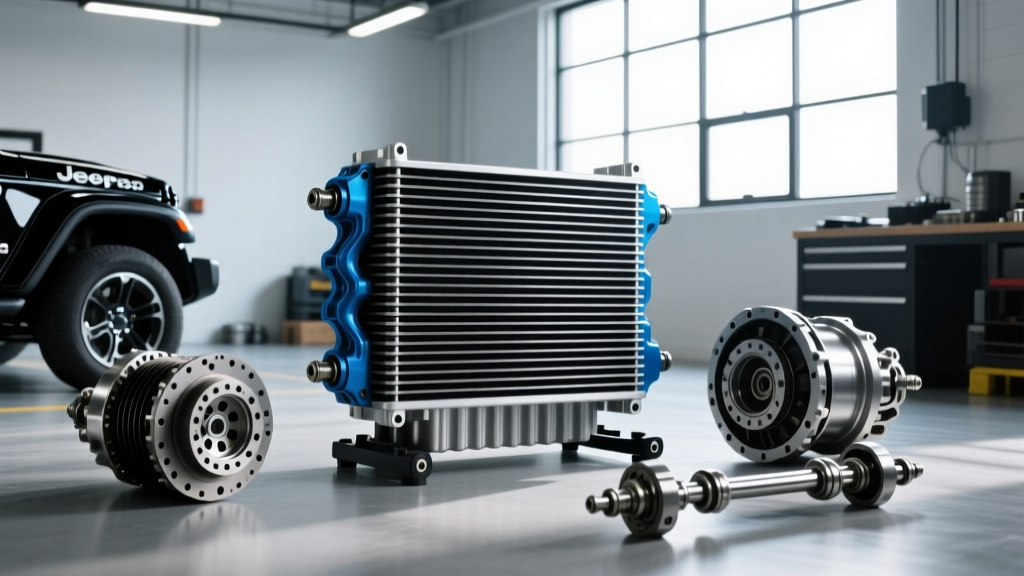
For severe hot climate driving, the stacked-plate design is the undisputed winner. Stacked-plate coolers offer the highest surface-area-to-volume ratio and maintain a consistent internal fluid velocity, which prevents the fluid from lingering and cooking inside the cooler during slow-speed rock crawling.
Expert Routing: Bypassing the Radiator for Desert Climates
The most debated topic in JK cooling is routing: should the auxiliary cooler be installed in series (post-radiator) or should the radiator be bypassed entirely? For dedicated hot climate driving and desert crawling, bypassing the factory radiator loop is the expert consensus.
By routing the transmission fluid directly from the gearbox to a large, front-mounted stacked-plate cooler, you eliminate the radiator heat soak variable. However, this introduces a cold-climate issue: the fluid may never reach optimal operating temperature (160°F-180°F) during winter. To solve this, install an inline transmission thermostat, such as the Derale 13011 Fluid Control Thermostat. This billet aluminum housing routes fluid back to the transmission until it reaches 180°F, at which point a wax pellet expands and diverts the fluid to the auxiliary cooler.
The Low-Speed Airflow Problem
Stacked-plate coolers rely on ram-air effect. When you are crawling through a slow, technical desert trail at 3 MPH in 115°F heat, there is zero airflow across the cooler core. For extreme off-road hot climate use, you must pair your stacked-plate cooler with an auxiliary puller fan. Look for slim-profile PWM (Pulse Width Modulation) fans that can be wired to a thermal switch set to trigger at 195°F.
The NAG1 Thermal Bypass Valve Dilemma
If you are driving a 2012-2018 JK with the W5A580/NAG1 transmission, you must address the factory Thermal Bypass Valve. Located on the side of the transmission case near the cooler lines, this valve is designed to bypass the cooler during cold starts to warm the fluid faster.
Unfortunately, the factory plastic and spring mechanism is notorious for failing in the 'closed' position, permanently trapping hot fluid inside the torque converter and preventing it from ever reaching the cooler. According to drivetrain specialists at Sonnax and various independent transmission shops, deleting this valve or replacing it with a heavy-duty aftermarket billet bypass delete block is a mandatory best practice for any NAG1 operating in high-heat environments. Failure to address this valve will render even the most expensive auxiliary cooler completely useless.
Installation Specs: Fittings, Hoses, and Torque
Improper installation of cooler lines leads to pressure drops, aeration, and catastrophic fluid loss. Follow these exact specifications when installing your Jeep JK transmission cooler:
- Line Sizing: The JK utilizes 5/16-inch (0.312") ID transmission lines. Do not use 3/8-inch hose and clamp it down; this creates internal restrictions and aeration. Use exact 5/16-inch ID hose.
- Hose Material: Never use standard fuel line or cheap rubber vacuum hose. You must use SAE J30R6 or J30R7 rated transmission cooler hose (typically EPDM rubber with a braided synthetic core) capable of withstanding continuous 300°F and 150+ PSI.
- Clamps: Abandon standard worm-gear clamps; they slice into the EPDM rubber over time due to thermal expansion and contraction. Use constant-tension fuel injection clamps (T-Bolt or spring clamps) sized for 1/2" to 5/8" OD. Torque T-Bolt clamps to exactly 25-30 in-lbs (inch-pounds, not foot-pounds).
- Fittings and Sealants: When threading brass or aluminum NPT adapters into the transmission case or cooler, do not use standard Teflon tape, which can shred and clog the NAG1 valve body solenoids. Use a liquid PTFE thread sealant like Permatex 80045 High-Temperature Thread Sealant. Torque brass adapter fittings to 15-18 ft-lbs to avoid cracking the aluminum transmission case.
Fluid Chemistry and Active Monitoring
A cooler is only half of the thermal management equation; the fluid itself must be up to the task. For the 42RLE and NAG1, Chrysler mandates the ATF+4 specification (Mopar Part #68218925AB). While factory ATF+4 is a high-quality synthetic blend, dedicated hot-climate drivers often benefit from switching to a premium full-synthetic alternative that meets the ATF+4 license, such as Amsoil Signature Series Fuel-Efficient Synthetic ATF. Full synthetics maintain their shear stability and resist oxidation significantly longer when pushed to the 220°F threshold.
Finally, you cannot manage what you do not measure. The factory JK dashboard does not display transmission fluid temperature. Utilize an OBD2 Bluetooth adapter paired with an app like Torque Pro or the JK-specific 'JScan' application to monitor the live PID data for the Transmission Fluid Temperature (TFT) sensor. Set an audible alarm on your smartphone or tablet to trigger at 215°F, giving you the warning needed to pull over, shift into neutral, and raise the engine RPMs to 1,500 to increase cooler flow before permanent clutch glazing occurs.
By combining a high-efficiency stacked-plate cooler, a radiator bypass with a thermostat, and proper NAG1 valve management, your Jeep JK will confidently conquer the most punishing desert environments without cooking its drivetrain.