The Dual Nature of Clutch Intermittency
Intermittent clutch problems are among the most frustrating diagnostics in modern automotive repair. Unlike a hard failure—where a throwout bearing shatters or a clutch disc completely disintegrates—intermittent issues manifest unpredictably. You might experience perfect engagement on your morning commute, only to find the pedal dropping to the floorboard or the transmission refusing to engage first gear when the engine bay reaches peak operating temperatures. However, the word 'clutch' spans two critical vehicle systems: the drivetrain manual transmission clutch and the engine cooling fan clutch. Both rely on complex engagement mechanisms, and both are prone to heat-induced intermittent failures.
In this comprehensive 2026 diagnostic guide, we will decode the symptoms of failing drivetrain hydraulic clutches and thermal/electronic fan clutches. Furthermore, we will provide a precise, torque-spec-driven tutorial on how to install fan clutch assemblies on longitudinal V8 platforms, ensuring you have the exact data needed to resolve cooling system engagement faults.
Symptom Matrix: Drivetrain vs. Cooling System Clutches
Before tearing into the bell housing or the radiator shroud, you must isolate which clutch system is failing. The table below cross-references common intermittent symptoms with their primary mechanical culprits.
| Observed Symptom | Drivetrain Clutch Cause (Manual Transmission) | Cooling System Fan Clutch Cause |
|---|---|---|
| Pedal sinks slowly under constant pressure | Internal master cylinder cup seal bypassing or CSC micro-leak | N/A (Hydraulic cooling fans use different circuits) |
| Harsh engagement only when engine is hot | Dual-Mass Flywheel (DMF) spring fatigue or glazed friction material | Thermal bimetallic strip binding in the valve body |
| Random high-RPM engine fan roar at idle | N/A | Electronic Viscous Fan Clutch (EVFC) PWM signal loss |
| Difficulty shifting into gear at stoplights | Hydraulic fluid aeration or failing concentric slave cylinder | Severe duty clutch locked up due to silicone shear breakdown |
Diagnosing Intermittent Manual Transmission Clutch Drag
When a manual transmission clutch drags intermittently, the friction disc fails to fully disengage from the flywheel. This makes shifting into first or reverse at a standstill feel like grinding gears. In modern platforms utilizing internal Concentric Slave Cylinders (CSC)—such as the Tremec T56 Magnum found in performance applications or the Aisin AZ6 in light-duty trucks—the primary culprit is often hydraulic aeration or heat-induced fluid degradation.
The Heat-Aeration Loop
As the transmission tunnel reaches 180°F to 210°F, standard DOT 3 hydraulic fluid can begin to off-gas, especially if moisture contamination is present. This creates microscopic air bubbles in the hydraulic line. Because air is compressible, the pedal stroke is consumed by compressing the bubbles rather than actuating the CSC. The result is an intermittent failure to disengage that mysteriously resolves itself after the vehicle sits overnight and the fluid cools.
- Diagnostic Step: Connect a Motive pressure bleeder to the master cylinder reservoir. Pressurize the system to exactly 15 PSI. If the pedal feels spongy but holds pressure without dropping, you have aeration, not a physical leak.
- Correction: Flush the system with high-temp DOT 4 or DOT 5.1 fluid (e.g., Motul RBF 600, which has a dry boiling point of 617°F) and perform a reverse-bleed to force trapped air out of the CSC.
For deeper insights into hydraulic actuation tolerances, refer to the engineering specifications provided by Tremec.
How to Install Fan Clutch: Longitudinal V8 Truck Guide
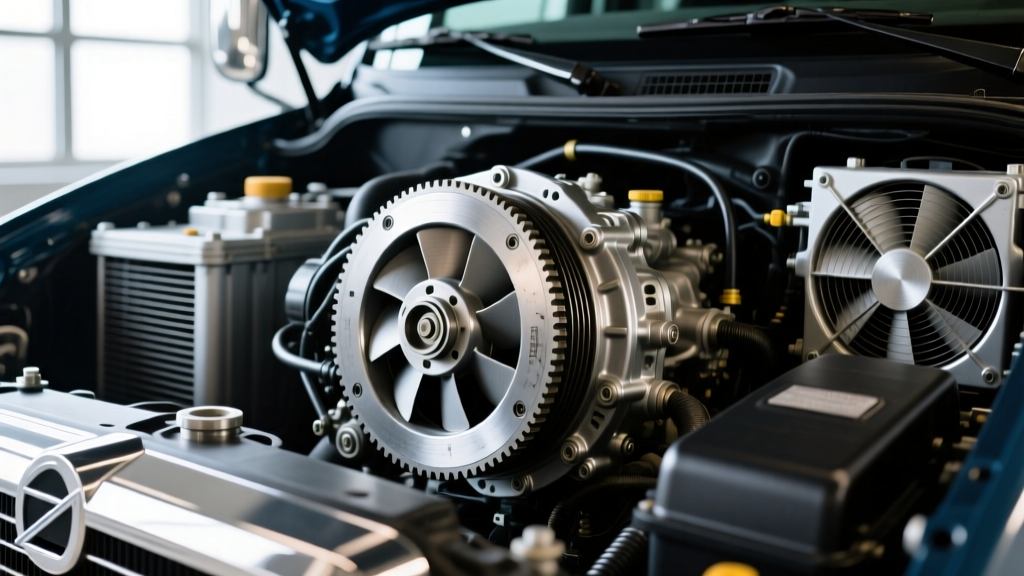
While drivetrain clutches require transmission removal, cooling system clutches are accessible but highly technical. A failing thermal fan clutch will cause intermittent overheating in traffic, while a locked-up clutch will sap horsepower and shatter the water pump bearings. Below is the exact procedure for how to install fan clutch assemblies on popular longitudinal V8 trucks (e.g., GM 5.3L/6.2L EcoTec3 or Dodge 5.7L Hemi platforms).
Required Tools and Torque Specifications
Do not attempt this repair with standard open-end wrenches. The torque required to break the retaining nut, combined with the rotation of the water pump shaft, requires specialized holding tools.
- Replacement Part: Hayden 51434 Severe Duty Thermal Fan Clutch (Verify fitment via RockAuto for your specific year/make).
- Wrench Set: Lisle 36mm Fan Clutch Wrench Set (Part #38120).
- Torque Spec: 41 lb-ft (55 Nm) for most GM LS/LT water pump shaft nuts.
- Thread Direction Warning: Many GM V8 applications utilize a left-hand (reverse) thread. This means you turn the wrench clockwise to loosen and counter-clockwise to tighten. Always check the stamping on the water pump pulley for an 'L' or 'R' indicator.
Step-by-Step Installation Procedure
- Belt Tension Release: Use a 15mm wrench on the belt tensioner pulley to relieve tension and slip the serpentine belt off the water pump pulley. Leave the belt wrapped around the other accessories to maintain tension and prevent it from falling into the crankcase.
- Lock the Pulley: Wrap the serpentine belt tightly around the water pump pulley and pinch it against the housing, or use the specialized pulley-holding strap tool. This prevents the shaft from spinning while you apply breakaway torque.
- Break the Nut: Fit the 36mm Lisle wrench onto the fan clutch nut. Strike the handle with a rubber mallet to shock the nut loose. If it is a reverse thread, strike toward the passenger side. If standard thread, strike toward the driver's side.
- Extract the Assembly: Once the nut is spun off, carefully pull the fan blade and clutch assembly forward. Note the orientation of the fan blades (they are directional and angled to pull air toward the engine).
- Transfer and Mount: Unbolt the fan blade from the old clutch (typically four 8mm or 10mm hex bolts). Transfer the blade to the new Hayden 51434 unit. Torque the blade bolts to 18 lb-ft in a crisscross pattern.
- Final Installation: Thread the new clutch onto the water pump shaft by hand to prevent cross-threading. Tighten to the final 41 lb-ft specification. Re-route the serpentine belt and verify the clutch spins freely with slight viscous resistance when the engine is cold.
For official torque charts and thermal engagement curves, consult the technical resources at Hayden Automotive.
Electronic Viscous Fan Clutch (EVFC) PWM Diagnostics
In 2026, heavy-duty trucks like the Ford 6.7L Powerstroke and RAM Cummins utilize Electronic Viscous Fan Clutches. These do not rely on a thermal bimetallic strip; instead, the Powertrain Control Module (PCM) sends a Pulse Width Modulated (PWM) signal to an electromagnetic coil inside the clutch hub. This coil opens a valve, allowing silicone fluid to enter the shear chamber and lock the fan.
If your EVFC is intermittently failing to engage, causing severe towing overheating, the issue is rarely the mechanical clutch itself. It is usually a wiring harness chafe near the fan shroud or a failing PCM driver. To diagnose this, back-probe the EVFC connector with a digital multimeter set to duty cycle. You should see a 10% to 90% PWM variance correlating with coolant temperatures and A/C head pressures. If the PCM commands 85% duty cycle but the fan remains disengaged, the internal electromagnetic coil has suffered an open circuit, necessitating a full EVFC replacement.
Cost Analysis and Final Verdict
Addressing intermittent clutch problems requires a methodical approach to avoid throwing expensive parts at a symptom. A hydraulic drivetrain flush and reverse-bleed costs roughly $40 in fluids and shop supplies, whereas replacing an internal CSC requires a transmission drop, costing between $800 and $1,400 in labor. Similarly, a thermal fan clutch replacement part costs between $60 and $120, while an electronic EVFC unit for a heavy-duty truck can exceed $350. By utilizing the diagnostic matrix and precise installation procedures outlined above, you can confidently isolate the failure point, apply the correct torque specifications, and restore your vehicle's drivetrain and cooling systems to factory-level reliability.