The Real Honda Pilot Torque Converter Replacement Cost in 2026
The Honda Pilot has long been a benchmark in the midsize SUV segment, powered by the legendary J35 V6 engine. However, as these vehicles accumulate mileage, a notorious issue frequently emerges: torque converter clutch (TCC) shudder. If you are actively researching the Honda Pilot torque converter replacement cost, you have likely experienced the violent vibrations at highway speeds or the dreaded flashing 'D' indicator on your dash. In 2026, repair costs have shifted due to inflation in OEM parts and the increasing complexity of the ZF 9-speed transmissions found in newer models.
As a senior transmission specialist at AutoGearNexus, I have compiled a definitive, model-specific cost analysis and technical teardown. This guide bridges the gap between dealership service advisor quotes and independent shop realities, giving you the exact part numbers, labor times, and diagnostic frameworks needed to make an informed decision.
2026 Cost Breakdown by Generation and Transmission Model
The Pilot has utilized three primary automatic transmission families over its lifespan: Honda's proprietary 5AT/6AT, the ZF 9HP 9-speed, and the newer Honda 10AT. The replacement cost varies drastically depending on which unit is bolted to your J35 engine.
| Generation (Years) | Transmission | OEM TC Part Number | Part Cost (2026) | Labor Hours | Estimated Total |
|---|---|---|---|---|---|
| Gen 1 (2003-2008) | Honda 5AT (BYBA) | 25000-RGL-000 | $450 - $550 | 7.5 - 8.5 | $1,500 - $2,100 |
| Gen 2 (2009-2015) | Honda 6AT | 25000-RV0-A05 | $550 - $680 | 8.0 - 9.0 | $1,700 - $2,400 |
| Gen 3 (2016-2022) | ZF 9HP (Elite/Touring) | 25000-5MG-005 | $850 - $1,150 | 9.5 - 11.5 | $2,400 - $3,600 |
| Gen 4 (2023+) | Honda 10AT | 25000-65C-000 | $900 - $1,200 | 10.0 - 12.0 | $2,600 - $3,800 |
Expert Note: Dealerships will almost always quote a complete transmission assembly replacement ($5,500+) if they detect TCC shudder codes (e.g., P0741, P1744). Independent transmission shops equipped with a lift and engine support bar can perform a standalone torque converter R&R (Remove and Replace) for less than half the price.
Model-Specific Failure Modes: Why the Shudder Happens
Honda 5AT and 6AT: The Friction Material Degradation
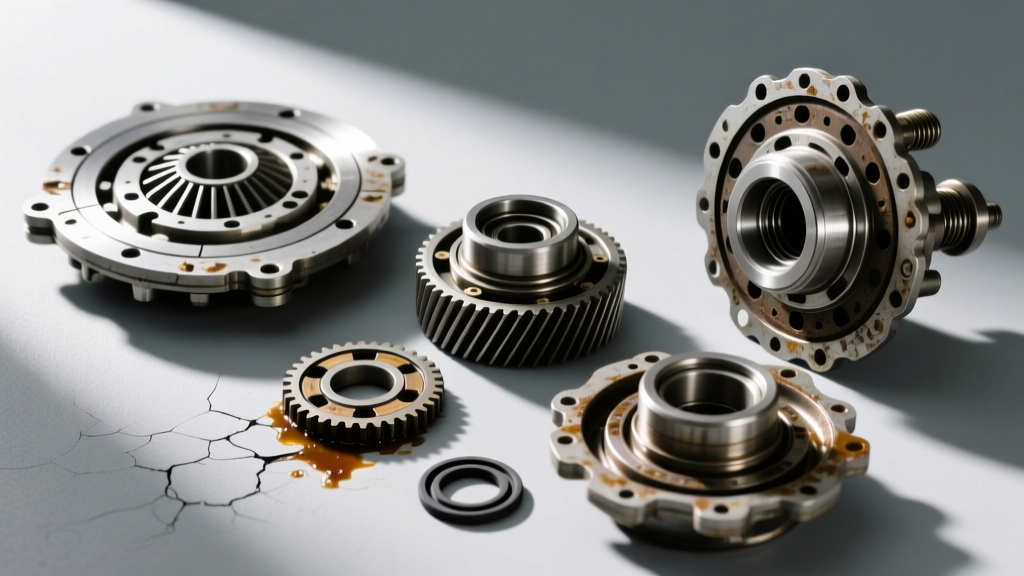
In the first and second-generation Pilots, the torque converter utilizes a single-plate lockup clutch. Over time, the friction material degrades due to thermal cycling and aggressive lockup scheduling designed to meet EPA fuel economy standards. The degraded material sheds into the transmission fluid, clogging the TCC control solenoid and the narrow passages in the valve body. This results in a 'slip-shudder' effect, typically felt between 35 and 50 mph when the TCC attempts to apply at partial slip.
The ZF 9HP Complexity: Mechatronic Sleeve Leaks
The third-generation Elite and Touring trims utilize the ZF 9HP transmission. This unit is highly complex and features a multi-plate wet clutch inside the torque converter. A critical edge case with the ZF 9HP is the failure of the mechatronic sealing sleeve. When this plastic/rubber sleeve degrades, it leaks hydraulic pressure internally. The TCM (Transmission Control Module) compensates by increasing line pressure, which eventually overworks the TCC friction plates, leading to premature burnout. Replacing the torque converter on a ZF 9HP without also replacing the mechatronic sleeve seal is a guaranteed path to a comeback repair.
Diagnostic Decision Tree: Software vs. Hard Parts
Before authorizing a $3,000 repair, you must rule out software and hydraulic anomalies. Follow this diagnostic sequence:
- Scan for TCC Slip RPM: Using a bidirectional OBD2 scanner, monitor the TCC Slip Speed PID while cruising at 45 mph in 5th gear. A healthy system shows 0-20 RPM of slip. If you see erratic spikes above 80 RPM, the clutch is failing.
- Check for TSB Software Updates: Honda has released multiple Technical Service Bulletins (TSBs) addressing TCC shudder via PGM-FI/TCM reprogramming. The update alters the slip-control algorithm, reducing the aggressive apply rate that causes the shudder. A software flash at the dealer costs around $120-$150.
- The 3x Drain and Fill Protocol: If the friction material is not entirely destroyed, performing three consecutive drain-and-fills (driving 50 miles between each) using the correct fluid can restore TCC lockup. This flushes out suspended clutch debris and restores the fluid's friction modifiers.
- Stall Test & Line Pressure Check: If the shudder persists post-flash and post-fluid exchange, and TCC slip remains high, the torque converter is mechanically compromised. A mechanical stall test confirming a low stall RPM (below 2,100 RPM for the J35 V6) indicates severe internal TC stator or clutch failure.
Labor Realities: The Subframe Drop Procedure
One major factor driving the Honda Pilot torque converter replacement cost is the labor intensity of the R&R procedure. You cannot easily pull the transmission from the top or side without dropping the entire front subframe. Here is what the labor entails:
- Engine Support: An OTC 1719 (or equivalent) cross-engine support bar must be rigged to hold the J35 V6 from above, as the engine mounts must be detached.
- AWD Disconnect: For VTM-4 (Gen 1/2) or i-VTM4 (Gen 3/4) models, the rear driveshaft and the transfer case bolted to the passenger side of the transmission must be unbolted and supported.
- Subframe Removal: The front subframe, steering rack, and lower control arms are lowered as a single assembly to provide clearance to slide the transmission backward and away from the engine block.
- Cooler Flushing: Mandatory Step. The transmission cooler and lines must be flushed using a specialized in-line flush tool. If old, debris-laden fluid is left in the cooler, it will immediately contaminate the new torque converter upon startup.
Critical Torque Specs and Fluid Specifications
For the DIY mechanic or the shop technician verifying the work, adhering to Honda's exact torque specifications is non-negotiable to prevent flexplate cracking or converter hub damage.
Torque Specifications (J35 V6 Applications)
- Flexplate to Crankshaft Bolts: 54 lb-ft (74 Nm). *Always use new OEM stretch bolts if specified by the year.*
- Torque Converter to Flexplate Bolts: 11 lb-ft (12 Nm). Do NOT use impact guns; hand-tighten with a crowfoot wrench.
- Bellhousing to Engine Block Bolts: 47 lb-ft (64 Nm) for the 12mm flange bolts.
- Transmission Mount Nuts: 28 lb-ft (38 Nm).
Fluid Selection: Do Not Cross-Contaminate
Using the wrong fluid will destroy the new torque converter's lockup clutch within 5,000 miles due to incompatible friction modifiers.
- Honda 5AT, 6AT, and 10AT: Requires Honda ATF DW-1 (Part #08200-9008). Do not use generic 'multi-vehicle' ATFs.
- ZF 9HP (9-Speed): Requires Honda ATF Type 3.1 (Part #08269-9901) or the exact ZF LifeguardFluid 8 equivalent. ATF DW-1 is NOT compatible with the ZF 9-speed wet clutch pack.
Final Verdict: Is the Repair Worth It?
When evaluating the Honda Pilot torque converter replacement cost against the value of the vehicle, the J35 V6's legendary reliability usually makes the repair a sound financial decision. A properly executed TC replacement, paired with a valve body inspection and a rigorous cooler flush, will easily yield another 150,000 miles of service. Always insist that your shop uses OEM Honda or ZF remanufactured torque converters, as aftermarket 'white box' units frequently suffer from poor stator welding and inferior lockup friction materials. For official service procedures and wiring diagrams, always consult the Honda Technical Information System or verify part numbers via Honda Parts Now before ordering.