The Physics of 700+ Horsepower: Why FWD Fails the Hellcat Drivetrain
When evaluating high-output platforms in 2026, the Dodge Challenger and Charger Hellcat remain the benchmark for American muscle. Producing upwards of 717 horsepower and 650 lb-ft of torque, the engineering team at Stellantis faced a critical layout decision early in the development cycle. While the broader automotive market has increasingly adopted Front-Wheel Drive (FWD) and transverse All-Wheel Drive (AWD) architectures for packaging efficiency, the Hellcat drivetrain strictly utilizes longitudinal Rear-Wheel Drive (RWD) and specialized AWD configurations. To understand why, we must examine the hard physical limitations of FWD architectures when subjected to extreme torsional stress.
In a FWD layout, the front wheels are responsible for both steering and transmitting engine torque to the pavement. When torque exceeds 300 lb-ft, FWD platforms suffer from severe torque steer—a phenomenon caused by unequal half-shaft lengths and varying CV joint angles under suspension compression. A typical heavy-duty FWD CV axle, such as those found in high-performance hot hatches, utilizes trunnion bearings and tripod joints rated for a maximum continuous torsional load of roughly 350 to 400 lb-ft. Subjecting a FWD half-shaft to the Hellcat’s 650 lb-ft of crank torque during a hard launch would result in immediate catastrophic failure, shearing the CV joint cage or twisting the shaft itself into a spiral.
Furthermore, FWD layouts inherently suffer from front-axle weight transfer during acceleration. As the vehicle squats, the front tires lose grip, rendering 700+ horsepower entirely useless. By utilizing a longitudinal layout, the Hellcat shifts weight to the rear axle, maximizing the traction footprint. For an in-depth look at OEM drivetrain component limits, enthusiasts often reference the engineering discussions on the Hellcat.org Drivetrain Forums, where real-world failure points of modified layouts are extensively documented.
Hellcat RWD Configuration: The ZF 8HP90 and 3.09 Rear Diff
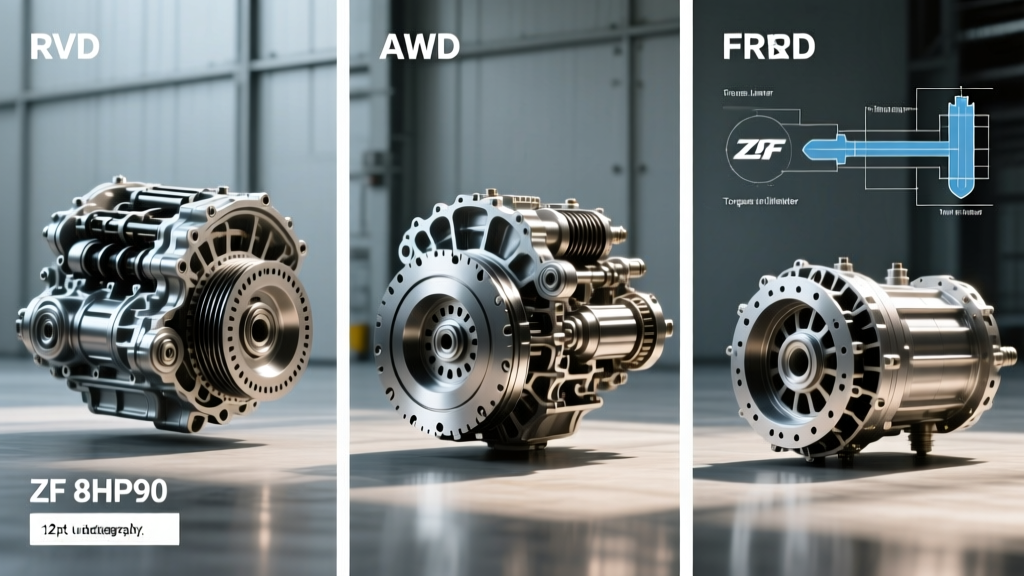
The backbone of the RWD Hellcat drivetrain is the ZF 8HP90 TorqueFlite 8-speed automatic transmission. While lesser Mopar V8s utilize the 8HP70 (rated for 700 Nm / 516 lb-ft), the Hellcat requires the 8HP90, which boasts a maximum input torque rating of 900 Nm (664 lb-ft). This provides a razor-thin 4.5% safety margin over the stock 650 lb-ft engine output, highlighting the absolute necessity of the 8HP90’s reinforced clutches and hardened planetary gearsets.
Common RWD Repair Scenarios: The Mechatronic Sleeve
Despite its robust internal hard parts, the ZF 8HP90 is not immune to peripheral failures. The most notorious issue in the Hellcat RWD drivetrain is the degradation of the Mechatronic sealing sleeve (Mopar Part # 68002685AA). This plastic sleeve houses the electrical pass-through connector between the transmission case and the internal Mechatronic valve body. Over time, heat cycles from the supercharged 6.2L HEMI cause the rubber sealing lips to flatten and leak fluid onto the plug, leading to erratic shift patterns, limp mode, and CAN-bus communication faults.
- Diagnostic Symptom: P0700 (Transmission Control System) accompanied by harsh 2-3 or 4-5 upshifts.
- Repair Procedure: Drop the ZF-specific plastic oil pan (which integrates the filter), unbolt the Mechatronic unit, and extract the old sleeve using a specialized hook tool.
- Torque Spec: Mechatronic sleeve retaining clip must be seated flush; ZF pan bolts require exactly 10 Nm (88 in-lbs) in a specific spiral pattern to prevent cracking the plastic pan.
Power is then routed to a rear limited-slip differential featuring a 3.09 final drive ratio. This relatively tall gearing is necessary to keep the engine within its optimal powerband at highway speeds, given the massive torque output. The rear differential requires Mopar Synthetic 75W-85 Gear Lubricant (Part # 68224952AA), with a strict capacity of 1.2 liters. Overfilling this unit will cause fluid aeration and premature clutch pack wear in the LSD.
Hellcat AWD Architecture: BorgWarner Transfer Case & Front Axles
For the Dodge Charger Hellcat (and later widebody variants), Stellantis introduced an AWD configuration to improve all-weather usability without sacrificing the longitudinal engine layout. Unlike transverse AWD systems that use a power take-off (PTU) bolted to the side of the transmission, the AWD Hellcat utilizes a dedicated BorgWarner transfer case mounted directly to the rear of the ZF 8HP90 transmission output shaft.
This transfer case features an active torque-on-demand system. Under normal cruising conditions, the vehicle operates in pure RWD to eliminate parasitic drivetrain loss. When slip is detected, an internal encoder motor actuates a clutch pack to route up to 40% of the torque to the front wheels via a dedicated front driveshaft. A critical component in this system is the Front Axle Disconnect (FAD) actuator. When in RWD mode, the FAD physically disconnects the front ring and pinion from the front axle shafts, preventing the front drivetrain components from spinning unnecessarily and saving fuel.
AWD-Specific Failure Points
The FAD actuator is highly susceptible to water ingress. Located low on the front differential housing, the actuator's internal PCB can corrode if the vehicle is driven through deep water or exposed to heavy road salt. When the FAD fails, the vehicle may throw a 'Service AWD System' light and default to FWD-only mode to protect the transfer case from binding. Additionally, the BorgWarner transfer case requires specific attention; using standard ATF+4 instead of the specified BorgWarner transfer case fluid will result in clutch pack chatter during torque transfer events.
Layout Comparison: RWD vs AWD vs FWD in High-Output Platforms
Understanding the mechanical trade-offs between these layouts is crucial for both repair technicians and performance enthusiasts. The table below contrasts the three configurations when applied to 700+ HP applications.
| Drivetrain Layout | Max Safe Torque Limit | Weight Penalty (vs RWD) | Primary Failure Point (High HP) | Traction / Launch Efficiency |
|---|---|---|---|---|
| FWD (Transverse) | ~350 lb-ft | -50 lbs (Lightest) | CV Joints, Half-shafts, Steering Rack | Poor (Severe torque steer, weight transfer) |
| RWD (Longitudinal) | 1,000+ lb-ft | Baseline | Rear Diff Pinion Gear, Axle Housings | Excellent (Optimal weight transfer) |
| AWD (Longitudinal) | 850+ lb-ft | +150 lbs (Heaviest) | Transfer Case Clutches, FAD Actuator | Superior (All-weather, minimal slip) |
Model-Specific Repair & Maintenance Specifications
For shop owners and DIY mechanics working on the Hellcat drivetrain in 2026, adhering to exact OEM specifications is non-negotiable. The tolerances on the ZF 8HP90 and the BorgWarner AWD components are incredibly tight. Below is a quick-reference guide for essential drivetrain maintenance on these platforms.
| Component | Fluid Type / Specification | Capacity | Critical Torque Spec |
|---|---|---|---|
| ZF 8HP90 Transmission | ZF LifeguardFluid 8 (or Mopar ZF 8&9 Speed ATF) | 8.5L (Dry) / 6.5L (Service) | Pan Bolts: 10 Nm; Output Shaft Nut: 250 Nm |
| Rear Differential (3.09 LSD) | Mopar Synthetic 75W-85 (No friction modifier needed) | 1.2 Liters | Cover Bolts: 35 Nm; Pinion Nut: Yield (Replace) |
| BorgWarner Transfer Case (AWD) | BorgWarner Specific TC Fluid (Do NOT use ATF+4) | 1.4 Liters | Fill/Drain Plugs: 20 Nm |
| Front Differential (AWD) | Mopar Synthetic 75W-85 | 0.8 Liters | FAD Actuator Bolts: 12 Nm |
Maintaining the Hellcat drivetrain requires respecting the engineering boundaries set by its designers. While the allure of swapping layouts or modifying components for alternative packaging exists in the custom car world, the physics of torque delivery dictate that the longitudinal RWD and specialized AWD configurations are the only viable solutions for harnessing the raw power of the supercharged HEMI. For verified OEM part numbers and updated technical service bulletins, always cross-reference with the official Mopar Service Parts portal and the ZF Friedrichshafen AG 8HP documentation.
Whether you are diagnosing a leaking Mechatronic sleeve on a RWD Challenger or replacing a corroded FAD actuator on an AWD Charger, understanding the fundamental differences between these drivetrain layouts ensures accurate repairs, longevity, and the preservation of one of the most iconic powertrain configurations of the modern automotive era.