The Mechanical Baseline: Harley Clutch Cable Replacement
When establishing a preventive maintenance baseline for manual transmissions and motorcycle drivetrains, the traditional mechanical clutch cable remains a benchmark for direct feedback and mechanical simplicity. For legacy and modern cruisers, understanding the exact parameters of a Harley clutch cable replacement is critical before diagnosing more complex hydraulic setups. A failing cable mimics hydraulic bypass symptoms, often leading mechanics down an incorrect diagnostic path.
On most Milwaukee-Eight and Twin Cam Big Twin models, the OEM clutch cable (such as part number 37795-04D for select Softail applications) operates under immense tensile stress. Preventive replacement is mandated every 20,000 to 30,000 miles, or immediately if fraying is detected at the barrel ends. The critical adjustment metric requires exactly 1/16-inch to 1/8-inch of free play at the lever blade. Insufficient free play causes the throwout bearing to ride against the clutch diaphragm spring, generating excess heat that glazes the friction plates and accelerates primary fluid degradation.
Torque Specifications and Mechanical Drag Diagnosis
Before condemning a clutch pack or converting to a hydraulic system, verify the mechanical hardware. When servicing the primary drive and clutch hub, the clutch hub nut on 2007-and-later Big Twin models requires a strict torque specification of 120 ft-lbs (163 Nm). Failure to secure this nut results in clutch basket wobble, which feels identical to a spongy, air-bound hydraulic lever. Furthermore, ensure the primary chain compensator nut is torqued to 120 ft-lbs using a dedicated primary locking tool. Mechanical drag from a misaligned cable or worn clutch basket tangs must be ruled out before diagnosing fluid-based clutch systems.
Hydraulic Clutch System Diagnosis: Core Symptoms and Failure Modes
As of 2026, hydraulic clutch conversions and OEM hydraulic setups (utilizing master cylinders from Brembo or Magura) dominate the high-performance and custom motorcycle market. Hydraulic systems multiply lever effort through fluid displacement, but they introduce complex failure modes rooted in fluid dynamics and seal degradation.
Symptom 1: The Spongy Lever and Fluid Cavitation
A spongy lever is the most common complaint in hydraulic clutch diagnostics. While air ingress is the primary suspect, cavitation and fluid boiling are equally culpable. DOT 4 and DOT 5.1 brake fluids are hygroscopic, meaning they absorb ambient moisture through microscopic pores in OEM rubber lines and reservoir diaphragms. Over a 24-month period, a DOT 4 fluid's wet boiling point drops from 446°F (230°C) to as low as 311°F (155°C). Under heavy stop-and-go traffic, the clutch slave cylinder absorbs radiant heat from the engine block. If the fluid boils, vapor bubbles form in the slave line. Because gases are compressible and liquids are not, the lever will pull to the handlebar without fully actuating the clutch pushrod.
Symptom 2: Slave Cylinder Weeping and Pushrod Seal Failure
If the lever feels firm but the clutch fails to disengage, inspect the slave cylinder pushrod seal. The slave cylinder operates in a hostile thermal environment. The internal O-ring or lip seal hardens over time, allowing fluid to bypass the piston or weep externally onto the primary chaincase. A leaking slave cylinder will often draw air into the system during the lever's return stroke, creating a compounding vacuum leak that results in a lever that 'pumps up' but loses pressure after a few seconds.
Symptom 3: Master Cylinder Bypassing
Internal master cylinder bypassing occurs when the primary rubber cup wears a groove into the aluminum bore or the cup itself degrades. The symptom is a lever that slowly creeps toward the handlebar when held under constant pressure at a stoplight. Fluid bypasses the piston and returns to the reservoir rather than pushing the slave cylinder. Diagnosing this requires tying off the clutch lever and monitoring the slave cylinder pushrod travel; if travel retracts over 60 seconds, the master cylinder requires a rebuild or replacement.
Fluid Specifications and Thermal Degradation Matrix
Selecting the correct fluid is paramount. Mixing fluid types will destroy hydraulic seals instantly. Below is the 2026 diagnostic matrix for common hydraulic clutch fluids:
| Fluid Type | Base Chemistry | Dry Boiling Point | Wet Boiling Point | Service Interval | Compatible Systems |
|---|---|---|---|---|---|
| DOT 4 | Glycol Ether | 446°F (230°C) | 311°F (155°C) | 24 Months | Brembo, Nissin, OEM Harley Hydraulic |
| DOT 5.1 | Glycol Ether | 518°F (270°C) | 374°F (190°C) | 24 Months | High-Performance Aftermarket |
| DOT 5 | Silicone | 500°F (260°C) | N/A (Non-Hygroscopic) | 60 Months | Legacy Harley-Davidson (Pre-2005) |
| Mineral Oil | Petroleum-Based | Varies by Brand | Non-Hygroscopic | 36 Months | Magura (Requires Magura Blood) |
Note: Never introduce DOT fluid into a Magura mineral oil system, or vice versa. The chemical reaction will cause the EPDM rubber seals to swell and rupture within hours, leading to total system lockup.
Preventive Maintenance Matrix: Cable vs. Hydraulic
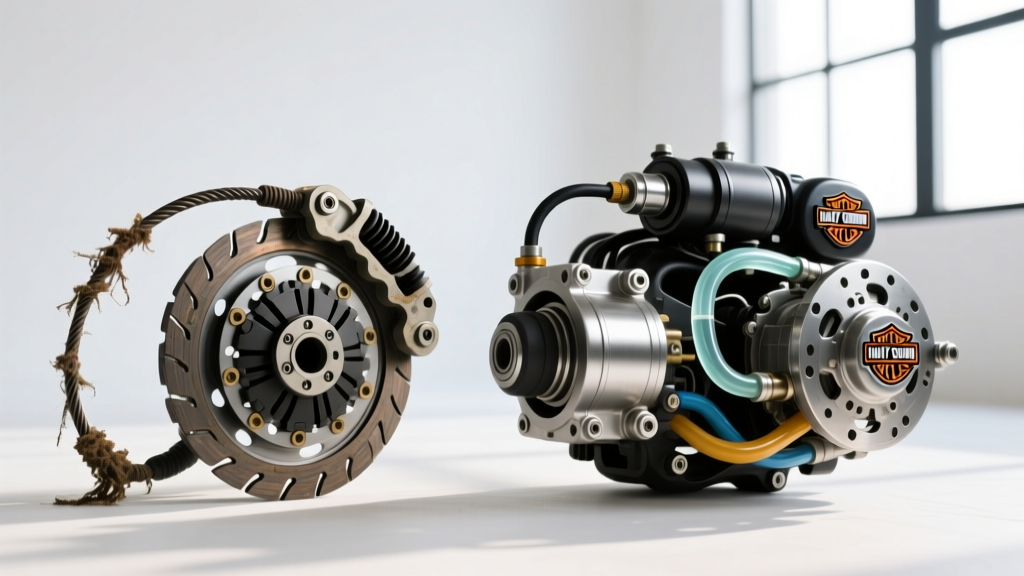
To streamline your workshop's diagnostic workflow, utilize this comparative maintenance schedule. Understanding the divergence in upkeep helps justify the cost and diagnostic time allocated to each system.
- Harley OEM Cable System:
- Inspection: Every 5,000 miles (check free play and barrel wear).
- Lubrication: Every 10,000 miles using a dedicated cable luber and PTFE spray.
- Replacement Interval: 20,000 - 30,000 miles or upon fraying.
- Primary Fluid: Change every 20,000 miles (Motor Oil or Syn3).
- Hydraulic Clutch System:
- Inspection: Every 5,000 miles (check reservoir level and slave cylinder weeping).
- Line Upgrade: Replace OEM rubber lines with braided stainless steel immediately to prevent volumetric expansion and moisture ingress.
- Fluid Flush: Every 24 months (DOT 4/5.1) or 36 months (Mineral Oil).
- Slave Rebuild: 50,000 miles or upon seal weeping.
Advanced Diagnostic Protocols for Hydraulic Systems
When diagnosing a hydraulic clutch that refuses to disengage fully—resulting in gear clunking and creeping at stoplights—mechanics must measure the slave cylinder pushrod travel. Most heavy V-twin applications require between 10mm and 14mm of linear travel to fully collapse the diaphragm spring. If travel is limited to 6mm, the system is suffering from volumetric loss.
Expert Diagnostic Tip: Before tearing down the primary chaincase to inspect the clutch pack, perform a 'bench bleed' test on the master cylinder. If the master cylinder was recently installed or run dry, air can become trapped in the banjo bolt cavity. Crack the banjo bolt at the master cylinder while an assistant holds pressure on the lever to purge the high-point air pocket. This solves 40% of 'unbleedable' hydraulic clutch complaints.
For stubborn air pockets, abandon the manual pump-and-bleed method. Utilizing a vacuum bleeder (such as the Mityvac MV8000) applied directly to the slave cylinder bleeder nipple pulls fluid downward, mimicking natural air travel and preventing the aeration caused by aggressive manual lever pumping. For a comprehensive visual walkthrough on fluid dynamics and bleeding techniques, refer to RevZilla's Hydraulic Clutch Bleeding Guide.
2026 Cost Analysis: Cable Upkeep vs. Hydraulic Overhaul
Budgeting for preventive maintenance requires an understanding of current aftermarket and OEM pricing. While a Harley clutch cable replacement is a low-cost, high-frequency maintenance item, hydraulic systems represent a high-cost, low-frequency investment.
- OEM Harley Clutch Cable: $65 - $95. Add $40 for labor if primary derby cover removal is required for lower barrel seating.
- Brembo 11mm Radial Master Cylinder: $350 - $550. Offers superior modulation and adjustable leverage ratios for heavy clutch springs.
- Magura Hydraulic Clutch Kit (OEM Replacement): $220 - $300. Includes reservoir, master cylinder, and pre-bled slave unit.
- Aftermarket Slave Cylinder Rebuild Kit: $35 - $60. Includes Viton O-rings and pushrod seals designed to withstand higher primary case temperatures.
- Stainless Steel Braided Clutch Line: $80 - $120. Essential for eliminating the 'ballooning' effect of OEM rubber hoses under heavy lever pressure.
For detailed specifications on high-performance master cylinder bore sizing and leverage ratios, consult the engineering data provided by Brembo Motorcycle Components. If you are diagnosing a European or custom build utilizing mineral oil systems, the technical documentation at Magura Motorcycle Hydraulics is indispensable for verifying seal compatibility and fluid viscosity requirements.
Final Diagnostic Synthesis
Whether you are performing a routine Harley clutch cable replacement or executing a deep-dive hydraulic clutch system diagnosis, the core principle remains identical: isolate the variable. Mechanical drag, thermal fluid degradation, and seal bypass all manifest as poor clutch engagement. By adhering to strict torque specifications, utilizing the correct hygroscopic or mineral-based fluids, and measuring exact pushrod travel, you can accurately diagnose the root cause of clutch failure without unnecessary teardowns. Preventive maintenance in 2026 is less about guesswork and more about precision metrics—master these data points, and your diagnostic accuracy will mirror the precision of the drivetrains you service.