The Intersection of GM RPO Codes and Drivetrain Math
Whether you are restoring a classic C10, upgrading a modern Silverado for heavy towing, or swapping a 10L80 transmission into a project car, understanding your axle is non-negotiable. Enthusiasts and mechanics frequently search for differential GM gear ratio codes to identify factory equipment via the glovebox RPO (Regular Production Option) sticker. However, simply knowing your factory code is only the first step. To make an informed purchasing decision for a ring and pinion swap, you must combine those codes with foundational gear ratio math.
In 2026, with the aftermarket flooded with options for both traditional internal combustion setups and EV-conversion drivetrains, selecting the wrong ratio can ruin your vehicle's drivability. A mismatched ratio will either cause your engine to drone at highway speeds or leave you struggling to pull a 6,000-pound trailer up a grade. This guide bridges the gap between decoding your factory GM RPO tags and applying the mathematical formulas required to choose the perfect aftermarket ring and pinion set.
The Master Gear Ratio Formulas
Before comparing parts on a buyer's guide, you must understand the math that dictates drivetrain behavior. At its most basic level, the axle ratio is determined by dividing the number of teeth on the ring gear by the number of teeth on the pinion gear.
Base Axle Ratio = Ring Gear Teeth ÷ Pinion Gear Teeth
Example: A 41-tooth ring gear and a 10-tooth pinion gear yield a 4.10 ratio (41 ÷ 10 = 4.10).
However, the base axle ratio does not tell the whole story. To understand how your vehicle will actually perform on the highway, you must calculate your Final Drive Ratio and your Cruising RPM. Modern GM transmissions, like the 6L80 or the 10L80, feature aggressive overdrive gears that drastically alter the mathematical reality at the wheels.
Calculating Highway RPM
To find your engine RPM at a specific speed, use the industry-standard formula utilizing the '336' constant (which accounts for the conversion of miles per hour to inches per minute and engine revolutions).
RPM = (MPH × Axle Ratio × Transmission Overdrive Ratio × 336) ÷ Tire Diameter (in inches)
Let us apply this math to a Silverado equipped with a 6L80E transmission (6th gear overdrive of 0.67), wearing 31.6-inch tires (265/70R17), cruising at 70 MPH with a 3.73 axle ratio:
- RPM = (70 × 3.73 × 0.67 × 336) ÷ 31.6
- RPM = 58,813.58 ÷ 31.6
- Final RPM = 1,861
This mathematical baseline is critical when shopping for new gears. If you drop to a 3.42 ratio, your RPM falls to 1,707. If you jump to a 4.10, it rises to 2,046. Knowing these exact numbers prevents buyer's remorse.
Translating Differential GM Gear Ratio Codes
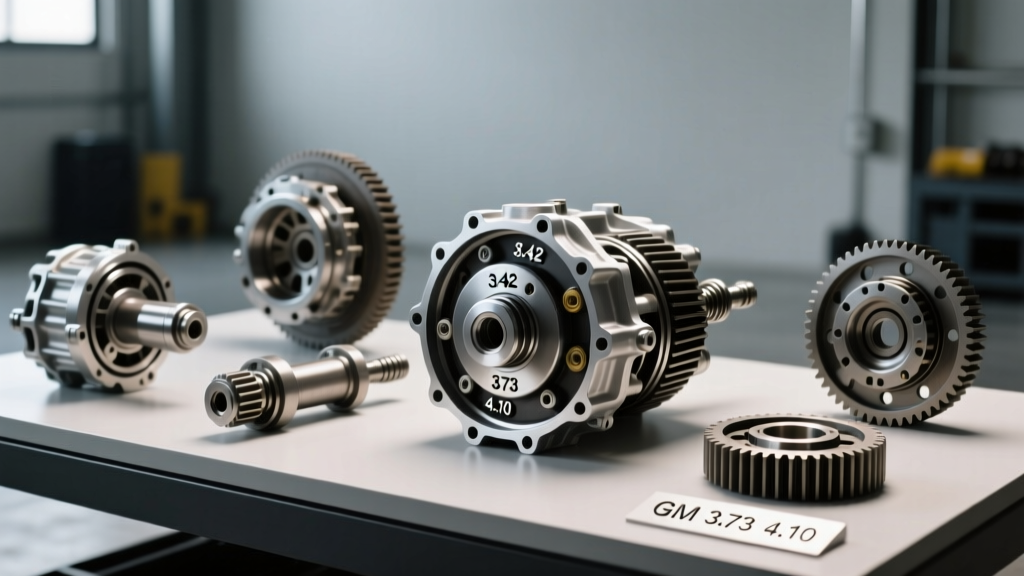
GM uses specific three-character RPO codes to denote axle ratios and differential types. You can find these codes on the Service Parts Identification sticker, typically located in the glovebox or under the trunk lid. Below is a comparison chart of the most common GM differential codes you will encounter when auditing a donor vehicle or planning an upgrade.
| RPO Code | Ratio | Common Applications | Best Use Case |
|---|---|---|---|
| GU4 | 3.08 | Silverado 1500, Tahoe, Camaro SS | Highway fuel economy, light loads |
| GU5 | 3.23 | Silverado 1500, Suburban, Corvette | Balance of MPG and daily driving |
| GU6 | 3.42 | Silverado 1500 (Tow Package), Sierra | Standard towing, larger tire clearance |
| GT4 | 3.73 | Silverado 2500HD, Trail Boss, Camaro ZL1 | Heavy towing, off-road crawling, track launches |
| HC4 | 4.10 | Silverado 3500HD (Dually), Colorado ZR2 | Maximum towing, extreme off-road, drag racing |
| G80 | N/A (Locker) | Most GMT800/900 Trucks with GU5/GU6/GT4 | Eaton Gov-Loc automatic locking differential |
Note: The G80 code is not a ratio, but rather indicates the presence of GM's Eaton Gov-Loc automatic locker. When buying replacement parts for a G80 axle, you must purchase carrier components specifically designed for the Gov-Loc mechanism, or swap to an aftermarket locker like an Eaton Detroit Truetrac.
Buyer's Comparison: Selecting Your Next Ring and Pinion
When browsing catalogs from manufacturers like Yukon Gear, Motive Gear, or Dana Spicer, you will primarily be choosing between the 'Big Three' ratios for GM half-ton trucks: 3.42, 3.73, and 4.10. Here is how the math translates to real-world purchasing decisions.
3.42 (The Highway Cruiser)
Math Impact: Lowers RPM, reduces fuel consumption, decreases torque multiplication at the wheels.
Buyer Profile: Ideal for buyers who have upgraded to a 10-speed transmission (like the 10L80 with a 0.63 10th gear). The ultra-low overdrive of the 10L80 mathematically requires a numerically higher axle ratio to compensate. If you put 3.42 gears behind a 10L80 with 33-inch tires, your RPM at 70 MPH drops to an lugging 1,450 RPM, which can cause severe transmission hunting and engine strain. Verdict: Only buy 3.42s if you are running a 6-speed transmission and stock tire sizes.
3.73 (The Versatile Workhorse)
Math Impact: Provides a 9% increase in wheel torque over the 3.42.
Buyer Profile: The gold standard for modern Silverado owners running 33-inch to 35-inch tires. The mathematical torque multiplication offsets the rotational mass of larger aftermarket wheels and tires. If you are buying a ring and pinion set for a truck that sees 50% highway and 50% towing, 3.73 is the safest investment.
4.10 (The Heavy Hauler)
Math Impact: Maximizes torque multiplication but pushes highway RPM past 2,200 on standard tires.
Buyer Profile: Dedicated tow rigs, rock crawlers, or drag cars. For a drag car, 4.10s maximize the area under the torque curve during the 1-2 and 2-3 shifts. For trucks, it is mandatory if you are running 37-inch tires and refuse to regear your transmission's internal ratios.
The Effective Gear Ratio Formula
One of the most common mistakes buyers make is changing tire sizes without recalculating their drivetrain math. When you install larger tires, you effectively change your gear ratio, even if the metal inside the differential remains untouched. Use this formula to find your Effective Gear Ratio:
Effective Ratio = (Original Tire Diameter ÷ New Tire Diameter) × Original Axle Ratio
If your truck came from the factory with 31.6-inch tires and a 3.73 ratio (GT4 code), and you install 35-inch tires, your math looks like this: (31.6 ÷ 35) × 3.73 = 3.36. Your truck now behaves as if it has 3.36 gears. To restore factory performance and shift points, you must purchase a 4.10 ring and pinion set, which will mathematically bring your effective ratio back to the 3.73 sweet spot.
Purchasing Advice: Brands, Pricing, and Installation Specs
When sourcing your gears, avoid unbranded, ultra-cheap import sets found on auction sites. Precision machining is vital for noise-free operation and longevity. According to Yukon Gear's technical database, inferior metallurgy leads to rapid pitting and whining under load.
What to Expect to Pay (2026 Market Rates)
- Ring and Pinion Set: $240 - $380 (Brands: Yukon, Motive Gear, Revolution Gear)
- Master Install Kit: $130 - $190 (Includes Timken bearings, seals, crush sleeve, shims, and ring gear bolts)
- Differential Fluid: $40 - $70 (AMSOIL or Royal Purple 75W-90 Synthetic)
- Professional Installation Labor: $800 - $1,400 (Depending on shop rates and whether the carrier must be swapped)
Critical Installation Torque Specs (GM 8.5-Inch 10-Bolt)
If you are installing the gears yourself, adhering to factory torque specifications is where the math meets the metal. A ring gear bolt that is under-torqued will shear under heavy throttle application.
- Ring Gear to Carrier Bolts: 70 lb-ft (Must be applied with Red Loctite 271 and torqued in a star pattern)
- Carrier Bearing Cap Bolts: 60 lb-ft (Always reuse original cap bolts and mark them for directional reinstall to maintain bearing preload)
- Pinion Nut (Prevailing Torque): 125 - 150 lb-ft (Requires a new crush sleeve and a heavy-duty inch-pound torque wrench to measure rotational drag. Target 15-25 in-lbs of rotational drag on new bearings)
Furthermore, the GM 8.5-inch 10-bolt differential requires approximately 2.1 quarts of 75W-90 gear oil. If your RPO code included the G80 locker, you must not add limited-slip friction modifiers, as the Gov-Loc mechanism relies on the flyweights engaging mechanically without the slip characteristics of modified fluids.
Final Thoughts on Drivetrain Mathematics
Decoding your differential GM gear ratio codes is merely the starting line. True drivetrain optimization requires a firm grasp of the gear ratio formula, an understanding of transmission overdrive multipliers, and a clear vision of your vehicle's intended use. By applying the RPM and effective ratio math outlined in this guide, you can confidently navigate the buyer's market, select the correct ring and pinion set, and transform your GM vehicle's performance with mathematical precision.