The Critical Link Between Gear Oil and Hypoid Gear Survival
When enthusiasts and fleet managers talk about axle upgrades, the conversation almost always gravitates toward hardened steel, gear ratios, and locker types. However, the unsung hero that dictates the lifespan of your drivetrain is the lubricant separating the metal. Specifically, the differential ring and pinion gear set operates under some of the most extreme mechanical stress found anywhere on a vehicle. In modern solid axles—such as the Dana 60, Ford 10.5-inch, and GM 9.5-inch—the ring and pinion are cut in a hypoid geometry. Unlike straight-cut or helical gears that primarily roll, hypoid gears feature an offset axis that forces the pinion to slide across the face of the ring gear under immense load.
This sliding action generates massive friction and localized heat. If the hydrodynamic fluid film separating the gear teeth shears down or boils off, you experience boundary lubrication. The result is micropitting, spalling, and eventually, catastrophic tooth shear. Choosing the correct gear oil is not merely a maintenance checkbox; it is a critical engineering decision. This 2026 buyer’s guide compares the top synthetic gear oils on the market, breaking down API specifications, viscosity grades, and additive packages to ensure your differential ring and pinion survives extreme towing, track abuse, and daily driving.
Decoding API Specifications: Why GL-5 is Mandatory
The American Petroleum Institute (API) classifies gear oils based on their Extreme Pressure (EP) additive concentrations. According to the American Petroleum Institute, the two most common classifications for automotive use are GL-4 and GL-5.
The Chemistry of Extreme Pressure
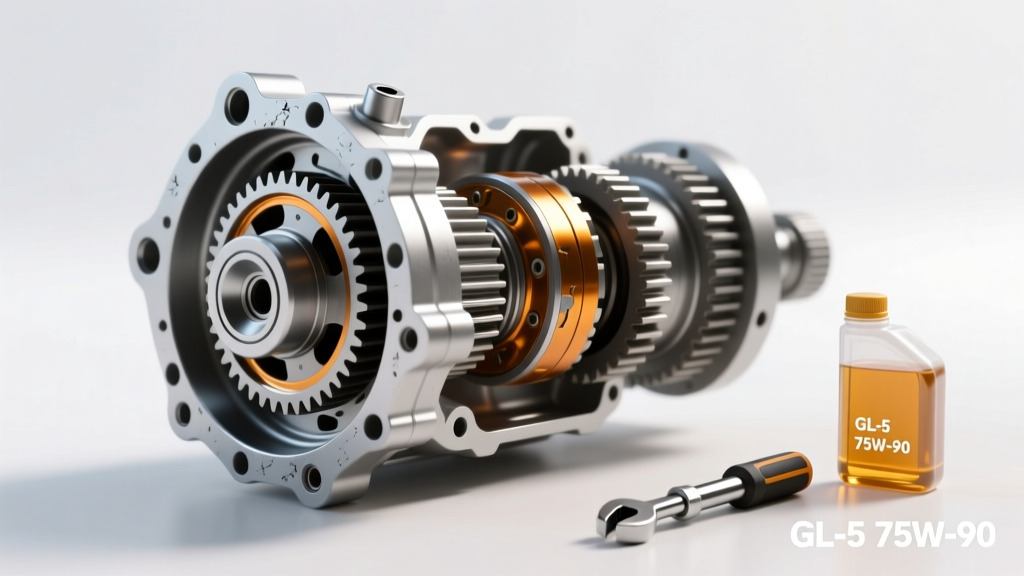
GL-5 gear oils contain roughly twice the amount of sulfur-phosphorus EP additives compared to GL-4. When the differential ring and pinion experience high-load sliding, local temperatures at the gear mesh can spike above 300°F (149°C). At these thresholds, the sulfur-phosphorus additives chemically react with the steel surface, creating a sacrificial solid-film layer that prevents the gears from welding together.
Expert Warning: Never use GL-5 gear oil in manual transmissions or transaxles that contain yellow metals (brass, bronze, or copper synchronizers), as the high sulfur content will corrode them. However, for the differential ring and pinion housed in a dedicated axle casing, GL-5 is an absolute requirement.
For a comprehensive understanding of how these lubricants are tested for shear stability and oxidation resistance, the Society of Automotive Engineers (SAE) maintains the J306 standard, which dictates the viscosity grading system (e.g., 75W-90) used by all major lubricant manufacturers.
2026 Buyer's Comparison: Top Synthetic Gear Oils
Not all synthetic gear oils are created equal. Base oil groups (Group III vs. Group IV/V PAO and Esters) dictate how well the fluid resists thermal breakdown. Below is our 2026 comparison chart of the top-tier synthetic gear oils designed to protect heavy-duty ring and pinion sets.
| Brand & Product | Part Number | Viscosity | Est. Price (Qt) | Base Oil & Additives | Best Application |
|---|---|---|---|---|---|
| Amsoil Severe Gear | SVGPK-EA | 75W-90 | $18.00 - $22.00 | PAO/Ester, High EP | Heavy Towing, Off-Road |
| Red Line 75W90 | 50304 | 75W-90 | $21.00 - $25.00 | Group V Polyol Ester | Track Use, Shock Loads |
| Mobil 1 Synthetic LS | 104361 | 75W-90 | $14.00 - $17.00 | Group III/IV, LS Mod | Daily Driving, Light Towing |
| Royal Purple Max Gear | 01501 | 75W-90 | $19.00 - $23.00 | Synerlec Additive Tech | High-Performance Street |
Deep Dive: Red Line vs. Amsoil for Severe Duty
When protecting a differential ring and pinion under severe shock loads—such as rock crawling or drag racing—Red Line 50304 is a favorite among drivetrain engineers. According to Red Line Oil's Technical Department, their use of Group V polyol ester base stocks provides a naturally high film strength that clings to gear teeth even when gravity and centrifugal forces try to pull the oil away from the mesh point.
Conversely, Amsoil Severe Gear 75W-90 excels in sustained high-heat environments, like pulling a 12,000-lb trailer up a 6% grade. Its proprietary antioxidant package prevents the fluid from varnishing and sludging over 50,000 miles of severe service, maintaining its viscosity index far longer than standard Group III synthetics.
Viscosity Selection: 75W-90 vs. 75W-140
Viscosity is the single most important physical property of gear oil. The SAE J306 standard measures kinematic viscosity at 100°C (212°F).
- 75W-90: The OEM standard for 90% of modern light-duty trucks and SUVs (e.g., Ford F-150, Ram 1500, Toyota Tacoma). It provides excellent cold-weather flow, reducing parasitic drag and improving fuel economy, while maintaining a sufficient protective film for the differential ring and pinion during normal towing and daily driving.
- 75W-140: Required for heavy-duty applications (e.g., Ford Super Duty Dana 80, Ram 2500 AAM 11.5). If you frequently tow near your Gross Combined Weight Rating (GCWR) or subject your axle to sustained track temperatures exceeding 250°F, stepping up to a 140-weight ensures the hydrodynamic film does not shear down to a dangerous level. Note: Using 75W-140 in a standard light-duty axle will increase rolling resistance, reduce fuel economy, and cause the differential to run hotter due to fluid churning.
The Limited-Slip Differential (LSD) Dilemma
If your axle houses a clutch-type limited-slip differential (such as the Ford Trac-Lok, Auburn LSD, or Eaton Positraction), the fluid you choose must address friction modulation. Clutch-type LSDs require a specific Friction Modifier (FM) additive to prevent the clutch packs from chattering and binding during low-speed cornering.
Products like Mobil 1 Synthetic Gear Lube LS (104361) and Royal Purple Max Gear come pre-mixed with friction modifiers, making them a convenient "fill-and-forget" solution. However, if you opt for a dedicated racing oil like Red Line, you must manually add a separate bottle of FM (typically 4 oz per axle). Pro-Tip: Gear-type LSDs, such as the Eaton Truetrac or Torsen, do not use clutch packs and therefore do not require friction modifiers. Standard GL-5 is perfectly safe and optimal for these units.
Break-In Procedures for New Ring and Pinion Sets
If you have just installed a new differential ring and pinion gear set, the first 500 miles are critical. The mating process of the gears generates microscopic metallic debris and immense heat. Follow this strict break-in protocol to ensure longevity:
- Initial Fill: Use a high-quality, non-synthetic GL-5 mineral gear oil for the break-in phase. Synthetics are too slippery and can prolong the mating process, leading to premature wear.
- First 500 Miles: Drive normally, but avoid sustained highway speeds over 65 MPH and avoid towing entirely. Allow the axle to cool down completely after every 100 miles of driving.
- The 500-Mile Drain: Drain the break-in fluid immediately. Inspect the magnetic drain plug (or differential cover magnet). A fine, glitter-like metallic paste is normal; large shards or chunks indicate improper gear backlash or bearing preload.
- Final Fill: Refill with your chosen premium synthetic gear oil (e.g., Amsoil Severe Gear 75W-90) to the bottom edge of the fill hole.
Service Specifications: Torque and Capacities
Proper servicing of the differential requires adherence to OEM torque specifications to prevent casing distortion and fluid leaks. Over-torquing the differential cover bolts on an aluminum or stamped-steel housing can warp the mating surface, leading to chronic leaks that starve the ring and pinion of lubrication.
- Ford 8.8-inch Axle: Cover bolts torque to 30-40 lb-ft. Fluid capacity is approximately 2.0 to 2.5 quarts. Fill plug (if equipped on aftermarket covers) is 15-30 lb-ft.
- Dana 60 Axle: Cover bolts torque to 35-45 lb-ft. Fluid capacity is 3.0 to 3.5 quarts. The 1/2-inch NPT fill/drain plugs should be torqued to 25-35 lb-ft. Always use Teflon tape or a liquid thread sealant on NPT plugs to prevent weeping.
- GM 9.5-inch (14-Bolt Semi-Floating): Cover bolts torque to 25 lb-ft. Capacity is roughly 2.75 quarts.
By understanding the chemical and physical demands placed on your axle, you can select a gear oil that actively defends your investment. Whether you are crawling over boulders in a Dana 60 or towing a fifth-wheel with a Ford 10.5-inch, the right synthetic GL-5 fluid is the ultimate insurance policy for your differential ring and pinion.