The Architecture Divide: Transverse FWD vs. Longitudinal RWD
In the 2026 automotive landscape, packaging efficiency and emissions regulations have cemented the transverse front-wheel drive (FWD) layout as the dominant architecture for passenger vehicles. However, when enthusiasts and technicians analyze the subaru brz drivetrain, they are looking at a radically different mechanical philosophy. The BRZ utilizes a longitudinal rear-wheel drive (RWD) layout, prioritizing weight distribution, steering feel, and dynamic balance over interior cabin space.
Understanding the fundamental differences in front-wheel drive system operation compared to a longitudinal RWD setup is critical for accurate symptom diagnosis. A misdiagnosed drivetrain vibration or clunk can lead to unnecessary parts replacement. This guide breaks down the mechanical operation of FWD systems, contrasts them with the Subaru BRZ’s RWD configuration, and provides a precise diagnostic framework for drivetrain troubleshooting.
Front-Wheel Drive System Operation & Power Flow
To diagnose FWD issues, you must first understand the power flow. In a transverse FWD vehicle (such as a Honda Civic or Toyota Corolla), the engine and transmission are mounted side-by-side in the engine bay. The transmission and differential are combined into a single unit known as a transaxle.
- Power Input: Torque from the engine crankshaft enters the transaxle input shaft.
- Gear Reduction: Power moves through the helical-cut gearset to the layshaft, providing the necessary gear reduction and torque multiplication.
- Differential Split: The layshaft drives an integrated ring and pinion gear. The differential splits the torque left and right to the front wheels, allowing them to rotate at different speeds during cornering.
- CV Axle Delivery: Power is transmitted to the wheels via Constant Velocity (CV) axles. These axles must accommodate both the up-and-down travel of the suspension and the side-to-side pivot of the steering knuckles.
The outer CV joint is typically a Rzeppa joint, utilizing six ball bearings in a cage to handle steering angles up to 47 degrees. The inner joint is usually a tripod (plunging) joint, which allows for the axial plunge required as the suspension compresses and the distance between the transaxle and the wheel hub changes. For a deeper dive into CV joint kinematics, refer to the engineering resources at GKN Driveline.
The Subaru BRZ Drivetrain Contrast
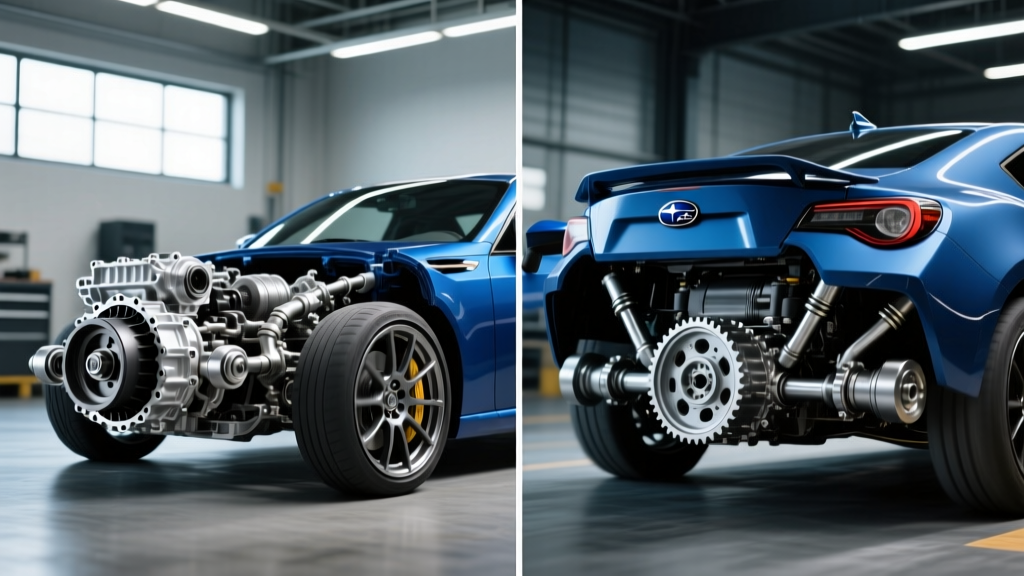
Unlike a FWD transaxle, the subaru brz drivetrain routes power longitudinally. The FA24 2.4L Boxer engine feeds torque rearward through a bellhousing into a dedicated transmission—either the TL70 6-speed manual or the A960E 6-speed automatic. From the transmission output shaft, power travels through a two-piece aluminum and steel propshaft (driveshaft) supported by a center bearing, finally reaching a rear-mounted hypoid differential. The rear axles utilize CV joints, but because the rear wheels do not steer, the steering-angle articulation requirements are vastly reduced compared to a FWD front axle.
Symptom Diagnosis Matrix: FWD vs. BRZ RWD
Because the power delivery paths differ entirely, identical symptoms often point to completely different failed components. Use the diagnostic matrix below to isolate drivetrain faults.
| Symptom | FWD System Diagnosis | Subaru BRZ Drivetrain Diagnosis |
|---|---|---|
| Rhythmic clicking on tight turns | Worn outer Rzeppa CV joint (boot failure leading to grease loss and contamination). | N/A (Rear wheels do not steer). Check front wheel bearings or strut top mounts. |
| Clunk on load reversal (accel to decel) | Worn inner tripod joint plunge mechanism, excessive transaxle backlash, or collapsed engine/trans mount. | Worn propshaft U-joints, failing center support bearing, or rear differential gear lash (Torsen LSD wear). |
| High-speed vibration (65+ mph) | Unbalanced front tires, bent CV axle shaft, or warped transaxle output flange. | Unbalanced propshaft, degraded propshaft center support bearing, or pinion flange runout. |
| Binding / Hopping on low-speed turns | Incorrect FWD differential fluid, or failing viscous coupling (if equipped AWD system). | Normal characteristic of the mechanical Torsen LSD (Manual transmission models) when cold, or incorrect rear diff fluid. |
| Torque Steer under hard acceleration | Unequal half-shaft lengths causing unequal torsional wind-up; worn lower control arm bushings. | N/A (RWD platform). If pulling occurs, check rear suspension toe-alignment or staggered tire wear. |
Deep Dive: CV Joint Failures vs. U-Joint Degradation
In FWD applications, the most common drivetrain failure is the outer CV joint. When the rubber CV boot tears, centrifugal force expels the molybdenum disulfide grease, and water/grit enters the joint. The diagnostic hallmark is a sharp click-click-click during full-lock steering maneuvers. Replacement requires a new CV axle assembly (typically $150–$350 for aftermarket, $400–$800 OEM).
Conversely, the subaru brz drivetrain relies on traditional Spicer-style Universal Joints (U-joints) at the propshaft connections. U-joints do not handle continuous high-angle articulation like CV joints; they operate at shallow angles. When U-joints fail due to lack of lubrication or needle-bearing brinelling, the symptom is a metallic clunk when shifting from Drive to Reverse, or a high-frequency squeak at idle that correlates with driveshaft rotation. For high-quality replacement U-joints and yoke specifications, technicians frequently reference Spicer Drivetrain Components.
Precision Troubleshooting: Torque Specs and Fluid Data
Proper diagnosis often involves pulling fluid samples or removing drivetrain components for bench inspection. Adhering to exact torque specifications is vital to prevent catastrophic failure, particularly in high-load RWD differentials and FWD transaxle mounts.
| Component / Specification | Typical FWD Transaxle / Axle | Subaru BRZ Drivetrain (2nd Gen / FA24) |
|---|---|---|
| Axle Nut Torque (Front/Rear) | 180 - 250 lb-ft (Front FWD Axle) | 140 lb-ft (190 Nm) - Rear Axle Nut |
| Differential Drain/Fill Plug | N/A (Integrated into transaxle) | 36 lb-ft (49 Nm) |
| Propshaft to Diff Flange Bolts | N/A | 27 lb-ft (37 Nm) |
| Fluid Type & Capacity (Manual) | 75W-80 GL-4 (Approx. 1.5 - 2.0L) | GL-5 75W-90 (Approx. 2.2L for TL70 6MT) |
| Rear Diff Fluid Type & Capacity | N/A | GL-5 75W-90 (Approx. 0.9L) |
The Importance of Correct Fluid Chemistry
A frequent troubleshooting error in FWD vehicles is using GL-5 gear oil in a transaxle that requires GL-4. GL-5 contains high levels of sulfur-phosphorus extreme pressure (EP) additives which can corrode the yellow metals (brass/bronze synchronizers) inside a manual FWD transaxle.
In the subaru brz drivetrain, the rear differential is a separate hypoid gear unit that absolutely requires GL-5 75W-90 to protect the high-sliding-contact surfaces of the ring and pinion. Furthermore, if diagnosing a manual TL70 transmission, Subaru specifies a proprietary fluid (or specific GL-5 equivalent depending on the exact service bulletin year) to ensure the carbon synchronizers engage smoothly. Always verify current service data via the Subaru Technical Information System (TIS) before performing fluid services.
Common Misconceptions: Is There a FWD Subaru BRZ?
A surprisingly common search query from novice enthusiasts is whether a FWD version of the BRZ exists. The answer is a definitive no. The Subaru BRZ, developed in partnership with Toyota (sharing the GR86 platform), was engineered from the ground up as a lightweight, front-engine, rear-wheel-drive sports car.
While Subaru is globally famous for its Symmetrical All-Wheel Drive (AWD) systems found in the WRX, Crosstrek, and Outback, the BRZ intentionally omits the front differential, front CV axles, and center differential to save weight and lower the center of gravity. If you are diagnosing a front-end vibration on a BRZ, you are strictly looking at steering, suspension, or wheel bearing issues—not a FWD drivetrain fault.
Summary
Mastering drivetrain diagnosis requires recognizing the architectural boundaries of the vehicle. Front-wheel drive system operation relies heavily on complex CV joints and integrated transaxles to manage steering and suspension articulation simultaneously. In contrast, the subaru brz drivetrain separates these duties, utilizing a longitudinal propshaft and U-joints to deliver power, and dedicated rear CV axles for suspension compliance. By matching the specific symptom—be it a steering click, a load-reversal clunk, or a high-speed vibration—to the correct mechanical layout, technicians can eliminate guesswork and execute precise, cost-effective repairs.