The Great Layout Divide: Automotive vs. Motorcycle Architecture
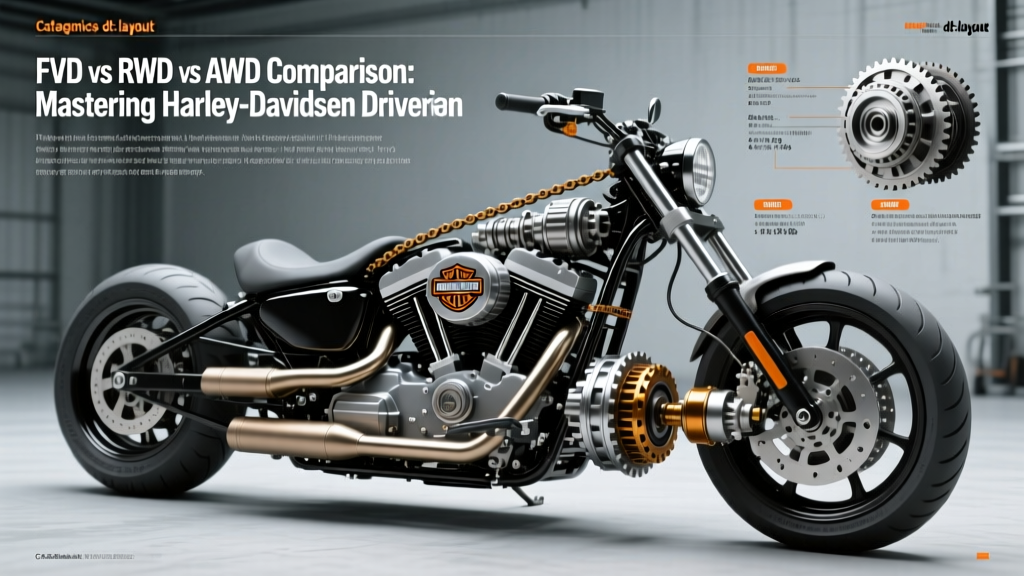
For automotive technicians and advanced DIYers transitioning into motorcycle maintenance, the paradigm shift in drivetrain engineering is profound. When analyzing the fundamental differences in a FWD vs RWD vs AWD comparison, automotive platforms rely on enclosed, fluid-coupled, and heavily synchronized systems. However, mastering the Harley-Davidson drivetrain requires unlearning automotive assumptions and embracing a longitudinal, three-stage rear-wheel-drive (RWD) architecture that exposes its mechanical linkages to the elements.
In 2026, the Milwaukee-Eight (M8) 114 and 117 cubic-inch powertrains represent the pinnacle of Harley-Davidson’s air/oil-cooled V-Twin evolution. Unlike a transverse automotive FWD transaxle that turns power 90 degrees through a hypoid gearset, or an AWD system that relies on a transfer case and viscous couplers to manage front-to-rear slip, the Harley-Davidson RWD layout is a linear, solid-state power delivery system. This guide bridges the gap between automotive drivetrain theory and the precise, model-specific repair procedures required for modern Harley-Davidson touring and softail platforms.
FWD vs RWD vs AWD vs Harley-Davidson Drivetrain Matrix
To understand the repair methodology, we must first compare the mechanical forces and component layouts across the major drivetrain configurations.
| Layout Type | Power Transfer Path | Differential | Primary Fluid / Lubrication | Common Failure Point |
|---|---|---|---|---|
| FWD (Automotive) | Transverse engine to transaxle, CV axles | Integrated Transaxle | 75W-90 Gear Oil / ATF | CV Joint boot failure, axle bind |
| AWD (Automotive) | Longitudinal/Transverse, Transfer Case, F/R Diffs | Front, Rear, Center | Specific Transfer/Diff Fluids | U-joint wear, clutch pack degradation |
| RWD (Automotive) | Longitudinal, Tubular Driveshaft, Rear Diff | Rear Axle Only | 75W-140 Synthetic Gear Oil | Pinion seal leaks, U-joint phasing |
| Harley-Davidson RWD | Longitudinal V-Twin, Primary Chain, 6-Speed, Belt | None (Solid Swingarm) | Formula+ / Syn3 (Primary) | Compensator wear, belt edge-loading |
Model-Specific Repair Guide: Milwaukee-Eight (M8) RWD Configuration
The Harley-Davidson drivetrain is effectively three separate components bolted together: the primary chaincase, the transmission, and the secondary belt drive. Repairing this system requires specific torque sequences and alignment protocols that do not exist in FWD or AWD automotive applications.
Stage 1: The Primary Chaincase (The "Transaxle" Equivalent)
In an automotive FWD layout, the clutch (if manual) and transmission share a single bell housing and fluid bath. On a Harley-Davidson, the primary chaincase houses the engine compensator, the primary chain, and the wet clutch assembly. According to Harley-Davidson’s official service documentation, the M8 primary requires precise fluid volume management to prevent clutch slippage or chain starvation.
- Fluid Specification: Screamin’ Eagle Formula+ Transmission and Primary Chaincase Lubricant or SYN3 Full Synthetic.
- Capacity (Touring Models): Exactly 32 oz (946 ml). Overfilling will cause the fluid to aerate and blow past the primary seal.
- Primary Chain Deflection: 3/8" to 1/2" (9.5mm - 12.7mm) of up-and-down play measured at the midpoint of the lower chain run with the engine cold.
- Compensator Sprocket Torque: The M8 compensator nut (Part No. 42200115) requires a massive 165-185 ft-lbs of torque, secured with Red Loctite 271. Failure to achieve this spec results in the compensator backing off and destroying the primary case.
Stage 2: The 6-Speed Cruise Drive Transmission
Automotive RWD and AWD systems utilize complex planetary gearsets (automatics) or synchronized dog gears (manuals). The Harley 6-speed Cruise Drive is a constant-mesh, dog-ring engaged transmission. There are no synchros to wear out, but the shift forks and mainshaft bearings are highly sensitive to lateral play.
When performing a mainshaft seal replacement or clutch hub service, the transmission mainshaft nut must be torqued to 150-165 ft-lbs. Unlike automotive axle nuts which often use a staked-collars or torque-to-yield stretch method, the Harley mainshaft relies on a precise thread-locker application and a specific washer configuration to maintain preload on the tapered roller bearings. If you are migrating from automotive AWD transfer case rebuilds, note that Harley transmission shims are measured in thousandths of an inch; a 0.003" error in end-play will lead to catastrophic gear walk at highway speeds.
Stage 3: Secondary Belt Drive (The "Driveshaft" Equivalent)
This is where the FWD vs RWD vs AWD comparison highlights the most drastic divergence. An automotive RWD system uses a tubular steel driveshaft with U-joints that allow for suspension articulation. An AWD system adds a front differential and CV axles. The Harley-Davidson drivetrain utilizes a Kevlar-reinforced Gates Poly Chain HTD belt. Because there is no differential and the rear wheel is fixed to a solid swingarm, the belt must endure massive shock loads during aggressive clutch engagement.
According to Gates industrial belt specifications, motorcycle belt drives require exact tensioning to prevent cord failure or pulley wear.
- Belt Deflection Spec: 1/4" to 5/16" (6.3mm - 7.9mm) when applying exactly 10 lbs (44.5 N) of downward force on the bottom belt run.
- Alignment: Unlike a chain, a belt cannot tolerate lateral misalignment. A misaligned rear pulley will cause the belt to track against the inner or outer flange, leading to immediate edge-fraying. Always use a laser pulley alignment tool rather than relying on the swingarm hash marks.
- Rear Axle Nut Torque: 95-105 ft-lbs. Ensure the axle adjuster cams are perfectly mirrored on both sides of the swingarm to maintain belt tracking.
Diagnostic Translation: NVH (Noise, Vibration, Harshness)
When diagnosing drivetrain NVH, automotive technicians are trained to look for U-joint harmonics in RWD setups or transfer-case binding in AWD setups. The Harley-Davidson drivetrain presents a unique NVH profile that frequently leads to misdiagnosis by those accustomed to automotive layouts.
Expert Diagnostic Tip: If you feel a rhythmic "clunk" or surge at low RPMs (1,800 - 2,200 RPM) that mimics a failing automotive torque converter or a bad AWD center differential, you are likely experiencing compensator sprocket wear or primary chain stretch. The M8 compensator is designed to absorb the extreme torsional pulses of a 45-degree V-Twin. When its internal springs fatigue, the torsional energy transfers directly into the transmission mainshaft, causing premature bearing failure.
Furthermore, high-frequency whining that sounds like an automotive differential gear whine is almost always traced to the secondary belt drive. A belt that is tensioned beyond the 1/4" deflection spec will place extreme lateral loads on the transmission output shaft bearing (Part No. 8983) and the rear wheel bearings. In the automotive world, over-tensioning a serpentine belt damages the alternator bearing; on a Harley, over-tensioning the drive belt will literally split the transmission case or crush the inner race of the rear wheel bearing.
Conclusion: Respecting the Longitudinal RWD Layout
While the FWD vs RWD vs AWD comparison is essential for understanding automotive power distribution, the Harley-Davidson drivetrain demands a specialized, model-specific approach. By treating the primary chaincase, the 6-speed transmission, and the secondary belt drive as three distinct, interdependent systems rather than a single unified transaxle, technicians can achieve OEM-level reliability. Always refer to the latest OEM and aftermarket service manuals for year-specific torque updates, especially as Harley-Davidson continues to refine the Milwaukee-Eight platform through the 2026 model year. Proper fluid volumes, strict adherence to belt deflection metrics, and precision compensator torquing are the keys to mastering this iconic American RWD architecture.