The Convergence of Automotive and Micro-Mobility Drivetrains
As of 2026, the boundary between high-performance automotive repair and elite micro-mobility maintenance has blurred. Boutique performance shops increasingly service both internal combustion track cars and high-end electric mountain bikes (e-MTBs). Understanding the mechanical nuances, parasitic losses, and repair protocols across different platforms is essential for the modern drivetrain specialist. This model-specific repair guide compares the transverse Front-Wheel Drive (FWD) layout of the Honda Civic Type R, the longitudinal Rear-Wheel Drive (RWD) architecture of the BMW M2, the symmetrical All-Wheel Drive (AWD) system of the Subaru WRX, and the mechanical paradigm of the SRAM drivetrain (specifically the XX1 Eagle AXS) found on premium e-MTBs.
While a car and a bicycle operate on vastly different scales, the fundamental physics of torque multiplication, chainline deflection, and gear reduction remain identical. Below, we break down the exact repair procedures, torque specifications, and failure modes for each layout.
Transverse FWD: Honda Civic Type R (FK8) Transaxle
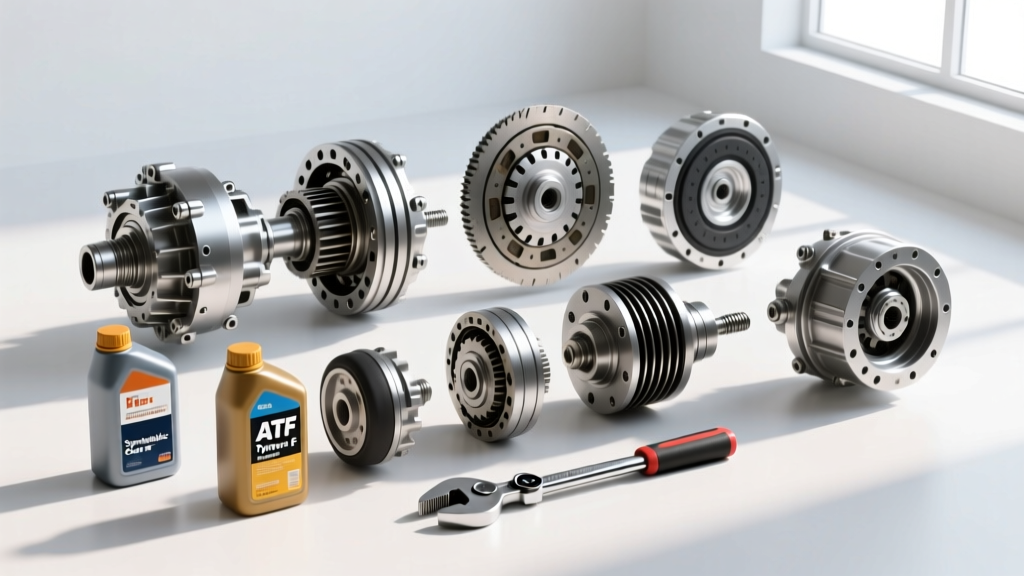
The FWD layout packages the transmission and differential into a single transaxle unit mounted transversely across the engine bay. In the Honda Civic Type R, this means a 6-speed manual transmission mated to a helical limited-slip differential (LSD). The primary engineering challenge here is managing torque steer and packaging equal-length or optimized half-shafts.
Common Failure Modes & Repair Protocol
The most frequent repair on the FK8 transaxle involves the outer Constant Velocity (CV) joints and the staked axle nuts. Because FWD vehicles handle both steering and power delivery, the outer CV joints endure extreme articulation angles.
- Fluid Specification: Honda Genuine MTF (Manual Transmission Fluid). Do not use standard 75W-90 gear oil, as it lacks the friction modifiers required for the helical LSD and synchronizers.
- Capacity: 1.9 Liters.
- Axle Nut Torque: 180 Nm (133 lb-ft) plus an additional 90-degree turn. Note: Honda axle nuts are staked and must be replaced upon removal.
- Driveshaft Play: Radial play in the inner tripod joint exceeding 2mm indicates worn roller bearings, requiring a complete half-shaft replacement (Part # 44300-TGH-A01).
Longitudinal RWD: BMW M2 (G87) and the ZF 8HP
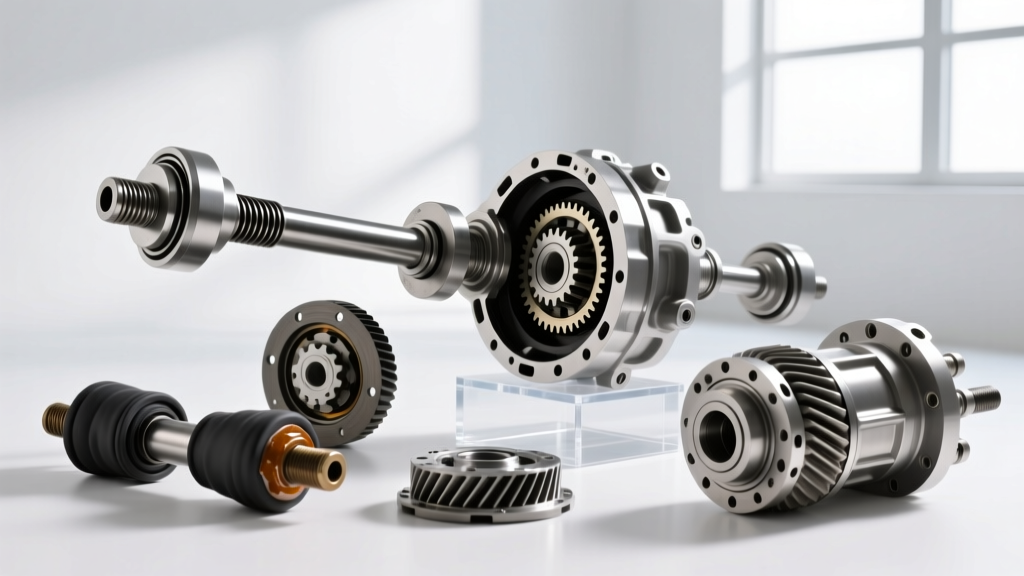
Rear-Wheel Drive separates the transmission from the final drive, connecting them via a multi-piece driveshaft. The BMW M2 utilizes the legendary ZF 8HP76 8-speed automatic transmission, sending power to an Active M Differential. This layout eliminates torque steer and allows for optimal front-to-rear weight distribution, but introduces rotational mass and U-joint/phasing complexities.
Driveshaft Guibo and Differential Service
The weak link in the BMW RWD drivetrain is not the ZF transmission, but the flex disc (guibo) and the rear differential fluid degradation under high thermal loads.
- Guibo Replacement: The rubber flex disc absorbs torsional vibrations from the S58 engine. Cracking or chunking requires immediate replacement. The M10 bolts securing the guibo to the transmission output flange must be torqued to 100 Nm (74 lb-ft).
- Differential Fluid: The Active M Differential requires BMW SAF-XJ 75W-140. Capacity is approximately 1.2 Liters.
- Fill Procedure: Unlike automotive transaxles, the ZF 8HP and BMW diffs require a strict temperature-dependent fill procedure. The fluid must be between 30°C and 50°C when the final level check is performed, as outlined in the ZF Friedrichshafen AG technical documentation.
Symmetrical AWD: Subaru WRX (VA) Power Distribution
AWD systems multiply the complexity of RWD by adding a transfer case, a center differential, and a front final drive. The Subaru WRX features a symmetrical AWD layout with a Driver Controlled Center Differential (DCCD) in its 6-speed manual variant. Power is split longitudinally, reducing the extreme driveshaft angles seen in transverse-based AWD systems (like the Haldex-based VW Golf R).
Center Differential and Gear Oil Degradation
The DCCD uses a combination of mechanical and electromagnetic clutches to vary the front/rear torque split. Failure to service the gear oil leads to clutch pack glazing and erratic torque distribution.
- Front/Rear Differential Fluid: 75W-90 GL-5 Gear Oil.
- Capacity: Front: ~1.2L | Rear: ~0.8L.
- Propeller Shaft U-Joints: Subaru uses staked U-joints on the rear propeller shaft. If vibration occurs under load at 70+ mph, the entire propeller shaft assembly often requires replacement, as aftermarket U-joint kits are rarely available for OEM Subaru shafts.
- Transfer Case Torque: The extension housing bolts securing the transfer case to the 6MT must be torqued to 37 Nm (27 lb-ft) using a star-pattern sequence to prevent case warping.
Engineering Insight: Parasitic loss in AWD systems typically ranges from 15% to 20% due to the additional gear meshes in the center differential and the rotational inertia of the front axles. By contrast, a well-maintained RWD system loses roughly 10-12%, and FWD loses about 8-10% due to the compact transaxle design.
The SRAM Drivetrain Paradigm: XX1 Eagle AXS
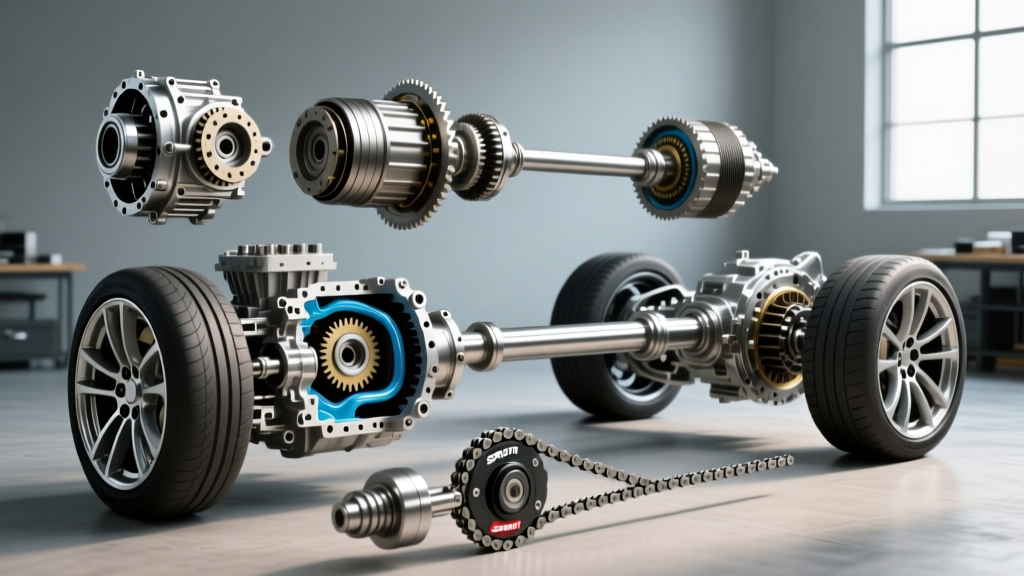
How does a high-end bicycle drivetrain compare to automotive architectures? The SRAM drivetrain, specifically the wireless XX1 Eagle AXS 12-speed system, represents the pinnacle of micro-mobility power transfer. Instead of a transaxle or a driveshaft, it relies on a single chainline, a massive 10-52T cassette, and a electronically actuated rear derailleur. For automotive technicians crossing over to e-MTB repair, the tolerances are exponentially tighter.
Precision Alignment and Torque Specifications
While an automotive CV joint can tolerate several degrees of operating angle, a SRAM drivetrain demands millimeter-perfect chainline alignment. A misaligned derailleur hanger by just 1.5mm will cause catastrophic shifting failure under the 90Nm+ of torque generated by an e-MTB motor.
- Cassette Lockring Torque: The XD driver body cassette lockring must be torqued to exactly 40 Nm (354 in-lb). Under-torquing leads to spline gouging; over-torquing crushes the aluminum hub shell.
- Derailleur Mounting Bolt: The M8 bolt securing the rear derailleur to the hanger requires 10-12 Nm.
- Chain Wear Limits: Unlike automotive timing chains that stretch over 100,000 miles, a SRAM Eagle chain must be replaced when it reaches 0.5% elongation (measured with a specialized chain checker tool). Waiting until 0.75% will destroy the $500+ cassette.
According to the SRAM Technical Service Manual, the B-tension (chain gap) must be set precisely to 15mm using the proprietary setup tool, ensuring the upper jockey wheel does not collide with the 52T cog under full suspension compression.
Comparative Layout Data & Repair Economics
Below is a 2026 market analysis comparing the mechanical efficiency, primary failure points, and average repair costs across these four distinct drivetrain layouts.
| Layout / Model | Parasitic Loss | Primary Failure Point | Service Interval | Avg. Repair Cost (2026) |
|---|---|---|---|---|
| FWD (Civic Type R) | 8% - 10% | Outer CV Joints / Axle Seals | 30,000 miles | $450 - $800 |
| RWD (BMW M2 ZF 8HP) | 10% - 12% | Guibo / Diff Clutches | 60,000 miles | $1,200 - $2,500 |
| AWD (Subaru WRX DCCD) | 15% - 20% | Center Diff / Prop Shaft | 30,000 miles | $1,500 - $3,200 |
| SRAM Drivetrain (XX1) | 2% - 4% | Chain Elongation / Hanger | 500 - 1,000 miles | $150 - $350 |
Cross-Disciplinary Troubleshooting Framework
Whether you are diagnosing a vibration in a BMW M2 driveshaft or a skipping chain on a SRAM Eagle e-MTB, the diagnostic framework remains rooted in mechanical empathy:
- Isolate the Load: Does the issue occur under acceleration, deceleration, or coasting? (e.g., AWD center diff bind vs. SRAM B-tension misalignment).
- Measure Deflection: Use dial indicators for automotive U-joint runout (max 0.05mm) and alignment gauges for bicycle derailleur hangers (max 0.25mm variance).
- Verify Fluid/Lubricant Chemistry: Never substitute Honda MTF with synthetic 75W-90, and never use wet chain lube on a SRAM AXS chain in dry conditions. The tribology of the lubricant dictates the lifespan of the friction materials.
Mastering the repair protocols of both macro-automotive and micro-mobility drivetrains positions the modern technician at the forefront of the 2026 performance repair industry. Understanding the SRAM drivetrain alongside traditional FWD, RWD, and AWD systems proves that whether moving 4,000 pounds of steel or 50 pounds of carbon fiber, the laws of torque and friction remain absolute.