Introduction to F-350 Super Duty Front Axle Maintenance
The Ford F-350 Super Duty is engineered for extreme workloads, from towing heavy fifth-wheel trailers to pushing commercial snow plows. While the rear Sterling 10.5 or 10.25 axle often gets the most attention, the front differential endures immense mechanical stress. When engaged in four-wheel drive, the front axle must simultaneously manage steering geometry, suspension articulation, and drivetrain torque. Neglecting the gear oil in this critical component can lead to catastrophic ring and pinion failure, bearing disintegration, and axle shaft binding.
One of the most common questions among Super Duty owners and fleet mechanics revolves around the exact Ford F350 front differential fluid capacity and the correct service procedures. Because Ford has utilized several different front axle configurations over the decades—most notably the legendary Dana 60, the older Dana 50, and the Ford 9.75-inch Independent Front Suspension (IFS)—the specifications and service methods vary significantly. This comprehensive guide will break down the exact capacities, service intervals, and a professional-grade step-by-step procedure to keep your front drivetrain operating flawlessly.
Determining Your Ford F350 Front Differential Fluid Capacity
Before purchasing gear oil, you must identify which front axle is bolted to your F-350. The fluid capacity is relatively small compared to the rear differential, but using the correct volume and viscosity is non-negotiable for proper gear lubrication and heat dissipation. Below is the definitive reference chart for F-350 front axle specifications.
| Axle Model | Application Years | Fluid Capacity | Recommended Viscosity |
|---|---|---|---|
| Dana 60 (Solid Axle) | 2005-2016, 2020+ | 3.0 - 3.5 Pints (approx. 1.75 Qt) | SAE 75W-90 Synthetic |
| Ford 9.75" IFS | 2017-2019 (Select Configs) | 3.3 Pints (approx. 1.65 Qt) | SAE 75W-90 Synthetic |
| Dana 50 (Solid Axle) | 1999-2004 | 3.5 Pints (approx. 1.75 Qt) | SAE 80W-90 or 75W-90 |
Expert Note: Unlike the rear axle, which frequently features a Limited Slip (LS) differential requiring a friction modifier additive, the front differential on almost all F-350s is an open differential or a manual locking differential. Do not add friction modifier to the front differential. Doing so can compromise the protective film strength of the gear oil on the ring and pinion teeth. For OEM-spec fluid, we recommend Motorcraft SAE 75W-90 Premium Synthetic Gear Lubricant (Part # XL-2).
Recommended Service Intervals
According to the Ford Scheduled Maintenance Guide, the front differential fluid is often categorized under 'inspect' during routine services, but proactive changes are vital for longevity.
- Normal Service (Highway/Commuting): Replace every 150,000 miles. Synthetic gear oils are highly resilient, but the additive packages eventually deplete.
- Severe Service (Towing, Plowing, Off-Road): Replace every 30,000 to 50,000 miles. The front axle generates massive heat when pushing a plow or pulling heavy loads up steep grades in 4-Low.
- Water Ingestion Event: Replace immediately. The front axle vent tube is located high on the pumpkin, but deep water crossings, heavy snow banks, or pressure washing can force water past the axle seals or vent. If the fluid looks like a milky chocolate shake, water has compromised the oil, and internal corrosion will begin within days.
Tools and Materials Required
To execute this service like a professional drivetrain technician, gather the following tools and materials. Budget approximately $60 to $85 for this service if doing it yourself.
- Gear Oil: 2 Quarts of SAE 75W-90 Synthetic (e.g., Motorcraft XL-2, Amsoil Severe Gear, or Red Line 75W90).
- Fluid Transfer Pump: A manual hand-pump that threads onto standard quart bottles (crucial for Dana 60s without drain plugs).
- Drive Tools: 3/8-inch square drive ratchet or breaker bar (for the fill plug).
- Cleaning Supplies: Brake cleaner, lint-free shop towels, and a wire brush.
- Sealant (If dropping cover): Permatex Ultra Black RTV Silicone (Part #81173) and a gasket scraper.
- Torque Wrench: Capable of measuring 30-40 lb-ft.
Step-by-Step Front Differential Fluid Change Procedure
The procedure varies slightly depending on whether your specific axle casting features a dedicated bottom drain plug. Many 2005+ Dana 60 axles do not have a drain plug, requiring either the removal of the differential cover or the use of a fluid extraction pump. We highly recommend the extraction pump method for routine changes, as it eliminates the need to scrape RTV silicone and prevents future cover leaks.
Step 1: Preparation and Axle Warming
Park your F-350 on a flat, level surface. Chock the rear wheels and engage the parking brake. To ensure the old, viscous gear oil flows out easily and carries suspended metallic particulates with it, drive the truck for 10 to 15 minutes to warm up the front axle assembly. Safely raise the front end using a floor jack and support it with heavy-duty jack stands rated for at least 6 tons.
Step 2: Accessing and Cleaning the Fill Plug
Locate the fill plug on the front of the differential housing or on the driver-side axle tube, depending on the year. It will typically require a 3/8-inch square drive to remove. Before removing the plug, use a wire brush and brake cleaner to thoroughly scrub the area around the plug. You do not want dirt or road grime falling into the differential once the plug is pulled.
Step 3: Extracting or Draining the Old Fluid
Method A: The Extraction Pump (Preferred for No-Drain Plug Axles)
Remove the fill plug. Insert the suction tube of your manual fluid extractor pump all the way to the bottom of the differential housing. Pump the handle to draw out the old 75W-90 oil into a waste container. Move the tube around the bottom of the housing to pull out any settled sludge or metallic shavings. Continue until no more fluid can be extracted.
Method B: The Cover Drop (For Older Models or Inspection)
If your axle has a drain plug, remove it and let the fluid drain into a pan. If it lacks a drain plug and you prefer to drop the cover, place a drain pan underneath. Use a socket to loosen the cover bolts in a crisscross pattern. Leave the top two bolts slightly threaded, then use a flathead screwdriver or gasket scraper to break the RTV seal at the bottom. Let the fluid drain, then remove the final bolts and the cover. Scrape all old RTV from the housing and cover using a plastic scraper to avoid gouging the mating surfaces.
Step 4: Inspection and Reassembly
If you dropped the cover, inspect the ring and pinion gears. A fine, glitter-like metallic paste on the magnet or cover is normal wear. However, if you find large metal chips, cracked gear teeth, or excessive backlash play, you need a professional differential rebuild. Clean the inside of the housing with brake cleaner and lint-free towels. Apply a continuous 1/4-inch bead of Permatex Ultra Black RTV to the cover, wait 10 minutes for it to skin over, and reinstall. Torque the cover bolts to 30 lb-ft in a star pattern.
Step 5: Refilling to the Correct Capacity
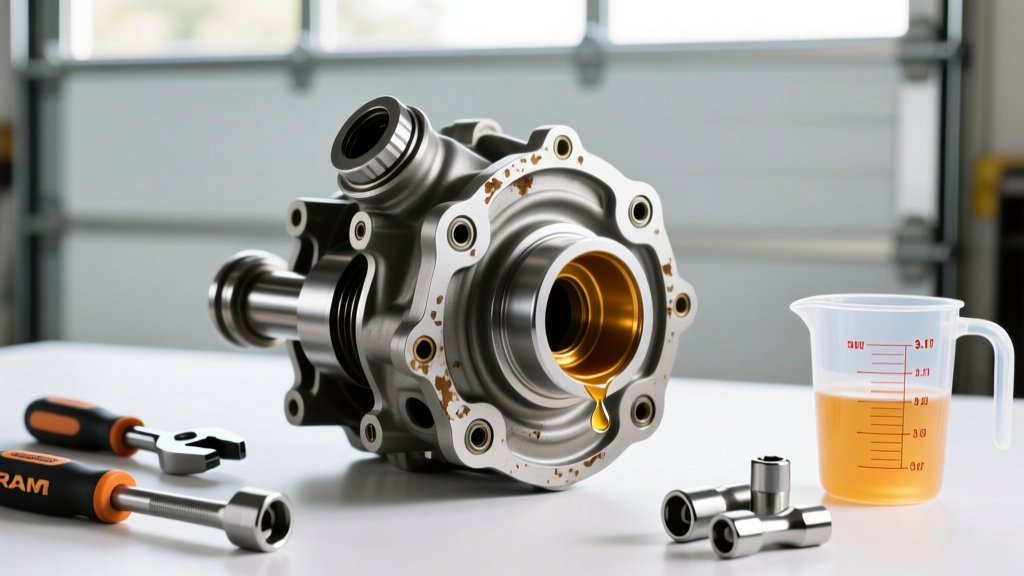
Thread your fluid transfer pump onto the new bottle of 75W-90 synthetic gear oil. Insert the hose into the fill hole and pump the new fluid into the differential. The correct Ford F350 front differential fluid capacity is reached when the gear oil begins to weep out of the bottom threads of the fill hole. This typically takes between 1.5 and 1.75 quarts. Once the fluid levels out and stops dripping, wipe the threads clean and reinstall the fill plug. Torque the fill plug to 35 lb-ft.
Troubleshooting Common F-350 Front Axle Issues
While performing the fluid change, take the opportunity to inspect related front drivetrain components. The Dana Spicer axle experts note that front-end noise is often misdiagnosed as internal differential failure when it is actually an external component.
- Clicking During Turns in 4WD: This is rarely the differential. It is almost always a failing outer axle shaft U-joint or a binding manual locking hub assembly. Remove the hub lockout and inspect the needle bearings.
- Whining That Changes with Load: A whine that changes pitch on deceleration vs. acceleration indicates worn ring and pinion gear teeth or incorrect backlash setup. This requires a teardown and shim adjustment.
- Clunking When Engaging 4WD: Check the transfer case shift motor, the front driveshaft slip yoke, and the axle engagement collar inside the differential housing.
Expert Tips for Longevity
To maximize the lifespan of your F-350's front differential, consider installing an aftermarket differential cover with integrated cooling fins and a magnetic drain plug (if your casting allows for drilling and tapping). Brands like Mag-Hytec or BDS Suspension offer heavy-duty covers that increase fluid capacity by up to half a quart, drastically reducing operating temperatures during heavy towing. Additionally, ensure your front axle vent tube is routed securely behind the grille or high up on the frame rail to prevent water ingestion during off-road excursions or deep snow removal. By adhering to these precise fluid capacities and service intervals, your Super Duty's front axle will reliably transfer torque for hundreds of thousands of miles.