The transition to the CD6 platform fundamentally altered the long-term maintenance profile of Ford’s flagship three-row SUV. When evaluating the 2025 Ford Explorer standard drivetrain, RWD or AWD configurations present vastly different mechanical realities, particularly regarding half-shaft longevity and constant velocity (CV) joint wear. Unlike the previous front-wheel-drive-biased D4 architecture, the current rear-wheel-drive-biased setup shifts the primary drivetrain load to the rear axles, while AWD models introduce a complex front Power Transfer Unit (PTU) and front CV half-shafts into the equation.
Executive Cost Summary: Replacing a single rear CV axle on a 2025 Explorer RWD averages $450–$680 at a dealership, utilizing OEM Motorcraft components. AWD models face a compounded 'maintenance tax,' with front CV axle replacements ranging from $520–$750 per side due to PTU integration and tighter steering knuckle clearances. Over a 100,000-mile lifecycle, AWD drivetrains carry a 65% higher probability of CV joint service events compared to their RWD counterparts.
The CD6 Platform: How Architecture Dictates CV Wear
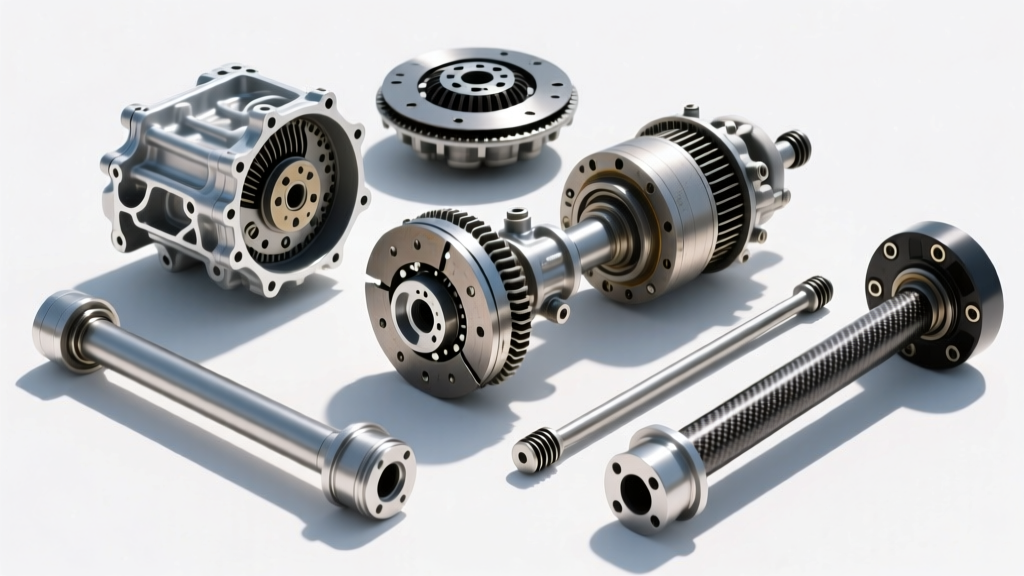
To understand the cost analysis of CV joint problems, we must first look at the 10R60 and 10R80 10-speed automatic transmissions that mate to the Explorer’s EcoBoost and naturally aspirated powertrains. In the standard RWD configuration, the rear differential receives direct torque via a two-piece driveshaft, meaning the rear CV axles (half-shafts) are under constant, high-torque load. The outer Rzeppa joints manage the steering articulation, while the inner tripod joints handle the plunging motion required for rear suspension travel.
However, when the Intelligent 4WD/AWD system engages, the front CV axles are subjected to aggressive torque spikes. The most common failure mode for the 2025 Explorer AWD front axles is not normal wear, but rather thermal degradation of the molybdenum disulfide grease inside the inner tripod housing, caused by proximity to the exhaust downpipes and the PTU’s inherent heat generation.
2025 Explorer CV Axle Cost Breakdown Matrix
The following data table outlines the real-world replacement costs for CV axle assemblies across the 2025 Explorer lineup. Labor rates are calculated using a national dealer average of $165/hour, while independent shop rates average $135/hour.
| Component / Configuration | OEM Part Cost (Motorcraft) | Aftermarket Part Cost (GSP/Cardone) | Dealer Labor (Hours / Cost) | Indie Labor (Hours / Cost) | Total Est. Range |
|---|---|---|---|---|---|
| Rear CV Axle (RWD & AWD) | $380 - $450 | $140 - $210 | 1.4 hrs / $231 | 1.4 hrs / $189 | $329 - $681 |
| Front CV Axle (AWD Only) | $420 - $510 | $160 - $240 | 1.8 hrs / $297 | 1.8 hrs / $243 | $403 - $807 |
| Front Intermediate Shaft (AWD) | $290 - $340 | $110 - $150 | 2.2 hrs / $363 | 2.2 hrs / $297 | $407 - $703 |
| CV Boot Kit (Outer, Universal) | $45 - $65 | $25 - $40 | 1.6 hrs / $264 | 1.6 hrs / $216 | $241 - $329 |
OEM Motorcraft vs. Aftermarket Alternatives
When sourcing parts via the Ford Motorcraft Parts Catalog, you are paying a premium for exact spline counts and OE-spec thermoplastic boot materials. Aftermarket suppliers like GSP or Cardone offer significant upfront savings (often 50-60% less than OEM). However, automotive drivetrain specialists frequently note that aftermarket inner tripod bearings often utilize inferior metallurgy, leading to premature 'shudder' under light-throttle acceleration within 30,000 miles. For high-torque applications like the 3.0L EcoBoost V6, sticking to OEM Motorcraft or premium Tier-1 suppliers is highly recommended to avoid repeat labor costs.
Diagnostic Profiling: Inner Tripod vs. Outer Rzeppa Joints
Accurate diagnosis prevents unnecessary parts swapping. CV joint problems manifest differently depending on which joint has failed. Understanding these symptoms is critical for accurate cost estimation.
- Outer Rzeppa Joint Failure (Clicking): Characterized by a rhythmic clicking or popping noise during tight, low-speed turns. This occurs when the protective rubber boot tears, allowing moisture ingress and grease egress. The bearing cages pit and score. Cost Implication: If caught early, a $45 boot kit and 1.6 hours of labor can save the $400+ axle assembly. If ignored, full axle replacement is mandatory.
- Inner Tripod Joint Failure (Shudder/Vibration): Manifests as a lateral shudder or vibration felt through the chassis during hard acceleration from a stop, or a clunk when shifting from Reverse to Drive. The tripod roller bearings develop flat spots or the housing wears into an oval shape. Cost Implication: Inner joints are rarely serviced separately on modern Fords; the entire half-shaft assembly is replaced.
- Intermediate Shaft Bearing Wear (AWD Front): A high-pitched whine or rotational growl that increases with vehicle speed, independent of engine RPM. The carrier bearing supporting the passenger-side intermediate shaft degrades. Cost Implication: Requires dropping the PTU shield and unbolting the intermediate shaft bracket (35 lb-ft torque spec on bracket bolts).
The AWD Tax: Front Power Transfer Unit (PTU) and Half-Shafts
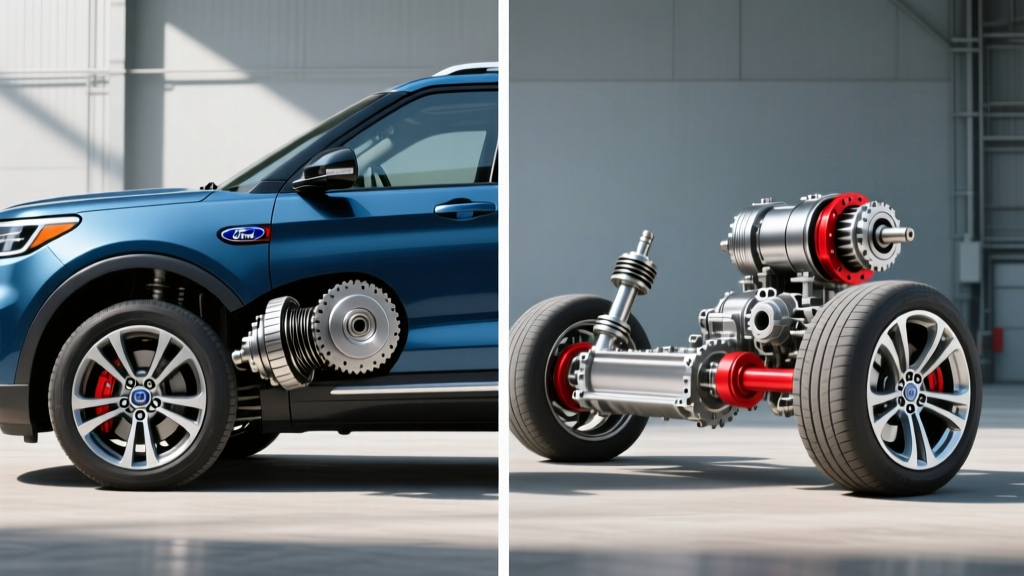
The decision between the 2025 Ford Explorer standard drivetrain, RWD or AWD, heavily impacts long-term drivetrain budgets. AWD models utilize a front PTU bolted directly to the 10-speed transmission. The front CV axles must navigate the steering rack, the lower control arms, and the intense heat radiating from the PTU and exhaust manifolds.
According to data aggregated from major repair databases and owner forums referenced on the Ford Explorer Official Page, AWD models experience front CV boot failures at nearly twice the rate of rear boot failures. The thermal cycling causes the elastomer boots to harden and crack prematurely. Fleet managers operating AWD Explorers in northern climates must also factor in road salt corrosion, which seizes the CV axle splines inside the steering knuckle hub, turning a standard 1.8-hour book time job into a 3.5-hour ordeal requiring knuckle removal and torch work.
Precision Installation: Torque Specs and Fluid Protocols
Proper installation of CV axles is non-negotiable. Over-torquing the axle nut can crush the wheel bearing races, while under-torquing leads to spline fretting and catastrophic hub failure. Below are the critical factory torque specifications for the 2025 Explorer CD6 platform.
| Fastener / Component | Metric Torque | Imperial Torque | Notes & Protocols |
|---|---|---|---|
| Rear Axle Nut (M16) | 350 Nm | 258 lb-ft | Use a new prevailing torque nut. Do not reuse. |
| Front Axle Nut (AWD M14) | 250 Nm | 184 lb-ft | Stake the nut collar into the axle groove post-torque. |
| Intermediate Shaft Bracket Bolts | 48 Nm | 35 lb-ft | Apply blue threadlocker (Loctite 243). |
| Wheel Hub-to-Knuckle Bolts | 115 Nm | 85 lb-ft | Clean threads; replace if stretched. |
| PTU-to-Transmission Bolts | 45 Nm | 33 lb-ft | Only if PTU is removed for intermediate shaft access. |
Fluid Protocol Warning: When removing the front CV axles on an AWD Explorer, a small amount of PTU fluid will inevitably leak past the output shaft seals. It is imperative to verify the PTU fluid level post-repair. The PTU requires specific 75W-85 synthetic gear oil. Running the PTU low on fluid will result in catastrophic gear failure within 5,000 miles, turning a $600 CV axle job into a $3,500 PTU replacement.
Final Verdict: RWD or AWD Maintenance Reality
When conducting a total cost of ownership analysis regarding the 2025 Ford Explorer standard drivetrain, RWD or AWD configurations must be weighed against your geographical and usage needs. The RWD layout offers a distinct financial advantage in drivetrain maintenance, halving the number of CV axles and eliminating the failure-prone front PTU and intermediate shafts. However, if AWD is required, proactive maintenance—specifically inspecting the front inner CV boots for heat damage every 30,000 miles and utilizing high-temp grease during any boot service—will mitigate the inherent 'AWD tax' and keep your Explorer reliably on the road. For parts sourcing and OEM diagrams, technicians frequently cross-reference the RockAuto Parts Database to compare Motorcraft pricing against premium aftermarket alternatives before committing to a repair strategy.