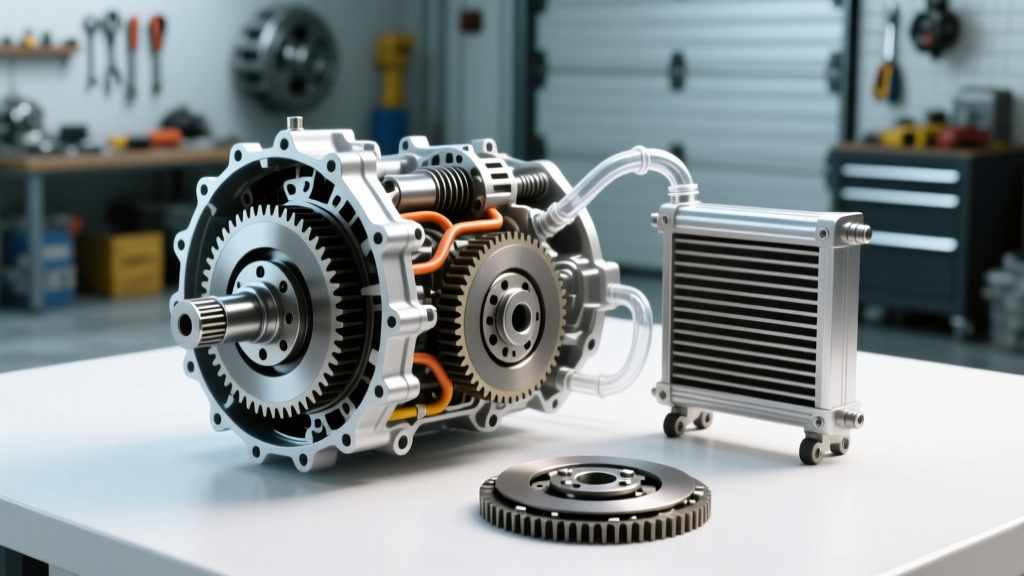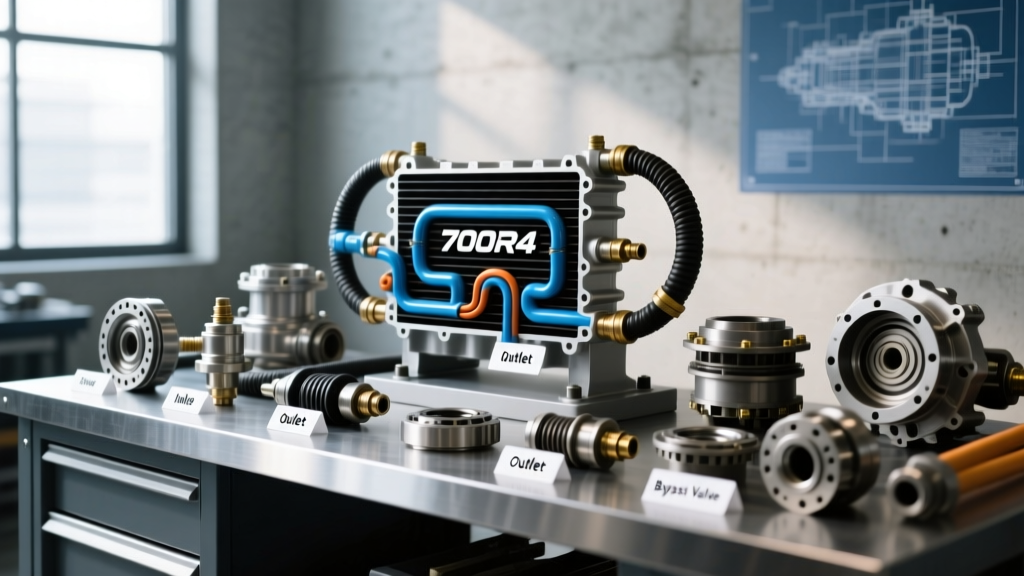
The Ford 7.3L Powerstroke remains one of the most revered diesel platforms in automotive history. However, its Achilles heel has always been the 4R100 transmission, particularly when subjected to modern towing demands, steep grades, and heavy payloads. The factory 7.3L transmission cooler—a relatively small tube-and-fin unit—simply lacks the thermal mass to keep 4R100 fluid temperatures in the safe zone under extreme load. As we navigate the 2026 aftermarket landscape, the most proven, cost-effective solution for preventing 4R100 burnout is installing a 7.3 to 6.0 transmission cooler kit. By adapting the massive stacked-plate cooler from the later 6.0L Powerstroke (which backed the 5R110W TorqShift), 7.3L owners can achieve drastic temperature drops without relying on expensive, over-engineered aftermarket alternatives.
Thermal Dynamics: Why the 6.0L Cooler Dominates
The factory 7.3L cooler utilizes a traditional tube-and-fin design. While adequate for unladen highway driving in the late 1990s, tube-and-fin coolers suffer from poor thermal transfer efficiency compared to modern designs. The fluid travels through a single continuous tube with exterior fins brazed or glued to the outside. If the fins detach or corrode, thermal dissipation plummets.
In contrast, the 6.0L OEM cooler employs a stacked-plate (plate-and-fin) architecture. In this design, transmission fluid flows through a series of flat, stacked aluminum plates, while ambient air is forced through corrugated fins sandwiched between each plate. This exponentially increases the surface area exposed to both the fluid and the cooling airflow. According to thermal testing data shared by the Ford Powerstroke Diesel Forum, the 6.0L stacked-plate core offers nearly 40% more cooling capacity than the stock 7.3L unit, effectively acting as a secondary radiator for your drivetrain.
Technical Specifications & OEM Part Numbers
When sourcing your 7.3 to 6.0 transmission cooler kit, you can either purchase a pre-packaged aftermarket bundle from specialists like Riffraff Diesel or piece together the OEM components yourself. Below is a direct comparison of the core specifications.
| Attribute | 7.3L OEM Cooler (4R100) | 6.0L OEM Cooler (5R110W) |
|---|---|---|
| OEM Part Number | F81Z-7A095-FA | 3C3Z-7A095-CA (or 5C3Z-7A095-A) |
| Core Design | Tube-and-Fin | Stacked-Plate / Plate-and-Fin |
| Approx. Dimensions | 18.5' x 12.5' x 1.0' | 23.0' x 16.0' x 1.5' |
| Estimated BTU/hr Dissipation | ~35,000 BTU/hr | ~55,000+ BTU/hr |
| Typical Cost (2026) | $120 - $160 | $250 - $320 (OEM) |
Step-by-Step Installation: Fitment and Brackets
Swapping the cooler is not a direct plug-and-play affair. The 6.0L cooler is physically wider and taller than the 7.3L unit. For 1999–2003 Super Duty trucks, the core support requires minor modifications to accommodate the larger footprint.
Core Support Trimming
The 6.0L cooler will not slide directly into the 7.3L factory mounting saddles. Most builders use a reciprocating saw or heavy-duty shears to trim the lower plastic air deflector and slightly notch the metal core support brackets. You will need to fabricate or purchase custom L-brackets (typically 1/8' thick steel or heavy aluminum) to secure the top and bottom of the 6.0L cooler to the 7.3L radiator support. Ensure you leave at least 1/2 inch of clearance between the cooler fins and the A/C condenser to prevent vibration-induced wear on the aluminum fins.
Plumbing the Lines: The Critical Fitting Adapters
The most common failure point in a 7.3 to 6.0 transmission cooler kit installation is the plumbing. The 4R100 transmission case uses specific quick-disconnect fittings and line diameters that do not mate natively to the 6.0L cooler nipples.
- 4R100 Line Sizes: The 7.3L utilizes 1/2' and 5/8' OD steel lines.
- 6.0L Cooler Inlets: The 6.0L cooler features larger, differently pitched quick-connect collars designed for the 5R110W's higher flow volume.
The AN Fitting Conversion Method
Rather than fighting with mismatched Ford quick-disconnects and prone-to-leak plastic retention clips, the industry standard for 2026 is to eliminate the quick-disconnects entirely. Cut the factory quick-disconnect fittings off the 7.3L steel lines using a tubing cutter. Next, thread AN8 (for the 1/2' line) or AN10 (for the 5/8' line) male flare-to-barb adapters onto the steel lines, or use compression-style hose barbs. From there, route high-pressure Gates Barricade fuel injection hose (rated for continuous hot oil immersion) from the steel lines to the 6.0L cooler nipples. Secure the hose using constant-tension T-bolt clamps or Gates PowerGrip heat-shrink clamps. This method guarantees zero leaks under the 4R100's peak line pressures, which can exceed 140 PSI during heavy towing in second gear.
Torque Specifications and Fluid Refill Procedures
Proper torque and fluid selection are non-negotiable when reassembling the cooling circuit. Over-tightening the soft aluminum threads on the 6.0L cooler will strip the case, resulting in an immediate and catastrophic fluid loss.
- Adapter Fittings to Cooler Case: 18–22 lb-ft. Use a crowfoot wrench on an inch-pound or low-range foot-pound torque wrench to avoid overtightening.
- Line Bracket Retention Bolts: 89 lb-in (approx. 7.5 lb-ft).
- Custom L-Bracket to Core Support: 15 lb-ft with a medium-strength threadlocker (e.g., Loctite 243).
Fluid Capacity and MERCON V Mandate
The 4R100 transmission holds approximately 17.5 quarts of fluid for a complete dry-fill. When swapping the cooler and lines, expect to lose and subsequently replace between 4 and 6 quarts. You must use MERCON V (Motorcraft XT-5-QMC or an approved equivalent). Do not use MERCON LV or standard Type F. MERCON V contains the specific friction modifiers required for the 4R100's clutch packs and torque converter clutch (TCC). Using the wrong fluid will cause immediate TCC shudder and eventual clutch glazing.
Real-World Towing Data and Temperature Drops
What kind of thermal gains can you actually expect from a 7.3 to 6.0 transmission cooler kit? Based on dyno and real-world towing telemetry collected from heavily modified 7.3L platforms pulling 12,000+ lb fifth-wheel trailers through 6% grades:
Stock 7.3L Cooler: Fluid temperatures routinely spike to 235°F–245°F on long climbs, pushing the MERCON V fluid past its thermal breakdown threshold (220°F), leading to varnish buildup and clutch slippage.
6.0L Stacked-Plate Cooler: Peak temperatures are consistently capped between 185°F and 195°F under identical loads, representing a massive 40°F to 50°F drop. Furthermore, cooldown times at the top of a grade are reduced by nearly half due to the superior thermal mass of the stacked-plate core.
Final Verdict: The Ultimate 4R100 Insurance Policy
If you plan to keep your 7.3L Powerstroke in active towing duty, upgrading the cooling system is not optional; it is mandatory for transmission survival. While aftermarket heavy-duty coolers from brands like Mishimoto or Derale offer excellent performance, they often cost upwards of $450 to $600. By utilizing an OEM Ford 6.0L stacked-plate cooler and fabricating your own AN-style adapter lines, you can build a superior 7.3 to 6.0 transmission cooler kit for under $350. The result is a vastly more resilient 4R100 transmission, capable of handling modern towing demands while keeping your fluid temperatures safely in the green.