The Anatomy of a Drivetrain Issue Across Vehicle Layouts
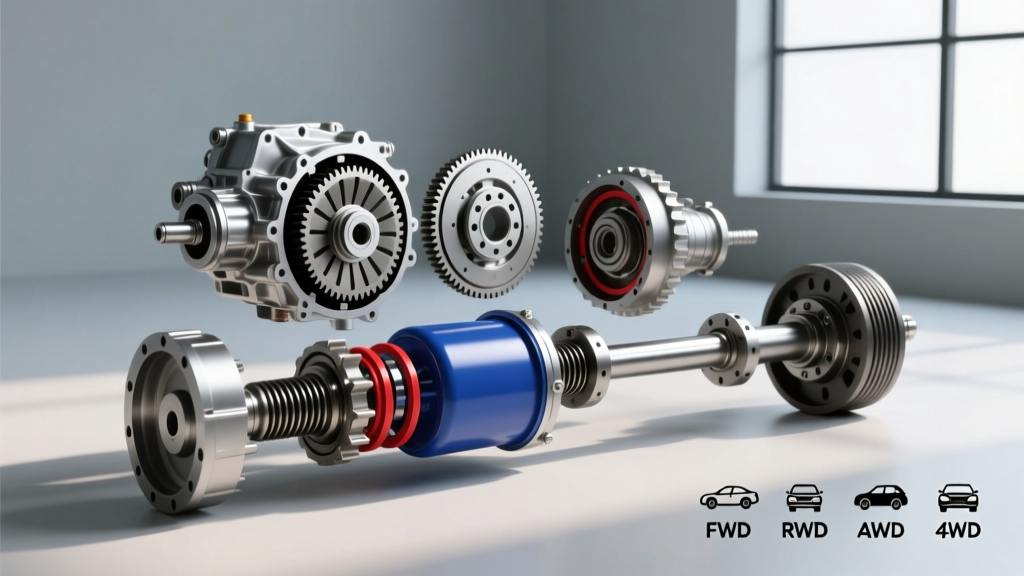
When a driver complains of a 'drivetrain issue,' the diagnostic path is entirely dictated by the vehicle's layout. A vibration in a Front-Wheel Drive (FWD) compact sedan requires a completely different approach than a binding sensation in an All-Wheel Drive (AWD) wagon. As of 2026, despite the rapid influx of electric vehicles, the internal combustion aftermarket remains massive, and understanding the mechanical nuances of FWD, RWD, AWD, and 4WD systems is critical for accurate repairs.
This model-specific repair guide breaks down the most common layout-specific failures, providing exact torque specifications, fluid capacities, OEM part numbers, and real-world diagnostic steps to resolve these complex mechanical faults.
FWD Diagnostics: Honda Accord (CVT & Half-Shaft Architecture)
Common Failure: High-Speed Shudder and CV Axle Binding
In FWD vehicles like the 10th-generation Honda Accord (2018-2022), the engine and transaxle are mounted transversely. Power is routed directly to the front wheels via unequal-length or equal-length CV (Constant Velocity) half-shafts. A frequent drivetrain issue reported by owners is a high-speed shudder under light acceleration, often misdiagnosed as a failing torque converter.
In reality, this is frequently caused by degraded CVT fluid failing to properly modulate the start clutch, or a binding intermediate shaft bearing. Furthermore, worn outer CV joints will manifest as a clicking noise during full-lock steering maneuvers.
Repair Specifications & Torque Values
- CVT Fluid: Honda HCF-2 (Part No. 08200-HCF2). Total capacity is approximately 3.9 quarts for a drain and fill.
- CV Axle Nut Torque: 134 lb-ft (181 Nm). Always use a new staked axle nut upon reinstallation.
- Intermediate Shaft Bracket Bolts: 33 lb-ft (45 Nm).
Expert Diagnostic Tip: Before condemning the CVT transmission for shudder, perform a stall test and check the CVT start clutch calibration using a bidirectional scan tool. A simple 3-quart drain-and-fill of HCF-2 fluid resolves over 60% of mild shudder complaints without internal teardowns.
RWD Diagnostics: BMW G20 3-Series (ZF 8HP Layout)
The Infamous 'Drivetrain Malfunction' Dash Warning
Rear-Wheel Drive (RWD) platforms, particularly those utilizing the longitudinal ZF 8HP automatic transmission (like the BMW G20 3-Series), deliver exceptional powertrain dynamics but are prone to specific leaks and driveline vibrations. When the iDrive screen displays a 'Drivetrain Malfunction' warning and limits engine RPM, the issue is rarely catastrophic internal gear failure.
More commonly, the fault stems from the ZF mechatronic sealing sleeve degrading and leaking transmission fluid directly onto the Transmission Control Module (TCM) pins, causing electrical shorts. Additionally, the Guibo (rubber flex disc) connecting the transmission output shaft to the front driveshaft is a known wear item that causes severe clunking upon engagement.
Repair Specifications & Torque Values
- Transmission Fluid: ZF Lifeguard 8 (Shell ZF-LG8). A standard pan drop and filter replacement requires approximately 5.5 liters. Always verify the source via ZF Aftermarket Lubricants.
- Guibo Flex Disc Bolts (M10): 74 lb-ft (100 Nm) plus a 90-degree torque-to-yield angle.
- Mechatronic Sleeve Sleeve Part Number: ZF 24347588725.
- Fluid Level Check Temperature: Must be performed with the fluid pan between 30°C and 50°C (86°F - 122°F) while the engine is idling in Park.
AWD Diagnostics: Subaru Outback (Symmetrical AWD & Lineartronic CVT)
Transfer Clutch Binding and AWD System Faults
Subaru's Symmetrical AWD system is unique because the AWD transfer clutch assembly is housed inside the rear extension of the Lineartronic CVT, rather than in a separate transfer case. A classic drivetrain issue in the Subaru Outback (2015-2022) is 'AWD binding'—a jerking or hopping sensation during tight, low-speed turns. This occurs when the AWD transfer clutch fails to disengage the rear axle, effectively locking the front and rear driveshafts together on dry pavement.
Binding is typically caused by a failed AWD solenoid valve inside the transmission valve body, contaminated CVT fluid, or the installation of mismatched tires that confuse the wheel speed sensors and force the clutch to remain engaged.
AWD Fluid & Component Matrix
| Component | Fluid / Part Spec | Capacity / Torque | 2026 Avg. Repair Cost |
|---|---|---|---|
| Lineartronic CVT | Subaru High Torque CVTF (SOA8689927) | 12.2L Total / ~5.0L Drop-and-Fill | $250 (Fluid Service) |
| Rear Differential | 75W-90 GL-5 Gear Oil | 0.8L (Fill plug to edge) | $85 (Fluid Service) |
| Transfer Clutch Solenoid | Valve Body Assembly (31360AA052) | 11 mm Valve Body Bolts: 7 lb-ft | $1,800 - $2,400 (Parts & Labor) |
For OEM component verification, technicians should cross-reference part numbers via Subaru OEM Parts databases to ensure compatibility with the specific TR690 transmission variant.
4WD Diagnostics: Ford F-150 (BorgWarner 4417 Transfer Case)
IWE Vacuum Loss and Front Axle Grinding
Part-time Four-Wheel Drive (4WD) systems, such as those found in the 13th and 14th generation Ford F-150, utilize a BorgWarner 4417 transfer case and an Integrated Wheel End (IWE) system to disconnect the front hubs in 2WD mode. A severe and alarming drivetrain issue occurs when the truck emits a loud grinding noise from the front wheels while driving in 2-High.
This grinding is almost never a failed wheel bearing or differential. Instead, it is caused by a loss of vacuum to the IWE solenoids. The IWE system uses engine vacuum to pull the hub collars out of engagement. If the vacuum check valve fails, or the plastic vacuum lines crack, spring pressure pushes the collars partially into engagement, resulting in catastrophic grinding against the spindle and hub ring.
Diagnostic Protocol & Specifications
- Vacuum Test: Connect a Mityvac to the IWE actuator hose at the wheel end. You should read a minimum of 15-20 inHg of vacuum with the engine idling in 2WD. If vacuum bleeds off rapidly, the IWE actuator diaphragm is ruptured.
- Solenoid Replacement: The IWE solenoid valve (Part No. BL3Z-3K332-A) is located on the passenger side firewall. Replacement takes under 30 minutes and costs roughly $65 for the OEM part.
- Transfer Case Fluid: Motorcraft Transfer Case Fluid (XL-12). Capacity is exactly 1.8 liters (1.9 quarts). Do not use standard ATF, as it lacks the necessary friction modifiers for the BorgWarner internal clutch pack.
Comparative Diagnostic Tooling Requirements (2026)
Resolving layout-specific drivetrain issues requires more than just mechanical wrenches; it requires OEM-level software to command solenoids and read proprietary clutch pressure data.
- FWD (Honda): Honda HDS (Diagnostic System) is required to perform the 'CVT Start Clutch Calibration' procedure after any fluid exchange or battery disconnect.
- RWD (BMW): ISTA+ (Integrated Service Technical Application) is mandatory for resetting transmission adaptation values after replacing the mechatronic sleeve or performing a fluid flush.
- AWD (Subaru): Subaru Select Monitor (SSM4) is necessary to monitor live AWD transfer clutch duty cycles and wheel speed sensor variances to diagnose binding issues.
- 4WD (Ford): FORScan (with an extended license and OBDLink EX adapter) can command the 4WD module to cycle the transfer case motor and read IWE solenoid PID states without needing the dealer-level IDS tool.
Final Verification and Safety Protocols
Regardless of the drivetrain layout, any repair involving rotating mass, high-torque fasteners, or pressurized hydraulic systems demands strict adherence to torque-to-yield specifications. In 2026, with independent shop labor rates averaging $165 per hour, misdiagnosing a simple vacuum leak as a failed transfer case or ignoring a CVT fluid specification can result in thousands of dollars in unwarranted teardowns. Always verify fluid part numbers against the manufacturer's latest Technical Service Bulletins (TSBs) before initiating a drivetrain repair.