The Terminology Trap: Fan Clutch vs. Transmission Clutch
In the modern 2026 automotive diagnostic landscape, terminology overlap frequently leads to costly misdiagnoses. When a driver reports 'clutch slipping symptoms,' the immediate instinct for many technicians is to inspect the manual transmission friction disc, check the clutch master cylinder, or run a line-pressure test on an automatic torque converter. However, a severely slipping thermal fan clutch can trigger engine thermal derating. This causes the Engine Control Unit (ECU) to limit RPMs, reduce engine torque, and induce transmission limp mode to protect the powertrain. To the driver, this feels exactly like a slipping drivetrain clutch. This preventive maintenance guide bridges the gap between engine cooling and drivetrain diagnostics by focusing on the root cause of thermal fan clutch failure: degraded fan clutch silicone oil.
The Physics of Fan Clutch Silicone Oil
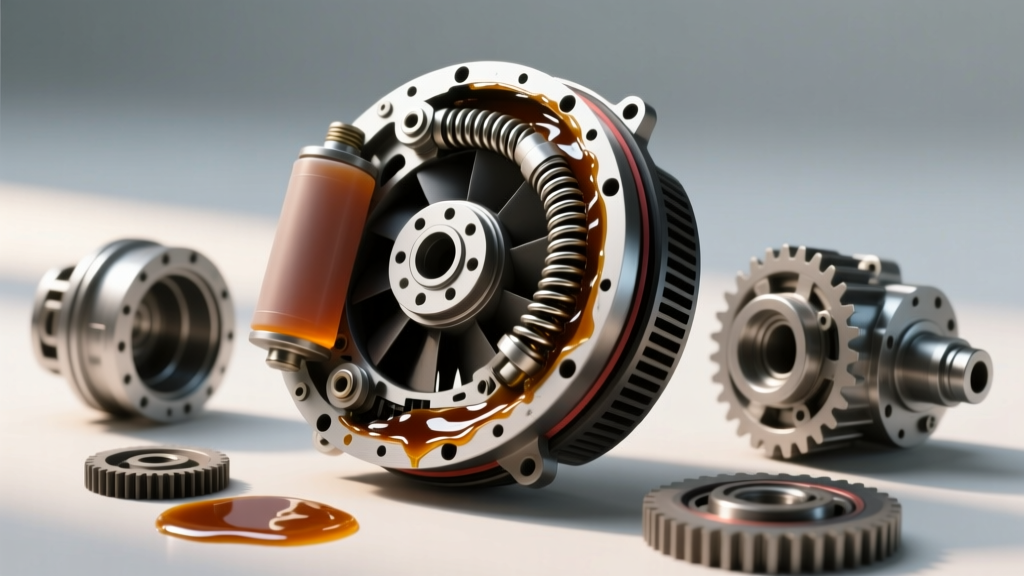
A thermal fan clutch relies entirely on the rheological properties of polydimethylsiloxane (PDMS), commonly known as silicone oil, to transfer torque from the water pump input shaft to the fan blade output housing. Unlike a mechanical friction clutch that uses physical surface engagement, a fan clutch operates on fluid shear. The bimetallic thermal coil on the front of the clutch reacts to ambient radiator air temperature. As the air heats up, the coil expands, opening a precision-machined valve that allows the fan clutch silicone oil to flow from the internal reservoir into the shear plane between the rotor and the housing.
When the silicone oil degrades due to extreme thermal cycling, contamination, or seal weeping, its viscosity drops. A loss of viscosity means the fluid can no longer maintain the necessary shear strength to drive the fan blade at high RPMs. The result is a 'slipping' fan clutch. The engine overheats, the ECU detects the rising coolant temperature, and the transmission control module (TCM) initiates a thermal protection strategy that mimics a slipping transmission clutch.
Symptom Comparison: Fan Clutch vs. Drivetrain Clutch
Before tearing into the transmission bell housing, technicians must differentiate between a mechanical drivetrain slip and a thermally induced ECU derate. The table below outlines the critical diagnostic distinctions.
| Diagnostic Symptom | Fan Clutch Slip (Thermal Derate) | Transmission/Manual Clutch Slip |
|---|---|---|
| RPM vs. Acceleration | Engine RPM is artificially limited by ECU; vehicle feels sluggish but RPMs do not flare freely. | Engine RPMs flare and climb rapidly without a proportional increase in vehicle speed. |
| Temperature Correlation | Symptoms only appear after 15-20 minutes of driving or under heavy load (towing/grade climbing). | Symptoms can occur immediately upon engagement or worsen as transmission fluid overheats. |
| Audible Cues | Absence of the characteristic 'roar' at high engine temps; fan sounds disconnected. | Whining, chatter, grinding, or a distinct burnt friction material smell from the bell housing. |
| OBD-II Telemetry | P0217 (Engine Overtemp) or P0740 (TCC Circuit) triggered alongside high coolant temp PID data. | P0730 (Incorrect Gear Ratio) or P0894 (Transmission Component Slipping) with normal coolant temps. |
Diagnostic Procedures for Slipping Fan Clutches
If your preliminary scan tool data points toward a thermal management issue rather than a mechanical transmission failure, proceed with these specific fan clutch diagnostic tests.
1. The Cold Spin Test (Baseline Resistance)
With the engine off and completely cold (sitting for at least 8 hours), attempt to spin the fan blade by hand. A properly functioning fan clutch with healthy silicone oil will offer noticeable resistance due to the fluid resting in the shear plane. If the fan spins freely with zero resistance, the internal reservoir is likely empty, indicating a severe seal leak or total fluid expulsion.
2. Infrared Thermometer Engagement Test
Start the engine and let it reach operating temperature. Using an infrared thermometer, monitor the temperature of the fan clutch body directly behind the thermal coil. Standard thermal clutches are designed to begin engaging when the air hitting the coil reaches 170°F to 185°F (76°C to 85°C). If the coil reads 200°F+ and the fan is not pulling significant air (verified by an anemometer or the 'newspaper test' against the grille), the internal valve is stuck, or the fan clutch silicone oil has lost its shear capacity.
3. Weep Hole and Seal Inspection
Inspect the perimeter of the fan clutch housing. Over time, the O-ring seals and gaskets degrade. Look for a greasy, dust-attracting residue around the seam of the clutch body. While silicone oil is generally clear, it picks up road grime and engine oil mist, creating a dark sludge. If you see this, the fluid volume is compromised, and slipping is imminent.
Preventive Maintenance: Fluid Specs and Rebuilds
While many shops default to replacing the entire fan clutch assembly (which can cost $85 to $150 for OEM units), preventive maintenance-minded technicians and DIYers can often rebuild the unit by draining and replacing the fan clutch silicone oil. This requires strict adherence to fluid viscosity specifications.
Understanding Centistokes (cSt) Ratings
Silicone oil for fan clutches is not a one-size-fits-all product. It is measured in centistokes (cSt), which dictates the fluid's resistance to shear.
- Standard Duty (10,000 cSt): Used in most passenger vehicles and light-duty trucks (e.g., standard GM LS applications, Ford 5.0L Coyote). Provides smooth engagement and minimal parasitic drag at highway speeds.
- Heavy Duty (20,000 to 30,000 cSt): Required for severe-duty applications, towing packages, and diesel engines (e.g., Dodge Cummins 6.7L, Ford PowerStroke). Using standard oil in a heavy-duty clutch will result in immediate slipping and overheating.
The Rebuild and Refill Process
- Removal: Remove the fan clutch from the water pump. For GM LS engines, use a 36mm thin wrench on the water pump shaft and a 32mm wrench on the clutch hub (reverse thread on many models).
- Draining: Remove the small Allen-head plug or pry off the expansion plug on the clutch body. Drain the old, degraded oil into a graduated beaker. Note the volume (typically 45ml to 60ml).
- Flushing: Flush the cavity with a non-chlorinated brake cleaner to remove sludge. Allow it to dry completely.
- Refilling: Using a syringe, inject the exact OEM-specified volume of fresh fan clutch silicone oil. Critical Warning: Do not overfill. Overfilling leaves no air gap for the fluid to expand into when hot, resulting in a clutch that never disengages, causing massive parasitic horsepower loss and potential water pump bearing failure.
- Sealing: Replace the O-ring or plug, ensuring a flush seat to prevent centrifugal leaks.
Torque Specs and Installation Best Practices
When reinstalling the fan clutch onto the water pump snout, proper torque is vital to prevent harmonic vibrations that can destroy the water pump bearings or crack the clutch housing.
- GM LS/LT V8 Engines: The large retaining nut on the water pump shaft is typically left-hand thread. Torque to 40 lb-ft (54 Nm). The four mounting nuts on the water pump pulley bracket should be torqued to 15 lb-ft (20 Nm).
- Ford Modular 4.6L/5.0L: Standard right-hand thread. Torque the main shaft nut to 35 lb-ft (47 Nm).
- Dodge Ram Cummins (Viscous Hub): Requires a specialized spanner wrench. Torque the hub mounting bolts to 45 lb-ft (61 Nm) in a star pattern.
When to Replace the Entire Assembly
Preventive maintenance via fluid replacement is highly effective if the internal bearings and bimetallic coil are intact. However, if the front bearing exhibits axial play (wobble when pushing/pulling the fan blade), or if the bimetallic strip is physically bent or seized, the unit must be replaced. For GM truck applications, the Hayden 2722 (Standard) or Hayden 2747 (Heavy Duty) remain the industry benchmark replacements, typically pricing between $65 and $95 depending on the retailer.
Conclusion
Diagnosing clutch slipping symptoms requires a holistic view of the vehicle's powertrain management systems. By understanding the critical role of fan clutch silicone oil, technicians can avoid unnecessary transmission removals and correctly address the root cause of thermal derating. Regular inspection of the fan clutch seals, coupled with an understanding of PDMS fluid dynamics, ensures that both the engine and the transmission operate within their designed thermal envelopes.
For further reading on thermal management systems and fluid dynamics, consult the Hayden Automotive Tech Tips database and the Gates Knowledge Center for OEM cooling system specifications.