The Paradigm Shift: Skateboards, Polar Moments, and Instant Torque
The transition from internal combustion engines (ICE) to electric vehicles (EVs) has fundamentally rewritten the rules of chassis dynamics. In a traditional ICE vehicle, the drivetrain is a complex web of heavy, rotating mass concentrated in the front or rear, connected via a multi-speed transmission and a mechanical driveshaft. In contrast, modern EVs utilize a 'skateboard' architecture, placing the heaviest component—the high-voltage battery pack—flat along the floorpan. This yields an exceptionally low center of gravity (CG) and a polar moment of inertia that resists roll but can make yaw transitions feel deliberate.
However, the battery is only half the story. Understanding the exact drivetrain configuration impact on car handling requires analyzing where the electric motors are placed, how they deliver torque, and how software manages slip angles. As we navigate the 2026 automotive landscape, buyers are faced with an unprecedented array of e-axle configurations, from single-motor setups to independent quad-motor systems. This guide breaks down the engineering realities of EV drivetrain layouts to help you choose the exact handling profile that matches your driving demands.
Single-Motor Layouts: FWD vs. RWD Dynamics
Single-motor EVs are the most common and cost-effective configurations on the market. By eliminating the mechanical linkage between the front and rear axles, engineers can package the motor, inverter, and single-speed reduction gear into a single, compact e-axle module. Yet, placing this module at the front versus the rear yields drastically different handling signatures.
Front-Wheel Drive (FWD) EVs
FWD EVs, such as the base Hyundai Kona Electric or the Nissan Leaf, place the electric motor and power electronics over the front axle. While EVs lack the heavy cast-iron engine block of an ICE car, the combined weight of the motor, silicon carbide inverter, and onboard charger still creates a front weight bias (typically around 55/45).
- Handling Trait: Inherent understeer at the limit. The front tires are tasked with both steering and managing regenerative braking forces, which can easily overwhelm their slip angle threshold during aggressive corner entry.
- Regen Braking Effect: Heavy front-biased regenerative braking (often up to 0.3g of deceleration) can cause front suspension dive, unsettling the chassis mid-corner if the driver lifts off the accelerator abruptly.
Rear-Wheel Drive (RWD) EVs
Rear-wheel drive is the preferred layout for performance-oriented single-motor EVs, including the Tesla Model 3 Standard Range and the BMW i4 eDrive35. By placing the Permanent Magnet Synchronous Reluctance Motor (PMSRM) at the rear, engineers achieve a near-perfect 50/50 weight distribution.
- Handling Trait: Neutral to mild oversteer. The instant torque delivery (often available from 0 RPM) allows drivers to rotate the chassis on corner exit by modulating the throttle, effectively using the rear motor to steer the car.
- Traction Limits: Because the heavy battery pack sits low and centrally, the rear axle maintains excellent mechanical grip under hard acceleration, minimizing the wheelspin that plagues lightweight ICE RWD cars.
Dual-Motor AWD: Torque Vectoring and Yaw Control
Dual-motor configurations represent the sweet spot for all-weather capability and high-performance handling. By placing an e-axle at both the front and rear, the vehicle's software can independently vary torque distribution in milliseconds—far faster than any mechanical limited-slip differential or Haldex AWD system.
Decoupling and Efficiency
In many 2026 dual-motor EVs, the front motor is an induction motor or a specialized PMSRM equipped with a mechanical decoupling clutch. During light-load cruising, the front motor is completely disconnected to eliminate cogging torque and parasitic drag, effectively turning the car into an RWD vehicle to maximize range. When slip is detected, or when lateral G-forces exceed 0.4g in a corner, the front motor re-engages in under 10 milliseconds to pull the car through the apex.
The Porsche Taycan’s 2-Speed Rear Axle
While 99% of EVs use a single-speed reduction gear (typically with a final drive ratio between 9.0:1 and 10.5:1), the Porsche Taycan employs a revolutionary two-speed transmission on the rear axle. First gear features a massive 16:1 ratio for violent launch control acceleration, while the second gear drops to 8.05:1 to optimize high-speed efficiency and top-end handling stability. This mechanical advantage allows the Taycan to maintain exceptional chassis composure at track speeds where single-gear EVs suffer from motor back-EMF limitations and torque drop-off.
Tri-Motor and Quad-Motor: The Apex of Handling Precision
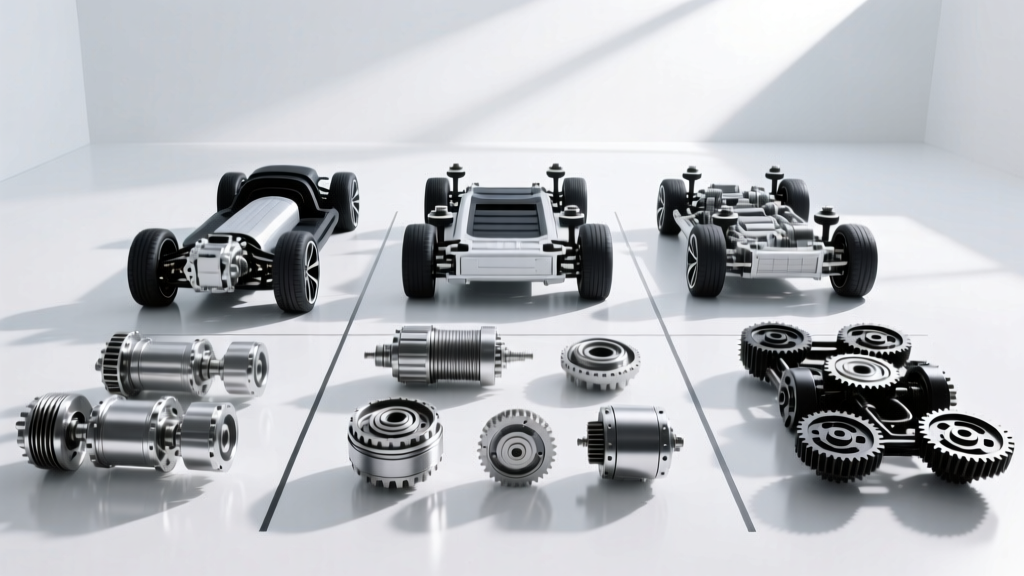
For the ultimate in chassis manipulation, the industry has moved toward tri-motor (one front, two rear) and quad-motor (one at each wheel) layouts. This is where the drivetrain configuration impact on car handling becomes entirely software-defined.
The Rivian Quad-Motor system and the Tesla Model S Plaid tri-motor setup utilize independent torque vectoring. By over-driving the outside wheels and applying regenerative drag to the inside wheels during cornering, these systems generate a massive yaw moment that physically pivots the car into the turn. This eliminates traditional understeer and allows a heavy, 6,000-pound EV to change direction with the agility of a mid-engine sports car. Furthermore, quad-motor systems enable 'tank turns,' where wheels on opposite sides of the vehicle spin in opposite directions, a feature that requires immense thermal management and independent half-shaft durability.
Technical Deep Dive: Reduction Gears and Drivetrain Maintenance
While EVs lack the complex clutch packs and planetary gearsets of a traditional 8-speed or 10-speed automatic transmission, their reduction gearboxes and e-axles require precise maintenance to sustain handling integrity and prevent catastrophic failure under instant torque loads.
Reduction Gear Fluid Specifications
Most integrated e-axles house the electric motor, inverter, and reduction gear in a shared or thermally linked casing. The reduction gear typically utilizes a helical gearset for noise reduction. These gearboxes require specialized, low-viscosity, dielectric-compatible EV transmission fluids.
- Capacity: Typically 1.2L to 1.8L per drive unit.
- Fluid Type: OEM-specific thermal fluids or equivalents like Pentosin ATF 9, designed to protect copper windings while providing high film-strength for the helical gears.
- Service Interval: While some manufacturers claim 'lifetime' fluid, telemetry data from high-performance EVs suggests draining and replacing the reduction gear fluid every 60,000 miles to remove metallic shear debris from the bearings.
Half-Shaft and Axle Nut Torque Specs
The instant torque delivery of an electric motor puts extraordinary stress on CV joints and half-shafts. A common failure point in modified or heavily tracked EVs is the stripping of the half-shaft splines. To prevent this, the hub axle nuts (often M22 or M24 thread) require immense clamping force. Standard torque specifications for EV rear axle nuts generally demand 200 Nm to 250 Nm (147 to 184 lb-ft) followed by an additional 90-degree angle turn. Failure to adhere to this torque-to-yield specification will result in spline chatter, degraded handling precision, and eventual drivetrain failure.
2026 Buyer’s Matrix: Matching Layout to Driving Style
To synthesize the engineering data, use the following matrix to determine which EV drivetrain layout aligns with your handling preferences and daily requirements.
| Drivetrain Layout | Typical Weight Distribution | Primary Handling Trait | Best Application | 2026 Benchmark Vehicle |
|---|---|---|---|---|
| Single Motor FWD | 55% Front / 45% Rear | Safe understeer, predictable lift-off regen dive | Urban commuting, efficiency, packaging space | Hyundai Ioniq 5 (Standard Range) |
| Single Motor RWD | 48% Front / 52% Rear | Neutral balance, throttle-steer oversteer | Canyon carving, driving enthusiasts, drift modes | Tesla Model 3 RWD |
| Dual Motor AWD | 50% Front / 50% Rear | High corner-exit grip, software yaw control | All-weather traction, track days, high-speed stability | Porsche Taycan 4S |
| Tri / Quad Motor | 50% Front / 50% Rear | Active torque vectoring, pivot-on-a-dime agility | Heavy off-road, hypercar track performance | Rivian R1T Quad-Motor |
Conclusion
The days of judging a car's handling solely by its suspension geometry and mechanical differentials are over. In 2026, the drivetrain configuration impact on car handling is dictated by motor placement, inverter switching speeds, and software-defined torque vectoring. Whether you prioritize the tail-happy engagement of a single-motor RWD setup, the all-weather certainty of a dual-motor AWD system, or the physics-defying cornering of a quad-motor array, understanding the underlying e-axle architecture is the key to selecting an EV that truly connects you to the road.