The Anatomy of Dual Plate Clutch Chatter in Performance Builds
Upgrading to a twin-disc setup is a mandatory milestone for any high-horsepower manual transmission build. Whether you are pushing 800 wheel horsepower in a C7 Corvette Z06 or building a 1,200-hp Toyota Supra MK4, a performance dual plate clutch (such as the McLeod RXT or RAM Force 9.5) provides the necessary clamping force and thermal capacity. However, aggressive friction materials and complex floating plate dynamics introduce a common, often destructive symptom: clutch chatter and severe driveline vibration.
Clutch chatter is not merely an acoustic annoyance; it is a violent torsional resonance that can fracture transmission input shafts, shatter bellhousings, and destroy engine thrust bearings. In the modern 2026 performance landscape, where traction compounds and drag radial tires transfer immense shock loads directly into the drivetrain, precise diagnosis of twin-disc vibration is critical. This guide bypasses generic advice and dives into the exact metrology, torque specifications, and hydraulic diagnostics required to eliminate dual plate clutch chatter.
Bellhousing Concentricity: The Silent Killer of Twin-Disc Setups
The most frequent root cause of dual plate clutch vibration is excessive bellhousing runout. A twin-disc assembly is significantly heavier and more sensitive to misalignment than a single-disc organic clutch. If the transmission input shaft is not perfectly concentric with the engine crankshaft, the release bearing will apply uneven pressure to the diaphragm spring fingers. This causes the intermediate floater plate to wobble at high RPM, resulting in severe vibration and uneven friction material wear.
Measuring Total Indicator Runout (TIR)
Before installing any performance clutch, you must measure the bellhousing bore runout using a dial indicator (e.g., Mitutoyo 2046F or Intercomp digital indicator) mounted to the crankshaft or flywheel face, with the needle resting on the precision-machined bore of the bellhousing.
- Maximum Allowable TIR: 0.005 inches (0.127mm) for high-performance dual plate applications.
- Ideal Target: Under 0.003 inches (0.076mm).
If your measurement exceeds 0.005 inches, the chatter is virtually guaranteed. The corrective action is not to replace the clutch, but to install offset dowel pins. Brands like Lakewood (Part #15950) and RobbMc (Part #1014) offer precision-machined offset dowels in 0.007", 0.014", and 0.021" offsets to clock the bellhousing into perfect alignment. According to McLeod Racing's technical documentation, failing to correct bellhousing runout will void the warranty on their high-end twin-disc assemblies due to the predictable destruction of the intermediate drive straps.
Flywheel Step Height: The Critical Twin-Disc Metric
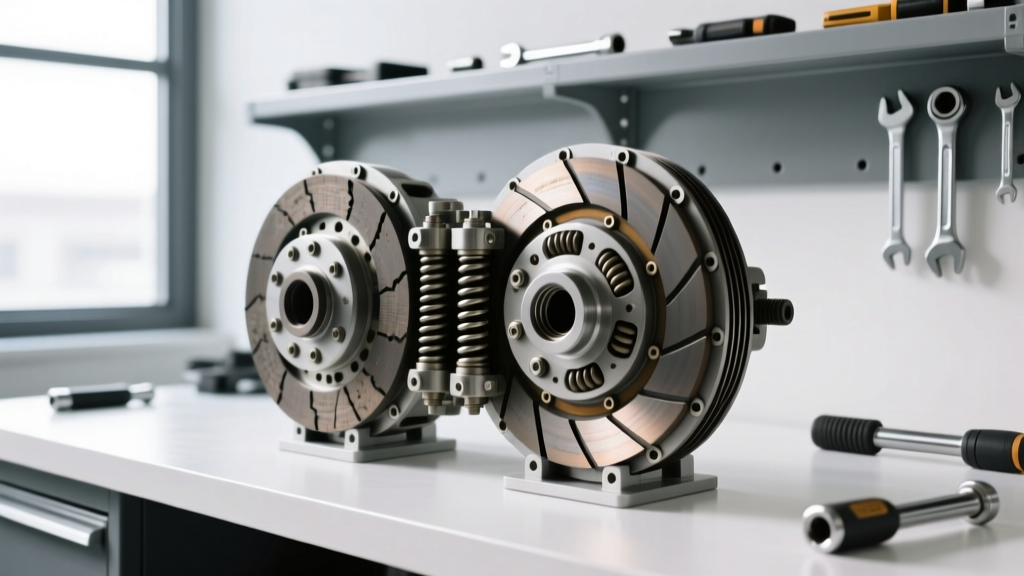
Unlike a single-disc clutch, a dual plate clutch relies on the precise spatial relationship between the flywheel face, the intermediate floater plate, and the pressure plate. This distance is dictated by the flywheel 'step height'. If the step is incorrect, the clutch will either fail to release (causing gear crunch and driveline shock) or fail to clamp evenly (causing violent chatter upon engagement).
Never assume a 'new' aftermarket flywheel has the correct step height for your specific dual plate model. Always verify the step with a straight-edge and feeler gauge or digital calipers before assembly.
Platform-Specific Flywheel Step Specifications
Below is a reference table for common performance platforms utilizing twin-disc setups. Always cross-reference with your specific clutch manufacturer's spec sheet, as variations exist between sprung and unsprung hub designs.
| Platform / Engine | Transmission | Target Step Height | Acceptable Tolerance |
|---|---|---|---|
| GM LS / LT V8 | Tremec T56 Magnum | 0.000" - 0.010" | +/- 0.002" |
| Nissan RB / 2JZ Swap | CD009 / V160 | 0.415" - 0.435" | +/- 0.003" |
| Ford Coyote 5.0 | MT-82 / Magnum XL | 0.460" - 0.480" | +/- 0.002" |
| Porsche 911 (964/993) | G50 / G52 | 0.550" - 0.570" | +/- 0.003" |
If a machine shop resurfaces your flywheel without accounting for the dual plate step requirement, the clutch pack will be pre-loaded or starved for travel. A step that is too deep results in the pressure plate over-extending, causing the diaphragm spring to lose its mechanical advantage and inducing high-frequency chatter. A step that is too shallow prevents full disengagement, causing the floater plate to drag against the flywheel during shifts, generating massive heat and vibration.
Hydraulic Release Systems and Quick-Release Valves
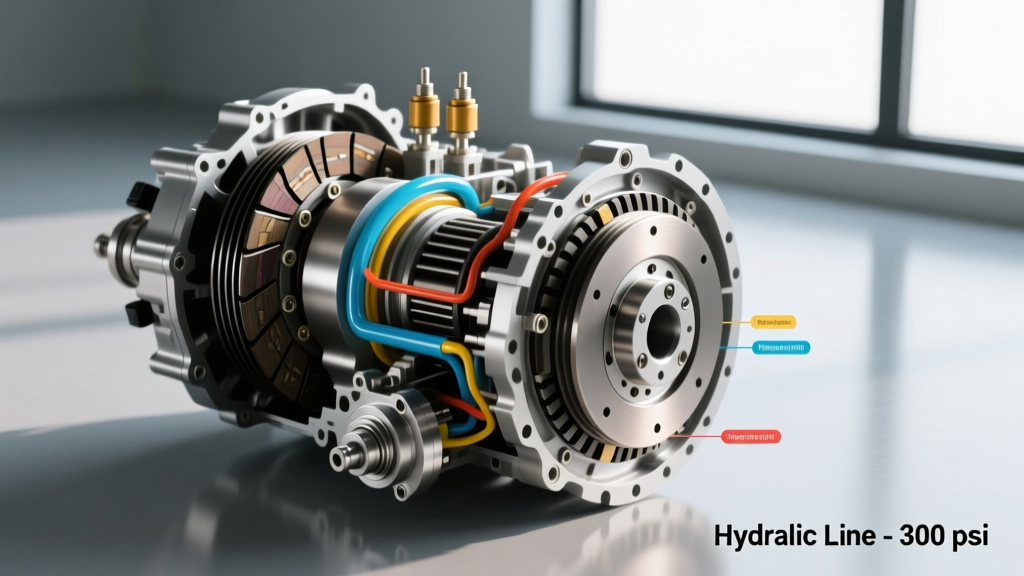
In modern performance builds, the hydraulic actuation system is frequently overlooked during clutch chatter diagnosis. Many enthusiasts install aftermarket clutch master cylinders equipped with Quick-Release Valves (QRV) or 'delay valves' designed to soften pedal engagement for street driving. In a dual plate clutch setup, these valves are catastrophic.
A dual plate clutch requires a distinct, positive engagement. A QRV artificially restricts fluid return, causing the release bearing to drop away from the pressure plate too slowly, followed by a sudden 'snap' as the fluid finally bypasses the valve. This abrupt, uneven clamping force excites the torsional springs in the clutch disc hub, manifesting as severe chassis shudder and chatter when launching from a stop or shifting into second gear under load.
Hydraulic Diagnostic Checklist
- Remove the QRV: For any track or high-performance street car running a ceramic or carbon twin-disc, delete the delay valve entirely. Direct fluid transfer is mandatory.
- Master Cylinder Bore Size: Upgrading to a larger bore (e.g., moving from a 3/4" to a 7/8" or 1" bore) increases fluid volume, ensuring the release bearing achieves full travel without pedal pumping. This is especially critical for heavy-duty dual plate pressure plates like the RAM 902100HD.
- Bleeding Protocol: Air trapped in the slave cylinder acts as a compressible spring, causing inconsistent bearing pressure. Use a Motive Products pressure bleeder set to 15-20 PSI, and cycle the pedal slowly to purge micro-bubbles from the slave cylinder return port.
Drivetrain Backlash and Motor Mount Deflection
Clutch chatter is often a symptom of amplified driveline backlash rather than a fault in the clutch itself. When a dual plate clutch grabs, it transfers torque instantaneously. If the engine and transmission are allowed to twist excessively on degraded or overly soft motor mounts, the sudden shift in pinion angle and driveshaft phasing will create a harmonic vibration that feels exactly like clutch chatter.
For performance applications, inspect your motor and transmission mounts. While solid aluminum mounts eliminate deflection entirely, they transmit gear whine and NVH (Noise, Vibration, and Harshness) into the cabin. The optimal compromise for a dual plate street/track car is a high-durometer polyurethane mount (e.g., Energy Suspension or BMR Fabrication). Furthermore, verify the torque specs on the transmission crossmember. A loose crossmember allows the tail shaft to droop, altering the driveshaft operating angle and inducing vibration that is frequently misdiagnosed as clutch chatter.
Friction Material Selection: Ceramic vs. Carbon vs. Organic
The coefficient of friction (Mu) of your dual plate clutch material directly dictates its chatter propensity. Understanding the friction dynamics is essential for matching the clutch to the vehicle's weight and power output.
- Full Ceramic (e.g., McLeod Street Twin): Offers a very high, aggressive Mu. Prone to low-speed chatter in stop-and-go traffic due to the 'stick-slip' friction phenomenon. Best suited for dedicated drag or track cars over 3,200 lbs.
- Carbon / Carbon-Ceramic: Provides a smoother, more progressive engagement curve as heat increases. Carbon requires heat to reach its optimal Mu, meaning it may slip when cold but will resist chatter beautifully when up to temperature on a road course.
- Sprung vs. Unsprung Hubs: A dual plate clutch with a sprung hub (torsional dampening springs) will absorb the initial shock of engagement, significantly reducing chatter. Unsprung (rigid) hubs transfer all engine torsional vibration directly to the transmission input shaft. Never use an unsprung hub on a street car with a lightweight flywheel, as the resulting vibration will cause passenger discomfort and potential gear rattle.
Troubleshooting Matrix: Symptoms and Corrections
Use this diagnostic matrix to isolate the exact failure point in your dual plate clutch system based on the specific vibration profile.
| Symptom Profile | Primary Suspect | Diagnostic Tool | Target Spec / Action |
|---|---|---|---|
| Violent chassis shudder on 1st gear launch | Oil contamination or warped floater plate | Visual inspection / Micrometer | Replace friction discs; check rear main seal |
| High-frequency squeal and vibration at 3000 RPM | Release bearing preload / Air gap | Feeler gauge through inspection cover | Verify 0.100" - 0.150" air gap at rest |
| Gear crunch followed by driveline shock | Hydraulic restriction / Incomplete release | Pressure bleeder / Pedal travel gauge | Remove QRV; ensure 3/8" minimum bearing travel |
| Vibration that worsens as clutch heats up | Intermediate plate drive strap fatigue | Disassembly and visual inspection | Replace floater plate; inspect flywheel pins |
Final Assembly and Torque Specifications
When reinstalling the dual plate assembly after diagnosis, precision torque is non-negotiable. The pressure plate to flywheel bolts must be tightened in a strict star pattern to ensure the diaphragm spring loads evenly. For most 10.5" and 11" twin-disc setups, the final torque spec is between 25 and 35 lb-ft, depending on the bolt grade and manufacturer specification. Always use a high-temperature thread locker (such as Loctite 272) on the flywheel-to-crank bolts, and adhere to the OEM torque-to-yield specifications (e.g., GM LS engines require 15 lb-ft plus an additional 50 degrees of rotation).
By systematically verifying bellhousing concentricity, validating flywheel step height, and optimizing the hydraulic release system, you can eliminate dual plate clutch chatter and ensure your high-horsepower drivetrain operates with the precision and reliability required for modern performance driving. For further installation guidelines, consult the RAM Clutches tech library and verify transmission input shaft spline compatibility via the Tremec Transmissions official documentation.