The True Cost Differential: Decoding Gear Oil Specifications for Fleet Profitability
For independent mobile mechanics, fleet managers, and heavy-duty owner-operators, maintaining drivetrain assets is a constant battle between upfront parts costs and long-term reliability. When running the numbers through a business paycheck calculator with differential maintenance costs factored in, the margin difference between stocking standard mineral gear oils versus premium synthetic formulations becomes a critical factor in net profitability. In 2026, with the cost of a remanufactured Dana 80 or Ford 10.5-inch rear axle hovering between $3,200 and $4,500, understanding the precise chemical and financial specifications of differential gear oil is no longer optional—it is a fundamental business survival skill.
This comprehensive cost analysis breaks down the exact specifications, real-world pricing, and application data for differential gear oils. We will examine how selecting the correct API and SAE ratings protects ring and pinion gears from catastrophic spalling while simultaneously optimizing your service margins.
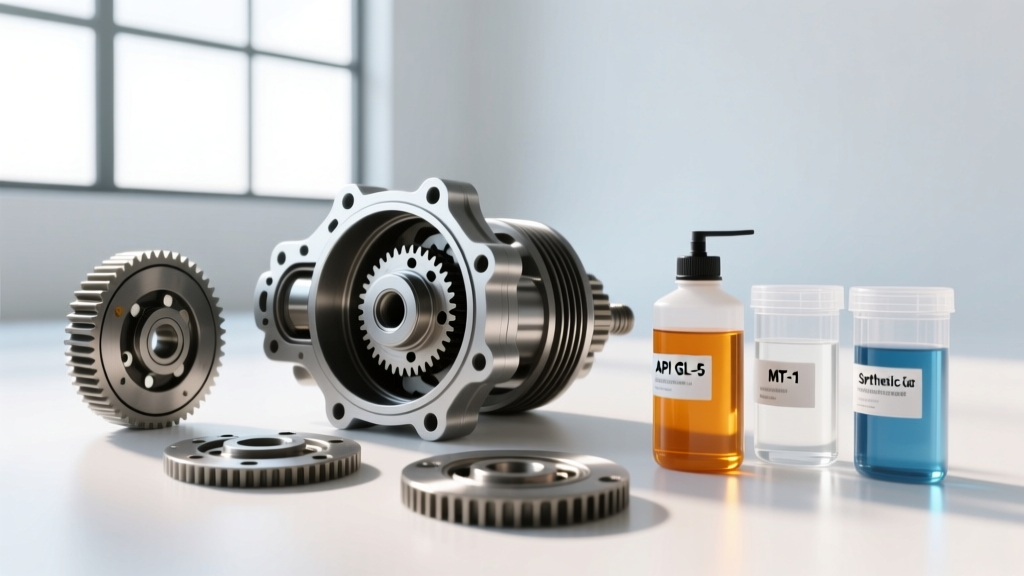
The Specification Matrix: API GL-5, MT-1, and SAE J2360
Before analyzing the financial breakdown, we must establish the technical baseline. Gear oil specifications dictate the extreme pressure (EP) additive packages, thermal stability, and yellow-metal compatibility of the fluid. According to the American Petroleum Institute (API), the primary classifications for drivetrain fluids are distinctly engineered for specific mechanical environments.
API GL-5: The Heavy-Duty Standard
API GL-5 is designed for hypoid gear axles operating under high speeds, low speeds, high torque, and high sliding action. It contains high levels of sulfur-phosphorus EP additives to prevent microwelding and pitting on the ring and pinion teeth. However, the active sulfur in standard GL-5 fluids can corrode yellow metals (brass, bronze, copper), making it entirely unsuitable for manual transmissions with brass synchronizers unless specifically tested for compatibility.
API MT-1: Manual Transmission Protection
API MT-1 is specified for non-synchronized heavy-duty manual transmissions. It provides superior thermal stability and deposit control compared to older GL-1 or GL-4 fluids, preventing carbon varnish buildup on bearing cages and synchronizer assemblies under sustained high-temperature highway hauling.
SAE J2360: The OEM Extended-Drain Benchmark
As detailed by SAE International, the J2360 standard is the gold standard for modern heavy-duty commercial axles. It combines the extreme pressure protection of API GL-5, the thermal stability of API MT-1, and rigorous OEM-specific bench testing (such as Mack GO-J and Eaton PS-163). Fluids meeting SAE J2360 (like Mobil Delvac 1 Gear Oil or Shell Spirax S6 GXME) allow for extended drain intervals up to 500,000 miles in line-haul applications, drastically altering the long-term cost differential for fleet operators.
2026 Cost Analysis & Price Breakdown
When an owner-operator uses a paycheck calculator with differential gear oil expenses to project annual maintenance budgets, the per-quart cost is only half the equation. The true cost analysis must include fluid capacity, friction modifier requirements, and labor intervals. Below is the 2026 market pricing breakdown for common differential fluids.
| Fluid Specification | Viscosity Grade | Avg. Price / Quart | Avg. Price / Gallon | Primary Application |
|---|---|---|---|---|
| Standard Mineral GL-5 | 80W-90 | $6.50 - $8.00 | $24.00 - $30.00 | Light-duty axles, budget services, off-road trail rigs |
| Full Synthetic GL-5 | 75W-90 | $13.50 - $16.00 | $50.00 - $62.00 | Half-ton trucks, SUVs, standard towing |
| Full Synthetic GL-5 | 75W-140 | $17.00 - $21.00 | $65.00 - $80.00 | 3/4-ton & 1-ton trucks, heavy towing, commercial fleets |
| SAE J2360 Synthetic | 75W-90 / 80W-140 | $19.00 - $24.00 | $72.00 - $90.00 | Class 8 line-haul, extended 500k mile drain intervals |
| OEM Branded Fluids | Various | $18.00 - $25.00 | N/A (Quart only) | Warranty-covered dealership services |
| Limited-Slip Modifier | 4 oz. Bottle | $7.50 - $10.00 | N/A | Clutch-type LSDs (Trac-Loc, Auburn) |
The Margin Reality for Mobile Mechanics
Let us run a practical scenario. A mobile mechanic services a 2019 Ford F-250 equipped with a Sterling 10.5-inch rear axle. The axle capacity is 3.75 quarts. If the mechanic uses a bulk-purchased standard 80W-90 mineral oil, the fluid cost is roughly $25. If they upsell the customer to a premium 75W-140 synthetic meeting Ford WSL-M2C192-A specifications, the fluid cost jumps to approximately $75. By properly educating the customer on the benefits of high-temperature shear stability during heavy towing, the mechanic increases their gross profit on the fluid by over 200%, while saving the customer from a $4,000 axle rebuild down the line.
Hidden Costs: Incorrect Spec Usage and Premature Failure
The most expensive mistake in drivetrain maintenance is ignoring OEM-specific friction and additive requirements. The cost differential of saving $15 on fluid can result in thousands of dollars in mechanical damage.
Failure Mode 1: The Limited-Slip Chatter
Clutch-type limited-slip differentials (LSD), such as the Ford Trac-Loc or GM G80 (Eaton Gov-Lock), require a specific friction modifier (e.g., Motorcraft XL-3 or ACDelco 10-9003) to allow the clutch packs to slip smoothly during tight cornering. If a technician uses standard GL-5 fluid without the modifier to save $9, the clutch packs will bind and chatter. Over 10,000 miles, this binding generates excessive heat, glazes the friction material, and ultimately shatters the clutch tabs, requiring a complete differential carrier replacement.
Failure Mode 2: Yellow Metal Corrosion
Using a standard API GL-5 fluid in a heavy-duty manual transmission (like the Eaton Fuller Road Ranger) that requires API MT-1 will lead to catastrophic synchronizer failure. The highly active sulfur in cheap GL-5 fluids chemically attacks the brass synchronizer rings under high heat, turning them black and brittle. The resulting missed shifts and gear grinding will necessitate a $2,500+ transmission overhaul.
Failure Mode 3: High-Temperature Varnish in Heavy Hauling
When pulling heavy fifth-wheel loads through mountain passes, differential sump temperatures can easily exceed 250°F (121°C). Standard mineral 80W-90 oils will oxidize rapidly at these temperatures, forming a thick, tar-like varnish on the pinion bearings and ring gear teeth. This varnish restricts oil flow to the critical pinion bearing cage, leading to localized overheating, bearing seizure, and the pinion gear physically tearing through the differential housing.
Axle Capacities, Torque Specs, and Labor Margins
Efficiency in the bay or on the mobile service truck directly impacts your bottom line. Knowing exact capacities and torque specifications prevents overfilling (which causes seal blowouts and aerated fluid) and underfilling (which starves the pinion bearings). Below is a reference guide for common heavy-duty and light-duty axles.
- Dana 60 (Front/Rear): Capacity: 3.0 - 3.5 quarts. Fill Plug Torque: 35 lb-ft. Spec: API GL-5 75W-90 or 80W-90.
- Dana 80 (Rear): Capacity: 4.0 - 4.5 quarts. Fill Plug Torque: 35 lb-ft. Spec: API GL-5 75W-140 (Heavy Towing).
- Ford/Sterling 10.5-Inch (Rear): Capacity: 3.5 - 4.0 quarts. Fill Plug Torque: 35 lb-ft. Spec: Ford WSL-M2C192-A (75W-140 Synthetic).
- AAM 11.5-Inch (Ram Rear): Capacity: 4.2 quarts. Fill Plug Torque: 25 lb-ft. Spec: Chrysler MS-8985 (75W-90 Synthetic).
- GM 11.5-Inch (Duramax Rear): Capacity: 4.0 quarts. Fill Plug Torque: 24 lb-ft. Spec: GM 9986115 (75W-90 Synthetic).
Pro-Tip for Mobile Mechanics: Always use a magnetic fill plug or install an aftermarket magnetic drain plug (such as the Dorman 65397) during the service. The cost differential of a $12 magnetic plug pays for itself by capturing microscopic ferrous ring-and-pinion wear particles before they embed into the pinion bearing rollers.
Optimizing Your Bottom Line: Bulk Sourcing and Fluid Extraction
To truly maximize the output on your paycheck calculator with differential service revenues, you must optimize how you purchase and handle the fluid. Purchasing quarts from retail auto parts stores destroys profit margins. In 2026, savvy fleet mechanics invest in 5-gallon pails or 16-gallon kegs of SAE J2360 certified synthetic gear oils from industrial suppliers like Lubrizol formulators or direct distributors.
Furthermore, investing in a high-quality pneumatic fluid extractor and dispensing system (such as the Lincoln 3684 or comparable 15-gallon mobile lube cart) reduces the labor time of a dual-axle heavy-duty truck service from 90 minutes down to 35 minutes. By eliminating the need to manually squeeze quart bottles upside down into tight fill ports, you increase your hourly effective rate and reduce the risk of cross-threading aluminum differential covers due to rushed wrench work.
Final Verdict: The Value of Premium Specifications
When analyzing the cost differential of gear oil specifications, the math heavily favors premium, OEM-certified synthetic fluids. While the upfront cost per quart is undeniably higher, the extended drain intervals, superior high-temperature shear stability, and prevention of catastrophic ring-and-pinion failures make it the only logical choice for commercial and heavy-towing applications. For the independent mechanic or fleet owner-operator, mastering these specifications is the key to turning a routine maintenance task into a highly profitable, value-added service that protects both the client's asset and your business's bottom line.