The Thermal Crisis in Modern Heavy-Duty Drivetrains
Modern heavy-duty trucks and high-performance SUVs are generating unprecedented levels of torque. Whether you are pushing a Cummins-powered Ram 3500 to its 37,000-pound GCWR limit or managing the instant torque delivery of an electric pickup’s reduction gearbox, the axle assemblies are subjected to extreme thermal stress. When ring and pinion gear meshing friction combines with high-viscosity fluid shear, differential temperatures can easily exceed 280°F (137°C) under sustained loads. At these temperatures, standard 75W-90 gear oil begins to oxidize, lose its shear stability, and fail to protect the bearing journals.
To combat this, automotive engineers have moved beyond simple stamped-steel pans. Today’s advanced axle systems utilize active lubrication circuits, external fluid coolers, and sophisticated electronic monitoring. A critical, yet often misunderstood, component in these high-end active lube systems is the differential pressure transducer. Understanding this sensor is key to diagnosing modern axle filtration and cooling faults.
How Does a Differential Pressure Transducer Work?
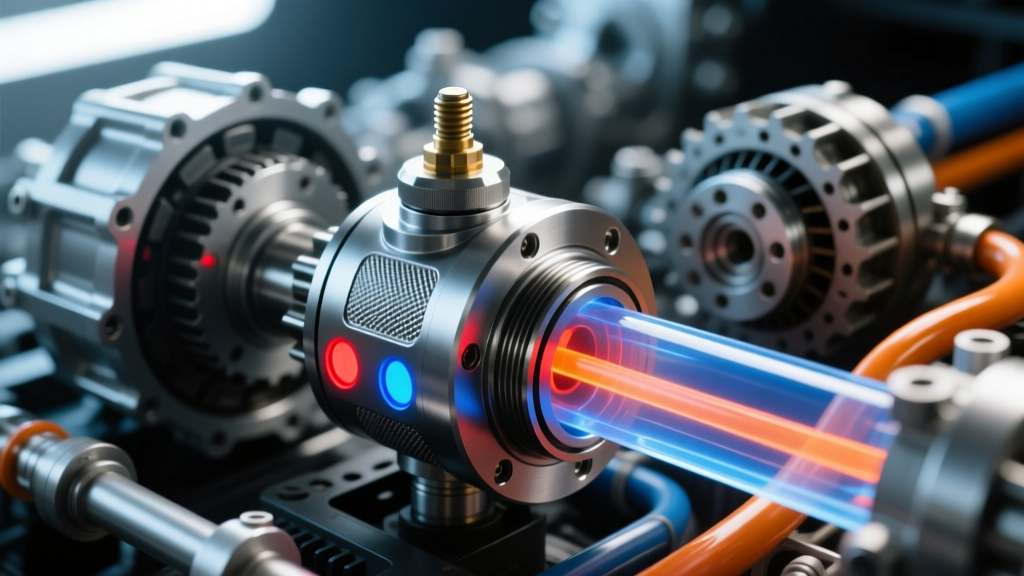
In traditional automotive applications, a differential is a mechanical gearset. However, in the context of electronic sensors, a differential pressure transducer measures the difference in pressure (Delta-P) between two distinct points in a fluid circuit. In heavy-duty axles equipped with active lube pumps and inline filtration (such as the AAM 11.5-inch axles found in late-model Super Duty and Ram HD trucks), this transducer is installed across the axle fluid filter.
The primary function of the sensor is to monitor filter restriction. As the active pump pushes gear oil through the filter media to remove metallic particulates and clutch material (from limited-slip differentials), a clean filter presents minimal resistance. The pressure entering the filter (P1) and the pressure exiting the filter (P2) are nearly identical, resulting in a low Delta-P reading (typically 2 to 5 PSI).
The Physics of Piezoresistive Sensing
Inside the transducer housing is a flexible metallic or ceramic diaphragm equipped with piezoresistive strain gauges arranged in a Wheatstone bridge circuit. As the filter media becomes clogged with debris, the fluid pressure upstream (P1) increases while downstream pressure (P2) drops. This pressure differential physically bends the diaphragm.
According to engineering principles documented by Honeywell Sensing and IoT, the bending of the diaphragm alters the electrical resistance of the strain gauges. The axle’s control module supplies a 5-volt reference and a ground to the sensor. As the resistance in the Wheatstone bridge shifts, the signal return voltage changes proportionally (usually scaling from 0.5V at 0 PSI Delta-P to 4.5V at maximum restriction). If the Powertrain Control Module (PCM) detects a voltage indicating a Delta-P exceeding 15-20 PSI, it triggers a "Service Axle" or "Filter Restricted" warning on the dashboard, preventing catastrophic bearing starvation.
Diagnostic Edge Cases and Bypass Valves
A common failure mode occurs when the mechanical filter bypass valve sticks open. If this happens, unfiltered oil bypasses the media, and the differential pressure transducer will read near 0 PSI Delta-P even if the filter is completely clogged. Conversely, a short to ground in the sensor signal wire will cause the PCM to read a 0V signal, which is often interpreted as a sensor circuit fault rather than a clean filter, logging a U-code or P-code for the axle lube monitor circuit.
Differential Cover Design and Passive Cooling Dynamics
While active lube systems rely on transducers and pumps, the vast majority of axle thermal management relies on the physical differential cover. Upgrading from a stock stamped-steel cover to a high-capacity, finned aluminum cover is one of the most effective modifications for towing and off-roading.
Premium aftermarket manufacturers like Mag-Hytec and PML design covers that address thermal management through three distinct mechanisms:
- Increased Fluid Volume: Deeper sumps increase total fluid capacity by 1.5 to 3.0 quarts. More fluid means a higher thermal mass, which takes longer to heat up and delays the onset of fluid oxidation.
- External Cooling Fins: Cast aluminum acts as a massive heat sink. The external fins increase the surface area exposed to ambient airflow, promoting convective heat transfer.
- Internal Baffling and Splashing: High-end covers feature internal fins that extend downward, sitting just millimeters from the rotating ring gear. As the ring gear spins, it slings gear oil against these internal fins, transferring heat directly from the fluid into the aluminum housing.
Material and Torque Specifications for Aftermarket Covers
When installing an upgraded differential cover, precise torque application is critical. Over-torquing can warp the mating flange or strip the threads in the axle housing, leading to persistent leaks. Below is a reference table for common heavy-duty axle applications.
| Axle Model | Stock Capacity | Aftermarket Capacity | Cover Bolt Torque Spec | Recommended Fluid |
|---|---|---|---|---|
| GM AAM 11.5" (14-Bolt) | 3.7 Quarts | 5.2 Quarts | 30 lb-ft (40 Nm) | 75W-90 Full Synthetic |
| Ford 10.5" Sterling | 3.3 Quarts | 4.8 Quarts | 28 lb-ft (38 Nm) | 75W-140 Synthetic |
| Ram AAM 11.5" (14-Bolt) | 3.7 Quarts | 5.5 Quarts | 33 lb-ft (45 Nm) | 75W-90 Synthetic + EOS Additive |
| Dana 80 (Ford/Dodge) | 4.0 Quarts | 6.0 Quarts | 35 lb-ft (47 Nm) | 75W-140 Full Synthetic |
Note: Always use a high-quality RTV silicone (such as Permatex Ultra Black or The Right Stuff) or the OEM-specified reusable gasket. Allow RTV to cure for a minimum of 4 hours before filling with fluid.
Fluid Selection: Matching Viscosity to Thermal Loads
The best differential cover in the world cannot compensate for the wrong gear oil. The choice between 75W-90 and 75W-140 hinges entirely on your operational profile.
For daily driving and light towing, a 75W-90 synthetic offers superior cold-weather flow characteristics, reducing parasitic drag and improving fuel economy. However, if you are frequently towing 5th-wheel trailers exceeding 10,000 pounds, or operating in sustained desert heat, the fluid film thickness of a 75W-90 may shear down under extreme pressure. In these scenarios, stepping up to a 75W-140 synthetic provides a thicker hydrodynamic wedge between the hypoid gear teeth, preventing metal-on-metal contact even when fluid temperatures push past 260°F.
Furthermore, if your axle is equipped with a clutch-type Limited Slip Differential (LSD), you must include the manufacturer-specified friction modifier (e.g., GM EOS additive or Ford XL-3). Failing to do so will result in clutch pack chatter during low-speed turns, generating excessive localized heat that can glaze the clutches and ruin the LSD assembly.
Integrating Active and Passive Cooling Strategies
For extreme-duty applications, such as competitive sled pulling or heavy commercial hauling, relying solely on a finned cover is insufficient. These setups require an active cooling loop: a PTO-driven or electric gear pump draws oil from the differential sump, pushes it through a remote-mounted trans cooler (often integrated with the transmission cooler stack), and returns it to the axle.
In these custom active loops, the differential pressure transducer becomes a vital safeguard. Because the external lines and cooler core introduce significant flow restriction compared to a stock internal splash setup, monitoring the Delta-P ensures that the pump is not cavitating and that the remote filter is not choked with metallic debris from the ring and pinion break-in process.
Summary
Understanding how a differential pressure transducer work alongside physical differential covers provides a complete picture of modern axle thermal management. While the transducer acts as the electronic sentinel guarding the active filtration circuit, the heavy-duty aluminum differential cover serves as the passive workhorse, shedding heat and increasing fluid volume. By pairing a high-capacity cover with the correct synthetic gear oil and adhering strictly to OEM torque specifications, you can ensure your axle assembly survives the most punishing thermal environments on the road.