The Thermal Threshold of Hypoid Gearsets
Modern heavy-duty axles, such as the GM AAM 1150 (11.5-inch), Ford Sterling 10.5, and Dana 80, are engineering marvels capable of transmitting massive torque to the ground. However, the hypoid gear geometry required to lower the driveshaft and increase ground clearance introduces extreme sliding friction. Under heavy towing conditions—increasingly common with 2026 heavy-duty truck payloads exceeding 35,000 lbs—differential fluid temperatures can easily surpass 280°F (138°C). At these thermal thresholds, conventional gear oils undergo rapid oxidation, viscosity breakdown, and additive depletion, leading to catastrophic ring and pinion wear.
Effective axle thermal management requires a two-pronged approach: maximizing heat dissipation through upgraded differential covers and utilizing high-shear-stability synthetic fluids. In this technical deep-dive, we examine the thermodynamics of differential cooling and how pairing finned aluminum covers with Valvoline differential oil creates a synergistic defense against heat soak.
Differential Cover Geometry and Heat Transfer
The factory-installed differential cover on most light and heavy-duty trucks is a stamped steel pan. While cost-effective for manufacturing, stamped steel is a thermal bottleneck. Steel has a relatively low thermal conductivity of approximately 50 W/m·K. Furthermore, the smooth, shallow exterior profile offers minimal surface area for convective heat transfer to the passing ambient air.
Cast A356 Aluminum vs. Stamped Steel
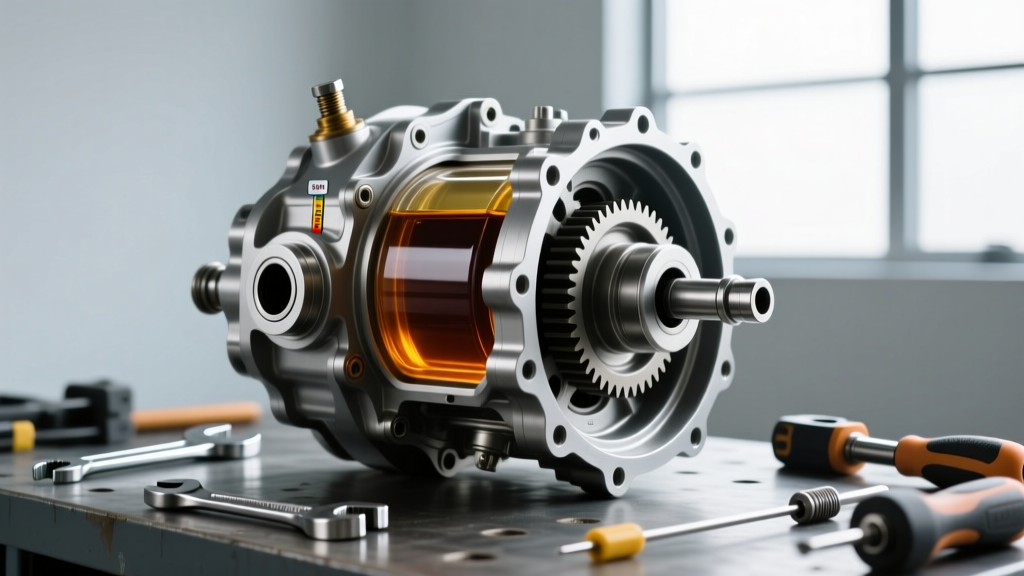
Upgrading to a cast aluminum differential cover (such as those manufactured by Mag-Hytec or PPE) fundamentally alters the heat transfer equation. A356-T6 aluminum boasts a thermal conductivity of roughly 150 W/m·K—three times that of steel. More importantly, aftermarket covers are engineered with aggressive external cooling fins. These fins increase the external surface area by 300% to 400%, drastically improving the convective heat transfer coefficient as the vehicle moves down the highway.
The Deep Sump Churning Loss Paradox
Many enthusiasts assume that a deeper differential cover is universally better because it increases fluid capacity. While a larger fluid volume increases the thermal mass (taking longer to heat up), it introduces a parasitic drag known as churning loss. When the ring gear is submerged too deeply in gear oil, it acts as an impeller, whipping the fluid into an aerated foam and generating excessive internal friction. Premium covers address this by incorporating internal baffles or by carefully calculating the sump depth to keep the fluid level just below the ring gear's centerline, ensuring adequate splash lubrication without severe churning losses.
Fluid Dynamics: Valvoline Differential Oil Under Load
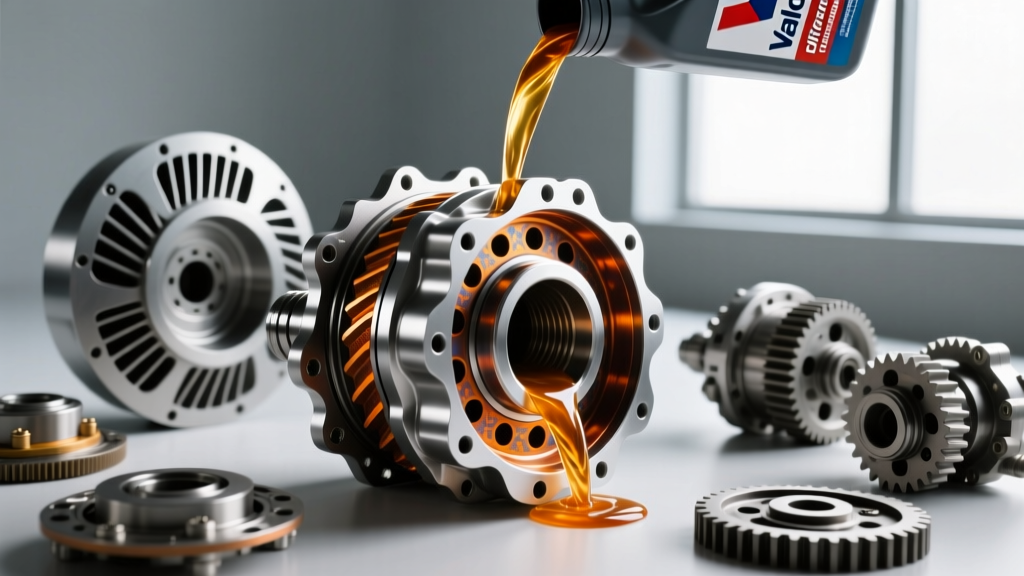
An aluminum cover can only dissipate heat if the fluid inside maintains its structural integrity and heat-transfer properties. This is where the formulation of the gear oil becomes critical. Valvoline differential oil, specifically the SynPower Full Synthetic line (available in 75W-90 and 75W-140 viscosities), is engineered to withstand the extreme pressure (EP) and thermal shear of hypoid gearsets.
Viscosity Index and Shear Stability
Under the intense shearing forces between the ring and pinion teeth, the long-chain polymers in inferior gear oils are physically torn apart, resulting in permanent viscosity loss. Valvoline SynPower utilizes advanced shear-stable viscosity index (VI) improvers. According to Valvoline Global technical data, their full synthetic formulations maintain their kinematic viscosity at 100°C even after extended KRL tapered roller bearing shear testing. This ensures that the hydrodynamic lubricating film separating the gear teeth does not collapse under peak towing loads.
Boundary Lubrication and API GL-5 Standards
During low-speed, high-torque scenarios (such as launching a heavy trailer or crawling off-road), hydrodynamic lubrication fails, and the axle enters the boundary lubrication regime. Valvoline's API GL-5 certified formulations contain high concentrations of sulfur-phosphorus extreme pressure (EP) additives. These additives react chemically with the microscopic asperities on the gear teeth to form a sacrificial solid-film layer, preventing metal-to-metal contact and microwelding even when surface temperatures spike locally to over 400°F.
Thermal Performance Matrix
The following data table illustrates the estimated thermal performance and cost analysis of various differential cover and fluid combinations, based on steady-state highway towing (12,000 lbs trailer) at 65 MPH in 90°F ambient conditions.
| Configuration | Est. Fluid Temp | Temp Drop vs. Stock | Fluid Capacity | Est. Cost (2026) |
|---|---|---|---|---|
| Stock Stamped Steel + Conventional 80W-90 | 265°F - 285°F | Baseline | 3.0 - 3.5 Quarts | $40 - $60 |
| Finned Cast Aluminum + Valvoline 75W-90 SynPower | 225°F - 240°F | -35°F to -45°F | 3.5 - 4.0 Quarts | $220 - $260 |
| Finned Cast Aluminum + Valvoline 75W-140 SynPower | 215°F - 230°F | -45°F to -60°F | 3.5 - 4.0 Quarts | $240 - $290 |
| Active Pump/Cover + Valvoline 75W-140 SynPower | 180°F - 200°F | -70°F to -90°F | 4.5+ Quarts | $450 - $600 |
Note: For limited-slip differentials (LSD), ensure the addition of the manufacturer-specified friction modifier to the Valvoline gear oil to prevent clutch chatter during low-speed cornering.
Precision Installation: Sealing and Torque Specifications
Upgrading your differential cover and fluid is only effective if the installation prevents leaks and maintains structural integrity. Improper torque sequences can warp cast aluminum covers, leading to chronic seepage.
GM AAM 1150 (11.5-inch) Axle Protocol
- Cover Part Reference: Mag-Hytec 1051 or PPE 1150.
- Sealing Method: The AAM 1150 utilizes a reusable rubber gasket or RTV. If using RTV, apply a 3mm continuous bead of Permatex 'The Right Stuff' (Part #29208). Allow 90 minutes for skin-over before filling.
- Torque Specification: The M8x1.25 cover bolts must be torqued to 20 lb-ft (240 in-lbs). Do not exceed this, as overtightening will strip the aluminum threads on the axle housing or warp the cover flange.
- Tightening Sequence: Use a crisscross star pattern, starting from the center bolts and working outward, in two progressive steps (10 lb-ft, then 20 lb-ft).
Dana 80 Axle Protocol
- Cover Part Reference: Mag-Hytec 1015.
- Sealing Method: The Dana 80 typically relies on RTV sealant. Ensure the mating surface is completely free of old silicone and axle oil using aerosol brake cleaner before application.
- Torque Specification: The 3/8-16 cover bolts require 25 to 30 lb-ft. Apply a medium-strength threadlocker (blue) to the threads if the cover does not utilize a locking washer or flanged bolt design to prevent vibration-induced backing out.
Conclusion: The ROI of Thermal Management
Ignoring differential thermodynamics is a costly gamble. A complete ring and pinion replacement, including bearings, seals, and labor, routinely exceeds $2,500 in 2026. By investing in a high-surface-area cast aluminum differential cover and filling it with the shear-stable, extreme-pressure formulation of Valvoline differential oil, you effectively cap operating temperatures well below the oxidation threshold of synthetic base stocks. Whether you are towing a fifth-wheel through the Rockies or subjecting a track car to sustained lateral G-loads, managing axle heat is the most reliable way to ensure drivetrain longevity.