The Physics of Performance Clutch Chatter
Clutch chatter is a violent, low-frequency torsional vibration that occurs during the engagement phase of a manual transmission. In the realm of high-performance drivetrains—whether you are piloting a Tremec T-56 Magnum swapped LS vehicle, a Porsche G50 transaxle, or a Honda K-Series track build—chatter is more than just a nuisance. It is a destructive harmonic feedback loop that can shatter ceramic friction pucks, fracture marcel springs, and ultimately destroy the input shaft of your transmission.
At its core, chatter happens when the friction material grabs the flywheel, transfers a shockwave through the drivetrain, and causes the engine to physically twist on its mounts. This twisting momentarily breaks the friction bond, allowing the RPMs to flare, only to grab again milliseconds later. While many builders immediately blame aggressive friction materials like sintered iron or cerametallic compounds, the root cause often lies upstream in the pedal geometry and hydraulic actuation. This is where evaluating an adjustable clutch linkage or master cylinder becomes critical for achieving streetable modulation.
Why Factory Fixed Linkages Fail High-Torque Builds
OEM clutch systems are designed for organic friction materials, forgiving engine mounts, and maximum manufacturing tolerances. Factory master cylinders and fixed-length pushrods operate on a predetermined hydraulic ratio that assumes a specific diaphragm spring height and clutch disc thickness.
When you upgrade to a twin-disc setup (such as a McLeod Street Twin or an ACT HDSS kit), the stack height changes, and the diaphragm spring fingers sit at a different depth relative to the release bearing. A fixed, non-adjustable hydraulic linkage often fails to provide the necessary over-center travel to fully disengage the clutch, or conversely, it over-strokes the pressure plate, bending the spring fingers. This improper modulation leads to a 'binary' engagement feel—either fully slipping or violently grabbing—which manifests as severe clutch chatter and vibration during 1st gear launches.
Diagnosing the Root Cause: A Step-by-Step Framework
Before tearing into the bellhousing or ordering an adjustable clutch master cylinder, you must systematically isolate the source of the vibration. Use this diagnostic framework to separate linkage issues from mechanical runout.
1. Flywheel Runout and Step Height
Performance flywheels must be perfectly true. According to precision machining standards, flywheel face runout should never exceed 0.002 inches (0.05mm). Furthermore, the 'step height'—the distance between the friction surface and the pressure plate mounting pad—must match the clutch manufacturer's exact specification. For GM LS applications, a step height deviation of just 0.010 inches can cause uneven clamping pressure, leading to localized hot spots and immediate chatter upon engagement.
2. Bellhousing Concentricity (Dial Indicating)
If the transmission input shaft is not perfectly aligned with the engine crankshaft, the release bearing will bind on the transmission guide collar. This binding prevents smooth hydraulic actuation, causing the clutch to engage erratically. Using a dial indicator on the bellhousing bore is mandatory for performance builds. Total Indicator Reading (TIR) must be kept under 0.005 inches. If your TIR exceeds this, you must install offset dowel pins to correct the alignment before blaming the clutch assembly.
3. Engine and Transmission Mount Deflection
Soft, worn, or improperly designed engine mounts allow the powertrain to rotate excessively under torque. When the engine twists, it pulls the hydraulic lines and linkage out of geometry, altering the pedal feel mid-engagement. Upgrading to polyurethane or solid aluminum mounts restricts this movement, providing a stable platform for the clutch to engage smoothly.
The Upgrade Path: Installing an Adjustable Clutch System
When mechanical runout and mount deflection have been ruled out, the hydraulic actuation system is your primary suspect. Upgrading to an adjustable clutch master cylinder or an adjustable pedal quadrant allows you to micro-tune the engagement point, eliminate dead-zone, and ensure the release bearing is properly positioned.
For hydraulic setups, an adjustable pushrod on the master cylinder (such as the Wilwood 0.75-inch bore adjustable master) allows you to set the exact resting position of the hydraulic piston. This ensures full fluid displacement without over-stroking the slave cylinder or hydraulic release bearing. For cable-driven applications (like Foxbody Mustangs or older Nissan Silvias), an adjustable clutch quadrant and firewall adjuster are mandatory to compensate for cable stretch and aftermarket disc thickness variations.
| Hydraulic Setup Type | Bore Size / Ratio | Avg. Cost (2026) | Modulation Precision | Best Application |
|---|---|---|---|---|
| OEM Fixed Master Cylinder | 3/4' (19mm) Fixed | $80 - $120 | Poor (Binary feel) | Stock daily drivers, organic discs |
| Aftermarket Non-Adjustable | 7/8' (22mm) Fixed | $130 - $180 | Moderate | Mild bolt-ons, single-disc upgrades |
| Adjustable Pushrod Master | 3/4' or 7/8' Adjustable | $190 - $260 | Excellent (Micro-tunable) | Twin-disc, sintered iron, track builds |
| Adjustable Hydraulic Release Bearing | Internal Adjustable Collar | $350 - $550 | Maximum (Internal setup) | Custom bellhousings, T-56 Magnum swaps |
Precision Setup: Torque Specs and Clearances
An adjustable clutch linkage is only as effective as the hardware holding the system together. Improper torque specs on the drivetrain components will introduce harmonics that mimic clutch chatter. Always refer to ARP Fasteners for specific torque values based on your bolt material and lubrication.
- Flywheel Bolts (ARP 2000): Torque to 120 lb-ft using ARP Ultra-Torque moly lube. Never use standard oil, as it alters the friction coefficient and leads to uneven clamping.
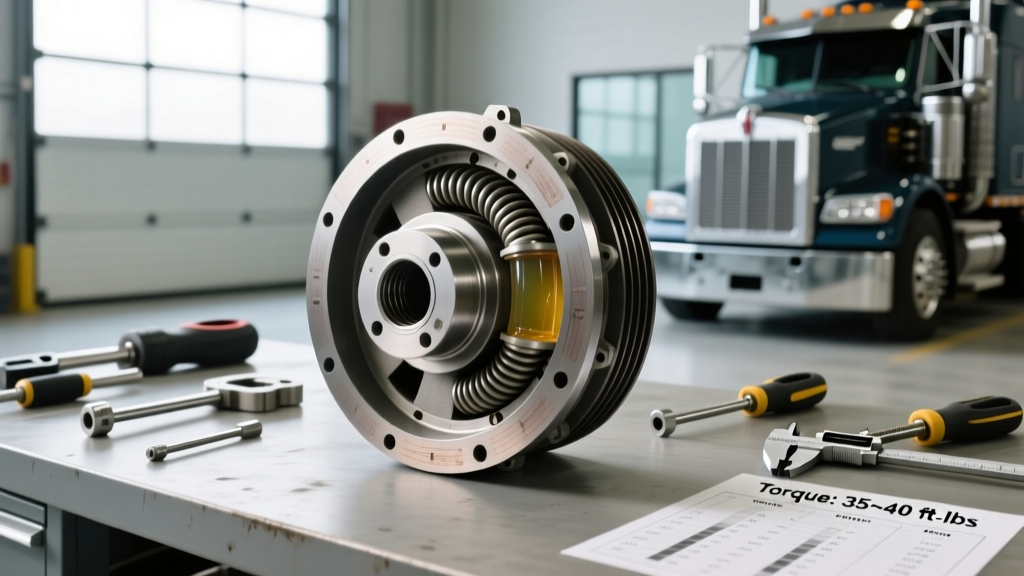
- Pressure Plate Bolts: Torque in a star pattern to 35-40 lb-ft (verify with manufacturer, e.g., McLeod or Tilton).
- Bellhousing to Block: 35-50 lb-ft depending on the block material (aluminum vs. cast iron).
- Release Bearing Air Gap: For adjustable hydraulic release bearings (like those from McLeod Racing), maintain a 0.100' to 0.150' air gap between the bearing face and the diaphragm spring fingers at rest to prevent premature wear and high-RPM vibration.
'Chatter is rarely just a bad friction material. In 90% of the high-horsepower builds we see, the chatter is a symptom of hydraulic over-stroke or bellhousing misalignment. Dial indicating the housing and installing an adjustable master cylinder pushrod solves the issue almost every time.' — Senior Drivetrain Engineer, AutogearNexus
Real-World Troubleshooting Edge Cases
Even with an adjustable clutch linkage perfectly tuned, edge cases can still induce vibration. One common culprit in modern swaps is the use of braided stainless steel hydraulic lines that are routed too close to the exhaust headers. The intense radiant heat boils the DOT 3 or DOT 4 fluid inside the line, creating microscopic vapor pockets. This 'spongy' pedal feel prevents the driver from modulating the engagement zone smoothly, resulting in chatter. Always use heat-sleeved lines and route them away from primary exhaust runners.
Another edge case involves the pilot bearing. If you are running a solid-hub race disc (which lacks a marcel wave spring to absorb engagement shock), the input shaft relies heavily on the pilot bearing to dampen harmonics. A worn or improperly sized pilot bearing will allow the input shaft to deflect under load, creating a secondary vibration that feels exactly like clutch chatter. For high-torque applications, always upgrade to a sealed, heavy-duty needle roller pilot bearing and ensure it is seated perfectly flush with the crankshaft flange.
By combining precision mechanical measurements with the fine-tuning capabilities of an adjustable clutch system, you can transform a violent, unmanageable performance drivetrain into a smooth, predictable, and highly competitive machine.