The Diagnostic Framework: Is It Time to Fix Your Rear Differential?
The rear differential is a marvel of mechanical engineering, tasked with transferring rotational force from the driveshaft to the axles while allowing the outer wheel to spin faster than the inner wheel during cornering. Because hypoid gear sets operate under extreme sliding friction and immense torque loads, the gear oil inside the housing is subjected to severe thermal and mechanical shear. When fluid degrades or seals fail, the resulting symptoms can mimic catastrophic internal failure. However, when you hear a howl from the rear axle, your first instinct might be to completely rebuild the unit, but often, a targeted service is all you need to fix rear differential noise and prevent catastrophic failure.
As of 2026, modern synthetic gear oils and advanced friction modifiers have extended service intervals, but severe-duty applications—such as towing, off-roading, or track use—still demand rigorous maintenance. This guide will walk you through the exact diagnostic framework to identify whether your rear axle requires a simple fluid service, a seal replacement, or a complete teardown.
Auditory Symptoms: Decoding Whines, Howls, and Clunks
Differential diagnosis relies heavily on auditory feedback. The load condition under which a noise occurs tells an experienced technician exactly which component is failing. According to diagnostic guidelines from AA1Car, isolating the noise to 'drive' or 'coast' conditions is the first step in troubleshooting.
Drive vs. Coast Whine
- Whine on Acceleration (Drive): If the differential howls when you are on the throttle, the drive side of the ring and pinion gear teeth is experiencing excessive friction or wear. This is often caused by degraded gear oil that has lost its extreme pressure (EP) additive film, leading to microscopic pitting on the gear faces.
- Whine on Deceleration (Coast): A howl that appears when you lift off the throttle indicates wear on the coast side of the gear teeth, or more commonly, a failing pinion bearing. The pinion bearing preload may be loose, allowing the pinion gear to deflect away from the ring gear under deceleration loads.
- Rhythmic Clunking or Knocking: A rhythmic knock that correlates with wheel speed usually points to a chipped gear tooth, a broken spider gear, or excessive backlash in the side gears. If the clunk happens only once when shifting from Reverse to Drive, the issue is likely excessive ring gear backlash or a worn slip yoke in the driveshaft, rather than internal differential failure.
Symptom vs. Probable Cause vs. Maintenance Fix
| Symptom | Load Condition | Probable Cause | Maintenance Fix |
|---|---|---|---|
| High-pitched whine | Deceleration (Coast) | Pinion bearing wear / low fluid | Fluid service & pinion seal/bearing check |
| Low-frequency howl | Acceleration (Drive) | Ring & pinion gear wear | Fluid change with EP additive; monitor |
| Chatter / Binding | Low-speed cornering | Depleted LSD friction modifier | Drain, refill, add LSD modifier |
| Single clunk | Direction change (Rev to Drive) | Excessive backlash / worn cross-pin | Inspect carrier; check driveshaft U-joints |
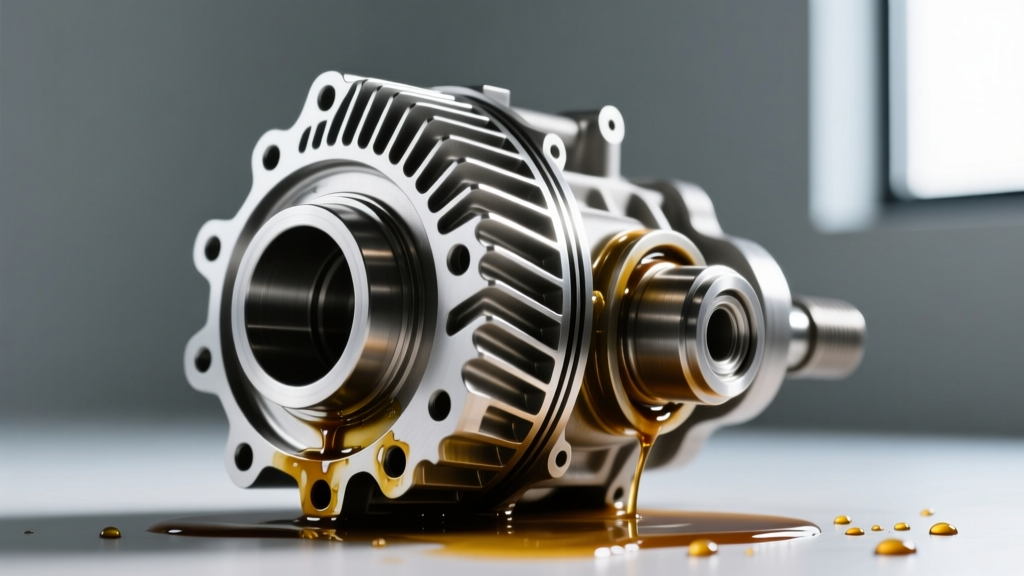
| Fluid on garage floor | Parked / Static | Axle seal or pinion seal failure | Replace seal, clean breather valve |
The Science of Gear Oil Degradation
To effectively fix rear differential issues related to noise and heat, you must understand the chemistry of hypoid gear lubrication. Rear differentials require API GL-5 rated gear oil. GL-5 fluids contain high levels of sulfur-phosphorus extreme pressure (EP) additives. Under the intense sliding pressure of hypoid gears, these additives react with the metal surfaces to create a sacrificial solid-film boundary layer that prevents metal-to-metal contact.
Over time, thermal cycling and mechanical shearing break down the viscosity index improvers in the oil. A 75W-90 fluid can shear down to the viscosity of a 75W-80, reducing the hydrodynamic wedge that separates the bearings and gears. For heavy-duty trucks equipped with AAM 11.5-inch or Dana 80 axles, upgrading to a 75W-140 synthetic, such as Motul Gear 300 or Amsoil Severe Gear, provides a thicker film strength that resists shear under high-torque towing conditions.
Troubleshooting Limited-Slip Differential (LSD) Chatter
If your vehicle is equipped with a clutch-type Limited Slip Differential (LSD), such as the Ford 8.8-inch Traction-Lok or the GM 8.6-inch G80, a common symptom of neglected maintenance is 'chatter' or 'binding' during low-speed turns. This occurs when the friction modifier additive in the gear oil depletes, causing the clutch packs to grab and release abruptly rather than slipping smoothly.
The Figure-8 Diagnostic Test
Before tearing into the differential, perform the Figure-8 test. Find an empty, clean parking lot and drive the vehicle in tight, continuous figure-8 patterns at idle speed. If you feel a rhythmic hopping or hear a grinding chatter from the rear axle, the LSD clutch packs are starving for friction modifier.
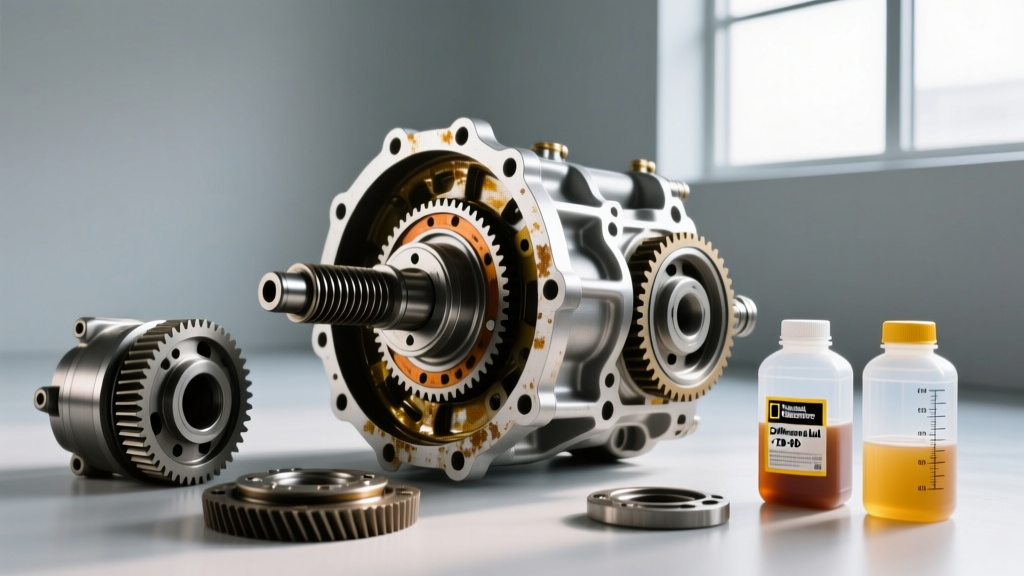
The Fix: Drain the existing fluid and refill with fresh GL-5 synthetic gear oil, accompanied by the OEM-specific friction modifier. For GM applications, use ACDelco 10-4014. For Ford applications, use Motorcraft XL-3 (EST-M2C118-A). Typically, one 4 oz bottle is sufficient, but if chatter persists after 50 miles of driving, add an additional 2 oz increment until the clutch packs engage smoothly.
Execution: Rear Differential Service Procedure & Specs
Performing a rear differential service is a cornerstone of preventative maintenance. However, improper execution can lead to immediate leaks or bearing failure. Expert technicians at Randy's Ring & Pinion emphasize the importance of proper sealing and torque specifications.
Essential Tools and Materials
- Fluid: 2.5 to 3.5 quarts of 75W-90 or 75W-140 GL-5 Synthetic Gear Oil (check door jamb sticker for exact capacity).
- Sealant: Permatex Ultra Black 85047 (Sensor-safe, high oil-resistance RTV silicone). Avoid cheap gaskets, as RTV provides a superior seal on stamped steel covers.
- Tools: 3/8-inch torque wrench, brake cleaner, gasket scraper, fluid transfer pump.
Step-by-Step Service & Torque Specifications
- Vent Clearance: Before opening the housing, locate the axle breather valve (usually on the upper axle tube). Ensure it is not clogged with mud or debris. A clogged breather causes internal pressure buildup during operation, which will force gear oil past the axle seals.
- Drain and Clean: Remove the cover bolts, leaving the top two bolts loosely threaded to act as a hinge. Pry the bottom of the cover to drain the fluid into a catch pan. Inspect the fluid for metallic glitter (normal wear) versus large metal chunks (catastrophic failure). Clean the mating surfaces on the housing and cover with brake cleaner until completely oil-free.
- RTV Application: Apply a continuous 3/16-inch bead of Permatex Ultra Black to the cover. Ensure you circle every bolt hole. Allow the RTV to skin over for 10 minutes before mating it to the housing.
- Torque Sequence: Hand-start all bolts, then torque them in a crisscross pattern.
- Ford 8.8-inch: 28-38 lb-ft
- GM 8.6-inch (10-bolt): 22 lb-ft
- Dodge AAM 11.5-inch: 35 lb-ft
- Fill and Verify: Pump fluid into the fill hole until it reaches the exact bottom lip of the plug opening. Do not overfill, as expanding fluid will blow past the pinion seal.
The Pinion Seal Trap: Crush Sleeves vs. Solid Spacers
If your diagnosis reveals a leak at the front of the differential where the driveshaft connects, you need to replace the pinion seal. However, this is where many DIYers destroy their differentials. Most factory differentials use a 'crush sleeve' to set the pinion bearing preload. If you overtighten the pinion nut to stop a leak or secure a new seal, you will over-crush the sleeve, generating massive friction and destroying the pinion bearings within 500 miles.
Expert Tip: When replacing a pinion seal, mark the pinion nut and shaft with a paint pen. Count the exact number of threads exposed and use an inch-pound torque beam wrench to measure the rotational drag before removal. Reinstall the new seal and tighten the nut only to the exact same thread count and rotational drag. Alternatively, upgrade to a solid pinion spacer kit during your next gear service, which eliminates the crush sleeve variable entirely and allows for safe, repeated pinion nut removal.
Cost Analysis: Preventative Service vs. Catastrophic Repair
Ignoring rear differential symptoms is a fast track to a depleted wallet. A standard DIY fluid and friction modifier service costs between $80 and $150, depending on the synthetic oil brand and axle capacity. If a pinion seal is leaking, the seal itself costs less than $20, though the labor requires careful torque management.
Conversely, if degraded fluid leads to spun pinion bearings or wiped ring gear teeth, a complete rear differential rebuild—including new bearings, seals, a gear set, and professional setup labor—will easily range from $1,500 to $2,800 in 2026. By understanding the auditory symptoms and adhering to strict torque and fluid specifications, you can confidently fix rear differential issues early, ensuring your drivetrain survives the harshest miles ahead.