The Acoustic Signature: Identifying Failing Bearings in Rear Differential Housings
The rear differential is a marvel of mechanical torque multiplication, relying on a precise network of tapered roller bearings to support the pinion gear, carrier assembly, and axle shafts. When evaluating bearings in rear differential assemblies, symptom diagnosis is primarily an acoustic and tactile exercise. Because these bearings operate under extreme radial and thrust loads, their failure modes produce distinct auditory signatures that change based on vehicle speed, load, and gear oil temperature.
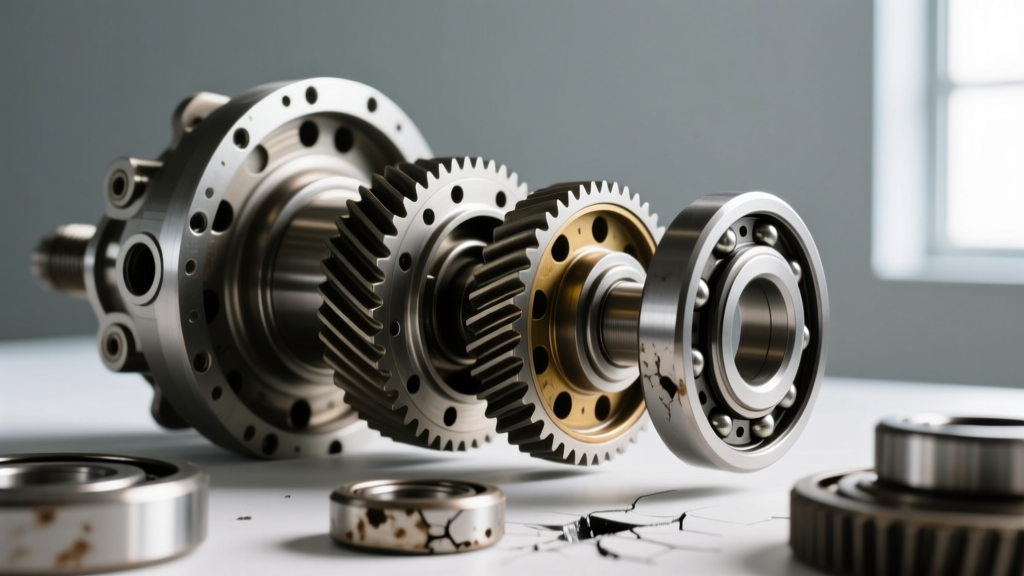
Ignoring the early warning signs of bearing degradation does not just result in an annoying cabin drone; it leads to catastrophic loss of gear mesh. As a bearing race spalls or a roller cages fractures, the pinion or carrier shifts out of its engineered axis. This misalignment alters the critical backlash and tooth contact pattern between the ring and pinion gears, often destroying a $600+ gear set in a matter of miles. According to drivetrain engineering data from Spicer/Dana, over 40% of premature ring and pinion failures are directly traced back to improper bearing preload or undiagnosed bearing wear.
Drive vs. Coast Load Testing
To accurately isolate failing bearings in rear differential units, a technician must perform a dynamic load test. The drivetrain must be evaluated under three distinct states: acceleration (drive load), deceleration (coast load), and steady-state cruising. Tapered roller bearings are designed to handle thrust loads in a specific direction. When you accelerate, the pinion gear attempts to 'climb' out of the ring gear, placing maximum thrust load on the inner pinion bearing. When you coast, the load reverses, shifting the thrust to the outer pinion bearing and altering the stress on the carrier bearings.
Expert Insight: If a high-pitched whine occurs exclusively under acceleration but vanishes when you lift off the throttle, the inner pinion bearing is likely suffering from race fatigue or inadequate preload. If the noise is present only on coast, suspect the outer pinion bearing or a worn pinion seal riding surface.
Symptom Mapping: Pinion, Carrier, and Axle Bearings
Diagnosing the exact source of differential noise requires mapping the frequency and pitch of the sound against vehicle behavior. Below is a diagnostic matrix used by senior drivetrain technicians to isolate the failing component.
| Acoustic Symptom | Driving Condition | Speed Dependency | Primary Suspect Component |
|---|---|---|---|
| High-pitched, continuous whine | Hard Acceleration | Increases with RPM | Inner Pinion Bearing / Pinion Preload Loss |
| Low-frequency growl or rumble | Steady Cruise (45-65 mph) | Peaks at specific resonance | Carrier Bearings / Carrier Bore Wear |
| Rhythmic knocking or clicking | Low-speed tight turns | Matches wheel rotation | Axle Shaft Bearings / C-Clip Wear |
| Grinding or crunching | All conditions | Constant | Catastrophic Bearing Cage Failure / Gear Spalling |
Precision Diagnostics: Measuring Preload and Runout
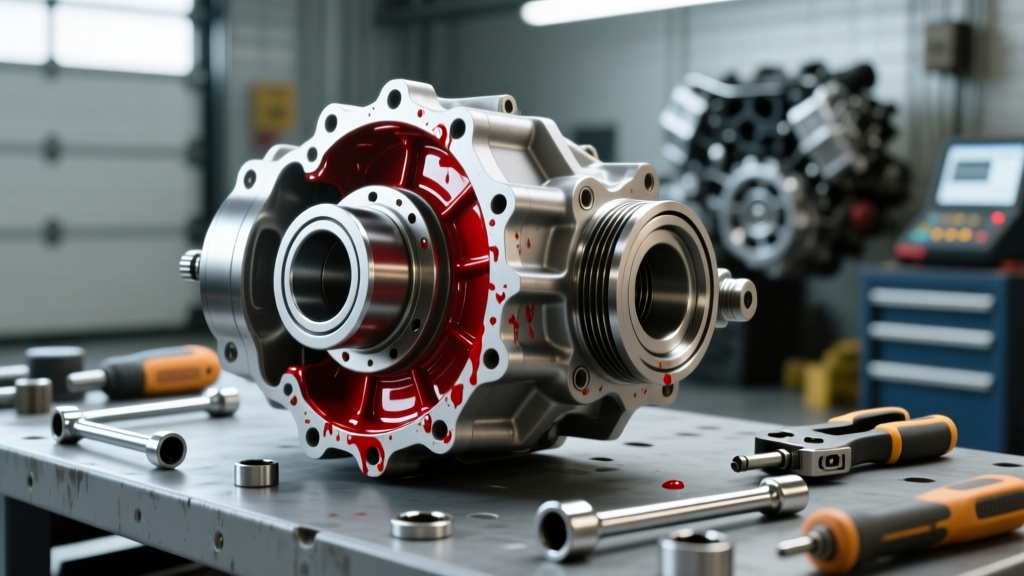
Before tearing down the differential, quantitative measurements must be taken to confirm bearing failure and establish baseline specifications for the rebuild. You will need a dial indicator with a magnetic base and an inch-pound beam-style torque wrench.
Step 1: Pinion Bearing Preload Verification
Remove the driveshaft and rear brake calipers to eliminate drag. Attach the inch-pound torque wrench to the pinion nut and rotate the pinion flange slowly to measure rotational drag. For most light-duty truck differentials, such as the ubiquitous GM 8.5-inch 10-bolt or the Ford 8.8-inch, the specification for used bearings is significantly lower than for new bearings.
- GM 8.5-inch / 8.6-inch 10-Bolt: Used bearing preload: 12-22 in-lbs. New bearing preload: 20-35 in-lbs.
- Ford 8.8-inch (Solid Axle): Used bearing preload: 8-14 in-lbs. New bearing preload: 16-29 in-lbs.
- Dana 60 (Heavy Duty): Used bearing preload: 15-25 in-lbs. New bearing preload: 25-40 in-lbs.
If your reading is below the 'used' specification, the crush sleeve has likely yielded over time, or the pinion nut has backed off, resulting in zero preload. This allows the pinion gear to oscillate under load, destroying the gear teeth and the bearing races.
Step 2: Carrier Bearing Side Play and Runout
Mount a dial indicator against the backside of the ring gear. Pry the carrier assembly upward using a pry bar between the carrier bearing cap and the housing. Total indicated runout (TIR) or side play should generally not exceed 0.005 inches. Excessive lateral movement indicates worn carrier bearings or stretched bearing caps, requiring a complete housing inspection and bearing replacement.
Service and Maintenance: Fluid Degradation and Bearing Starvation
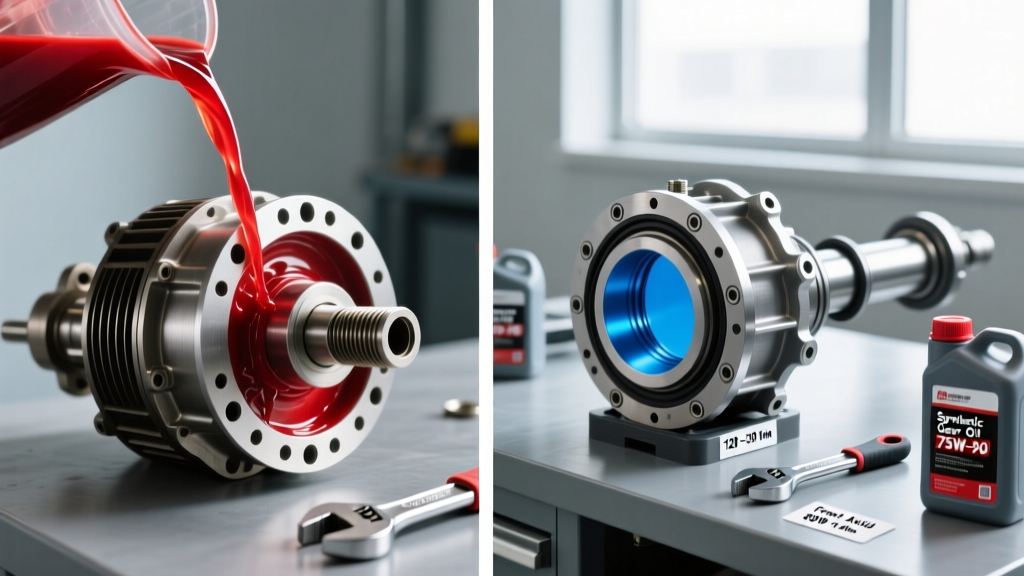
The lifespan of bearings in rear differential assemblies is inextricably linked to gear oil integrity. Modern 75W-90 and 75W-140 GL-5 synthetic gear oils contain extreme pressure (EP) additives, typically sulfur-phosphorus compounds, designed to protect gear teeth under high sliding friction. However, these fluids also carry the vital suspension of heat away from the tapered roller bearings.
Over 60,000 to 100,000 miles, the fluid's viscosity index improvers shear down. A 75W-140 fluid can degrade to the operational viscosity of a 90-weight oil under severe towing temperatures exceeding 250°F. When the fluid thins, the hydrodynamic wedge between the bearing rollers and the race collapses, leading to boundary lubrication, micro-welding, and eventual spalling.
The Magnet Test: Fluid Analysis
During a routine rear differential service, draining the fluid provides a direct window into bearing health. Wipe the differential cover magnet and the drain plug. Spicer drivetrain technicians note that a fine, glittery paste on the magnet is normal wear from the clutch packs in limited-slip differentials. However, if you find metallic flakes, chips, or distinct roller fragments, the bearings have already suffered structural failure, and a fluid change will not save the assembly. A complete teardown and rebuild are mandatory.
Replacement Protocol: Crush Sleeves vs. Solid Spacers
When replacing the pinion bearings, technicians face a critical decision regarding preload adjustment. Original Equipment Manufacturers (OEMs) utilize a 'crush sleeve'—a thin, collapsible steel spacer placed between the inner and outer pinion bearings. To achieve the correct preload, the pinion nut is torqued to massive levels (often 175 to 250 ft-lbs) to physically crush the sleeve until the desired inch-pound rotational drag is achieved.
The flaw with the crush sleeve is that it is a one-time-use component. If you over-torque the nut by even a fraction of a turn, the preload is too high, the bearings will overheat and seize within 50 miles, and you must discard the sleeve and start over. Furthermore, under heavy shock loads (like rock crawling or aggressive drag racing launches), the crush sleeve can yield, instantly losing all pinion preload.
The Solid Spacer Upgrade
For high-performance, towing, or off-road applications, upgrading to a solid preload spacer kit (available from manufacturers like Ratech or Yukon Gear) is highly recommended. A solid spacer uses precision-machined steel shims to set the bearing preload. While it requires more time to measure and select the correct shim thickness, it provides a permanent, non-yielding preload that will never degrade under shock loads, vastly extending the life of the new pinion bearings.
Cost Analysis and OEM Part Sourcing
Sourcing high-quality bearings is non-negotiable. The differential environment is unforgiving, and offshore, unbranded bearing kits often feature inferior metallurgy and improperly heat-treated races that will fail in under 10,000 miles. Always specify premium tapered roller bearings from industry leaders like Timken, SKF, or Koyo.
Common Bearing Kit Part Numbers
- GM 8.5' 10-Bolt Carrier Bearing Kit: Timken SET 34 (Includes LM104948 and LM104912 races/cones).
- GM 8.5' 10-Bolt Pinion Bearing Kit: Timken SET 45 (Includes inner and outer pinion bearings and seals).
- Ford 8.8' Carrier Bearing Kit: Timken SET 36.
- Dana 60 Carrier Bearing Kit: Timken SET 70.
Real-World Pricing Expectations
For a complete rear differential bearing overhaul (often called a 'master rebuild kit' which includes all bearings, seals, shims, and ring gear bolts), expect to pay between $120 and $250 for premium parts. If the ring and pinion must also be replaced due to bearing-induced misalignment, add $250 to $450 for the gear set. Professional shop labor for a bearing and gear setup typically ranges from $600 to $900, bringing the total repair cost to between $950 and $1,600 depending on the axle complexity and limited-slip clutch pack servicing.
Proper diagnosis of bearings in rear differential systems requires patience, precision tools, and an understanding of acoustic load mapping. By catching bearing wear early and utilizing solid spacers and premium synthetic 75W-140 fluids, you can ensure the drivetrain survives the brutal torque demands of modern trucks and SUVs for hundreds of thousands of miles.