The Catastrophic Reality of a Cracked Torque Converter
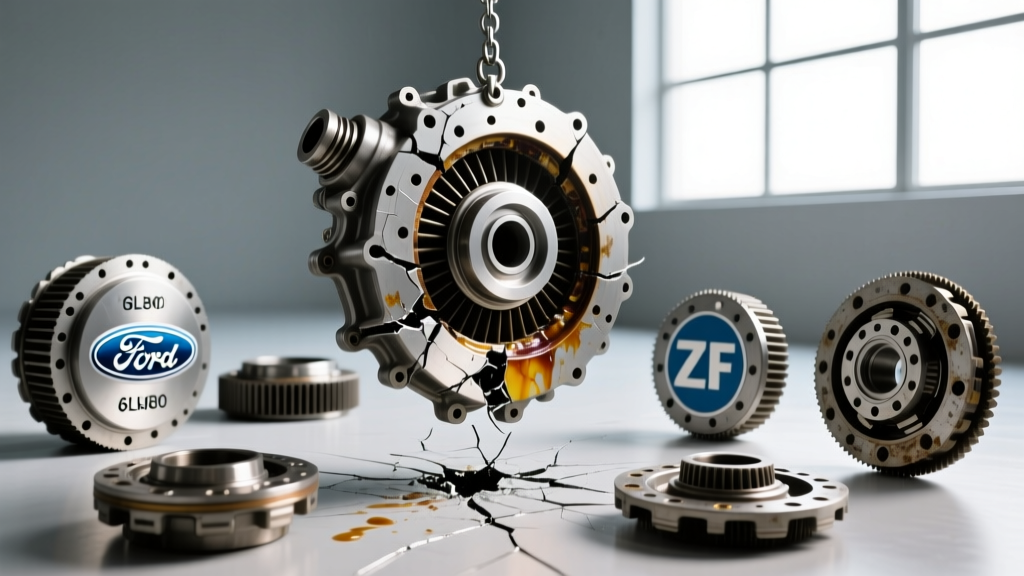
A cracked torque converter is a structural death sentence for your drivetrain. Unlike standard friction wear or solenoid faults, a physical fracture—whether at the impeller hub, the TIG-welded perimeter seam, or the turbine spline—introduces metallic debris directly into the hydraulic circuit. In 2026, with specialized drivetrain shop labor rates averaging $165 to $195 per hour, diagnosing and replacing a cracked unit requires a precise financial and mechanical roadmap. According to Sonnax Technical Resources, structural converter failures account for a significant percentage of catastrophic front pump and input shaft destruction if the vehicle is driven after initial symptoms appear.
This model-specific repair guide breaks down the exact replacement costs, OEM part numbers, and hidden machine shop fees associated with a cracked torque converter in the most common modern automatic transmissions: the GM 6L80/6L90, Ford 10R80, and ZF 8HP series.
Why Torque Converters Crack: Metallurgical and Stress Factors
Before evaluating costs, it is critical to understand where and why these units fracture. A cracked torque converter typically fails in one of three specific zones:
- The Impeller Hub: The hub rides on the transmission stator support. If the bushing fails or lubrication is starved, galling occurs. The resulting friction and heat cause the hub to expand and crack, often taking the front pump rotor with it.
- The Perimeter TIG Weld: High-stall applications, heavy towing, or aggressive lockup strategies place immense torsional stress on the outer seam. Porosity in the original TIG weld can propagate into a full circumferential crack, leading to massive fluid leaks and pressure loss.
- The Cover / Flex Plate Interface: Excessive flex plate runout (greater than 0.010 inches) causes the converter cover to flex with every engine revolution. Over time, this cyclic fatigue cracks the steel cover near the mounting pads.
2026 Model-Specific Replacement Cost Breakdown
The following table outlines the estimated costs for replacing a cracked torque converter across three major transmission platforms. These figures reflect 2026 national averages for parts, OEM fluids, and standard R&R (Remove and Replace) labor times.
| Transmission Model | OEM Part Number | Part Cost (2026) | Labor Hours | Total Estimated Cost |
|---|---|---|---|---|
| GM 6L80 / 6L90 | 24258819 (OEM) | $450 - $850 | 6.8 hrs | $1,650 - $2,400 |
| Ford 10R80 | JL3Z-7902-B | $750 - $1,100 | 7.5 hrs | $2,100 - $2,900 |
| ZF 8HP70 (Chrysler/Dodge) | 68157735AA | $900 - $1,400 | 8.2 hrs | $2,500 - $3,400 |
Deep Dive: GM 6L80 and 6L90 Platforms
The GM 6L80 and 6L90 transmissions, found in Silverados, Camaros, and Corvettes, utilize a 300mm torque converter. When paired with modified LS or LT engines, the factory stamped-steel covers are highly susceptible to warping and perimeter weld cracking under high torque loads.
Repair Nuances and Hidden Costs
If the crack originates at the impeller hub, you must inspect the front pump. A scored pump body requires replacement (OEM Pump Part # 24250116, approx. $450). Furthermore, GM specifies that the flex plate must be measured for runout. If runout exceeds 0.010 inches, the flex plate must be replaced to prevent the new converter from cracking prematurely.
- Fluid Requirement: Dexron VI or Dexron ULV (Approx. 11.2L dry fill, $120 in fluid).
- Torque Specs: Flex plate to crankshaft (M10x1.5): 25 Nm + 50 degrees. Torque converter to flex plate (M8x1.25): 25 Nm.
- Billet Upgrade: For vehicles pushing over 500 lb-ft of torque, experts at Transmission Digest recommend upgrading to a billet steel cover converter ($850 - $1,200) to eliminate cover flex and weld failures entirely.
Deep Dive: Ford 10R80 Platform
The Ford 10R80, ubiquitous in F-150s, Mustangs, and Expeditions, features an aggressive torque converter clutch (TCC) lockup strategy that engages in multiple gears to improve fuel economy. This constant lockup transfers severe engine harmonics directly into the converter's internal torsional dampers.
Failure Modes and Diagnostics
In early 2018-2020 models, cracks frequently initiate at the turbine hub due to inadequate dampening of the Coyote V8 or EcoBoost V6 harmonics. A cracked turbine hub will cause severe TCC shudder, followed by a complete loss of lockup and eventual internal contamination. Because the 10R80 is deeply integrated with the vehicle's PCM, a post-installation TCC adapt and relearn procedure is mandatory, adding 0.5 hours of shop time to the bill.
- Fluid Requirement: Mercon ULV (Approx. 13.1L dry fill. ULV fluid is expensive, averaging $280 for a full flush and fill).
- Torque Specs: Flex plate to crankshaft: 80 Nm. Torque converter to flex plate: 25 Nm.
- Thermostat Bypass: Many shops recommend installing a thermal bypass delete kit ($150) during the R&R to ensure immediate converter lubrication upon cold startup, preventing future hub galling.
Deep Dive: ZF 8HP70 Platform
The ZF 8HP transmission is a masterpiece of engineering, but its torque converter is incredibly complex. The ZF 8HP70 converter utilizes a multi-stage torsional damper with internal coil springs and a centrifugal pendulum absorber. When these internal springs fatigue and shatter, the broken metal fragments can puncture or crack the outer converter cover from the inside out.
The Cost of Precision
Replacing a cracked ZF converter is the most expensive of the three due to the sheer cost of the OEM unit and the complexity of the bellhousing removal. You cannot use generic ATF in these units; doing so will destroy the mechatronic sleeve and clutch packs. ATSG (Automatic Transmission Service Group) strictly mandates the use of specific ZF-approved fluids to maintain the precise friction coefficients required for the ZF's rapid shift events.
- Fluid Requirement: ZF LifeguardFluid 8 or Mopar ZF 8&9 Speed ATF (Approx. 9.5L, $220).
- Sealing Sleeve: The mechatronic sealing sleeve should be replaced while the transmission is out (Part # 68225053AA, $45) to prevent cross-leaks.
- Adaptation: Requires a bi-directional scan tool to reset the ZF clutch adaptions and fill pressures.
Hidden Costs: Cooler Flushing and Drivetrain Alignment
When a torque converter cracks, metallic shavings and friction material are pumped directly into the transmission cooler lines and the radiator's internal heat exchanger. In 2026, no reputable drivetrain shop will warranty a new torque converter without performing a heated, pressurized cooler flush ($150 - $225). If the cooler is clogged with debris from the cracked hub, the new unit will starve for lubrication and fail within 500 miles.
Additionally, improper drivetrain alignment during reinstallation can induce severe vibration. The transmission crossmember must be torqued to factory specifications (typically 50-70 Nm depending on the chassis) only after the engine and transmission mounts are fully seated, ensuring the input shaft remains perfectly concentric with the converter hub.
Expert Decision Matrix: OEM vs. Billet Replacement
How should you proceed when faced with a cracked unit?
- Choose OEM Replacement If: The vehicle is stock, used for daily commuting, and you plan to sell it within two years. OEM units provide factory-validated stall speeds and lockup characteristics.
- Choose Billet / Aftermarket Upgraded If: The vehicle is used for towing, has a modified engine (cams, superchargers, or tuning), or if the original failure was caused by a known weak point (like the 6L80 perimeter weld). Billet covers and forged hubs cost 40% more but offer infinite fatigue life.
- Choose Complete Transmission Rebuild If: The crack occurred at the impeller hub and the vehicle was driven for more than 5 miles after the noise began. The metallic debris will have embedded itself into the clutch pack friction materials and the valve body bore, requiring a full teardown and hot-tank cleaning.
Understanding the root cause of a cracked torque converter and the specific financial requirements of your transmission platform is the only way to ensure a lasting repair in today's automotive landscape.