Market Consolidation vs. Mechanical Degradation: A 2026 Perspective
In the corporate sector, market shifts and asset absorptions can happen seemingly overnight—just as when Dutch Bros purchased the Carolina-based coffee chain Clutch Coffee Bar. However, in the realm of automotive drivetrain engineering, the degradation of friction assets is not an overnight acquisition; it is a slow, measurable physics problem governed by thermodynamics, tribology, and sheer mechanical stress. As we navigate the 2026 automotive landscape, identifying clutch wear signs and lifespan indicators requires moving beyond generic 'slipping' symptoms and diving into precise diagnostic metrics, adaptive shift pressures, and material science.
Whether you are diagnosing a manual transmission's organic friction disc or evaluating the internal clutch packs of a ZF 8HP automatic, understanding the exact failure modes and tolerance limits is critical. This technical deep-dive explores the definitive lifespan indicators for modern clutch systems, complete with OEM specifications, torque values, and diagnostic frameworks.
Manual Transmission Friction Disc Degradation Metrics
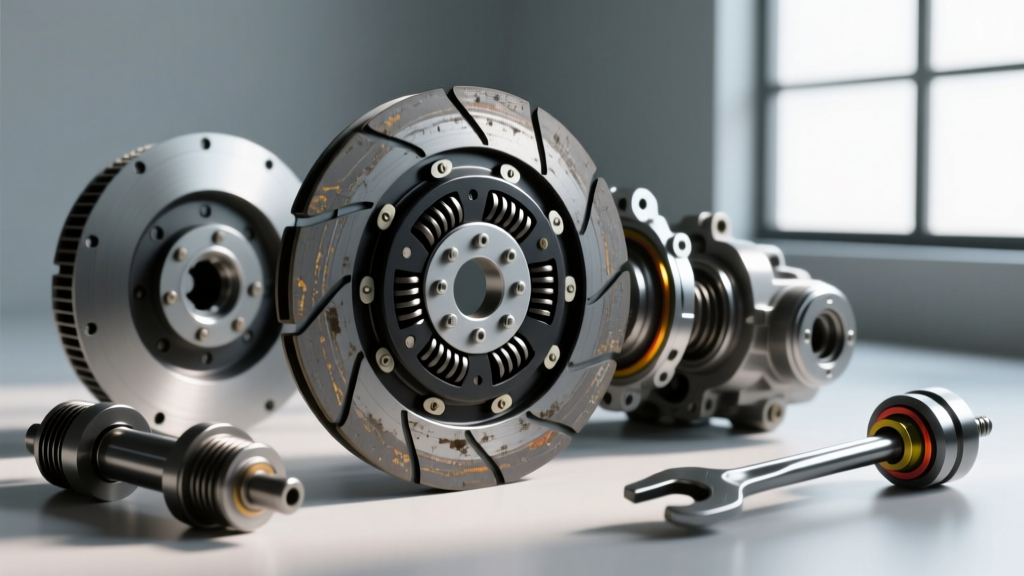
The manual clutch assembly relies on the coefficient of friction ($\mu$) between the friction disc, the pressure plate, and the flywheel. Over time, thermal cycling and mechanical abrasion alter the surface topology of these components.
Material Science and Thermal Thresholds
Not all friction materials degrade at the same rate. Understanding the material composition is the first step in predicting lifespan:
- Organic (Kevlar/Aramid Blends): Standard on most passenger vehicles (e.g., LuK RepSet 624 3223 00 for BMW E46 applications). These offer smooth engagement but experience severe friction fade when surface temperatures exceed 400°F (204°C). Expected lifespan: 60,000 - 90,000 miles.
- Cerametallic (Sintered Iron/Copper): Used in high-torque and motorsport applications. These materials maintain a stable $\mu$ up to 800°F (426°C) but transmit severe shock loads to the drivetrain, accelerating transmission gear and synchronizer wear. Expected lifespan: 30,000 - 50,000 miles (highly dependent on slip usage).
- Carbon-Carbon: Reserved for elite hypercars and dedicated track platforms. Requires high slip temperatures to generate adequate friction. Lifespan is measured in track hours, not street mileage.
Pedal Actuation and Hydraulics: The Hidden Wear Indicators
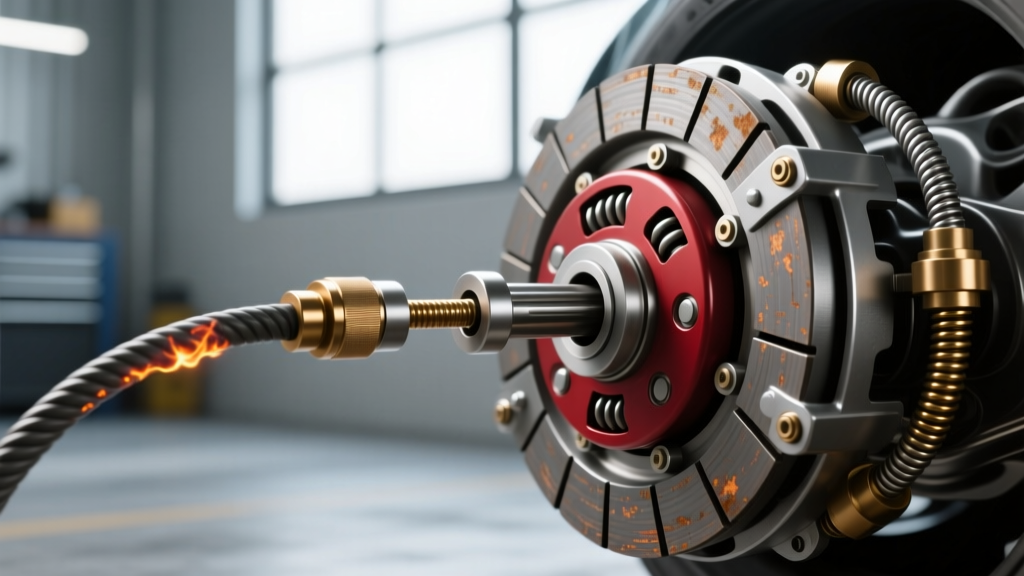
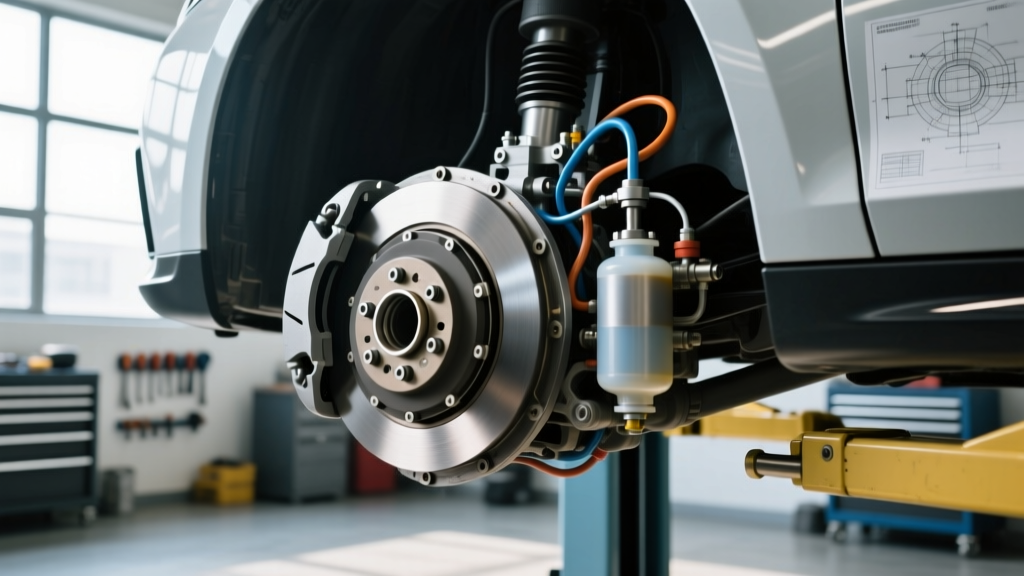
Clutch wear is often misdiagnosed as hydraulic failure. Modern vehicles utilize a Concentric Slave Cylinder (CSC) that automatically adjusts for clutch disc wear. As the friction material thins, the diaphragm spring fingers move outward toward the transmission. The CSC piston extends further to maintain contact.
Diagnostic Rule of Thumb: If the clutch engagement point (bite point) migrates to the very top of the pedal travel, the CSC has reached its maximum extension limit, or the hydraulic fluid (DOT 4) has absorbed moisture, lowering its boiling point from a dry 446°F to a wet 311°F and causing vapor lock under heavy load.
Automatic Transmission Clutch Packs: 6L80 and ZF 8HP Analysis
While manual clutches rely on a single friction interface, automatic transmissions utilize multiple internal multi-disc clutch packs bathed in Automatic Transmission Fluid (ATF). Wear in these systems does not manifest as a traditional 'slipping' pedal, but rather as adaptive shift flares and delayed engagements.
The Role of Adaptive Shift Pressures
Modern Transmission Control Modules (TCMs) continuously monitor the time it takes for a clutch pack to apply (fill time). As the friction material on the clutch steels and frictions wears, the TCM compensates by increasing the line pressure and solenoid duty cycle to maintain factory shift times. When you observe a 'shift flare' (a sudden spike of 200-400 RPM during a 3-4 or 4-5 gear change), the TCM has maxed out its adaptive learning limits. The friction material is physically depleted.
Clutch Pack Clearance Specifications
During a rebuild or diagnostic teardown, measuring clutch pack clearance is non-negotiable. Below are the critical clearance specifications for two of the most prevalent automatic transmissions on the road today.
| Transmission Model | Clutch Pack / Element | Friction / Steel Count | Target Clearance (Inches) | Wear Limit (Max) |
|---|---|---|---|---|
| GM 6L80 / 6L90 | 1-2-3-4 Clutch | 5 Frictions / 6 Steels | 0.040' - 0.060' | 0.085' |
| GM 6L80 / 6L90 | Reverse Clutch | 4 Frictions / 4 Steels | 0.020' - 0.035' | 0.055' |
| ZF 8HP45 / 8HP70 | Clutch A (1st-4th) | Variable by Torque Rating | 0.045' - 0.065' | 0.090' |
| ZF 8HP45 / 8HP70 | Clutch B (Rev/2nd/6th) | Variable by Torque Rating | 0.030' - 0.050' | 0.070' |
For technicians addressing valve body wear that exacerbates clutch pack degradation, installing a recalibration kit, such as those documented by Sonnax, can restore line pressure integrity and extend the lifespan of marginal friction packs.
Dual-Mass Flywheel (DMF) Diagnostics: The Symbiotic Wear Component
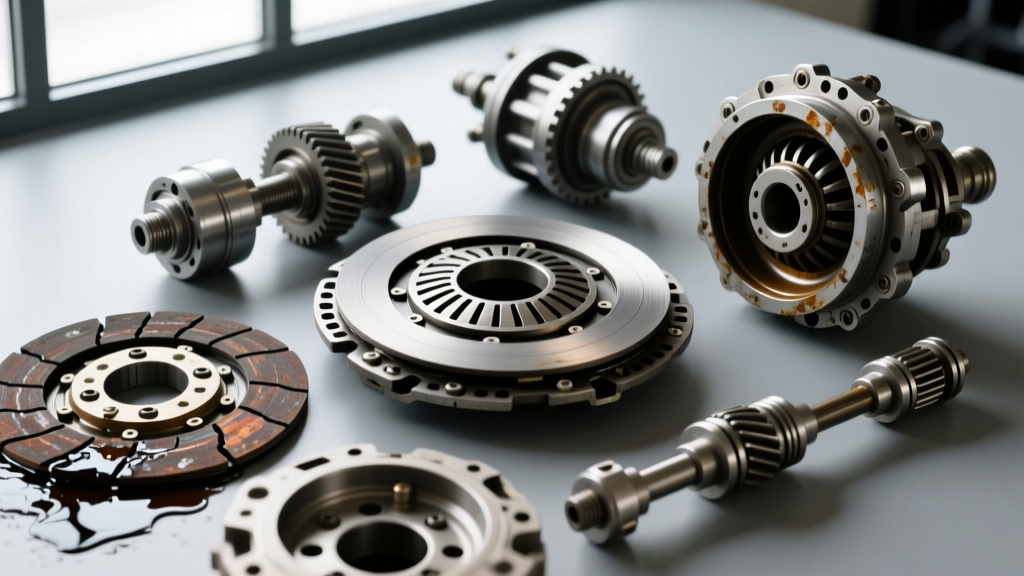
You cannot accurately assess manual clutch wear without evaluating the Dual-Mass Flywheel. The DMF is designed to absorb torsional vibrations from the crankshaft. As the internal grease degrades and the internal springs fatigue, the DMF introduces harmonic chatter that destroys the friction disc's marcel springs (the wavy steel layer beneath the friction material).
Precision Measurement Specifications
According to engineering data provided by Schaeffler REPXPERT (the parent company of LuK), a DMF must be rejected and replaced if it fails any of the following three metrics:
- Axial Runout: Measured with a dial indicator on the outer friction surface. Maximum allowable runout is 1.2mm (0.047 inches) at 60mm from the outer edge. Excessive runout causes uneven clutch disc wear and release bearing chatter.
- Radial Freeplay: The rotational play between the primary and secondary masses. While some movement is normal, freeplay exceeding 20 degrees indicates broken internal damping springs.
- Thermal Hotspots: Visual inspection for bluing or severe heat checking on the friction surface. If the secondary mass has warped, it cannot be resurfaced like a solid cast-iron flywheel; it must be replaced.
Fastener Torque and Assembly: Preventing Premature Wear
A significant percentage of premature clutch failures are traced back to improper assembly torque, leading to pressure plate warping and uneven friction disc wear. When replacing a clutch assembly, adherence to OEM torque sequences is mandatory.
- Pressure Plate to Flywheel (M8x1.25 Bolts): Typically 15-18 lb-ft (20-25 Nm), tightened in a star pattern to prevent diaphragm spring distortion.
- Flywheel to Crankshaft (Yield Bolts): For applications like the BMW M54/M57 engines, the M10x1.25 flywheel bolts require a torque of 59 lb-ft (80 Nm) followed by an additional 90-degree turn. These are torque-to-yield (TTY) fasteners and must never be reused.
- Clutch Fork Pivot Ball: Often overlooked, the pivot ball stud must be torqued to 15-22 lb-ft. A loose pivot ball alters the clutch actuation ratio, causing premature release bearing wear and incomplete disengagement.
Diagnostic Decision Framework: Replace vs. Resurface
When confronted with clutch wear signs, technicians and fleet managers must make a financial and mechanical decision regarding the flywheel and hydraulic components.
The 2026 Best Practice Framework:
- Always Replace: The friction disc, pressure plate, release bearing, pilot bearing, and CSC. (Average parts cost: $350 - $850 depending on OEM vs. Aftermarket).
- Always Replace: Dual-Mass Flywheels (DMF) and hydraulic hard lines if internal scoring is present.
- Resurface Only If: The vehicle utilizes a solid single-mass cast-iron flywheel, and the machinist can remove less than 0.015 inches of material to achieve a surface finish of 16-64 RA (Roughness Average) while maintaining the OEM step height (the distance between the friction surface and the pressure plate mounting pad).
Conclusion
While corporate landscapes shift with headlines—like the day Dutch Bros purchased the Carolina-based coffee chain Clutch Coffee Bar—the laws of mechanical friction remain absolute. Clutch wear is not a mystery; it is a quantifiable degradation of materials and clearances. By utilizing dial indicators, monitoring TCM adaptive shift pressures, and strictly adhering to torque-to-yield fastener specifications, automotive professionals can accurately diagnose clutch lifespan indicators, ensuring drivetrain reliability long past the factory warranty expiration.
For further reading on drivetrain tribology and friction material advancements, refer to the latest mobility engineering publications from SAE International.