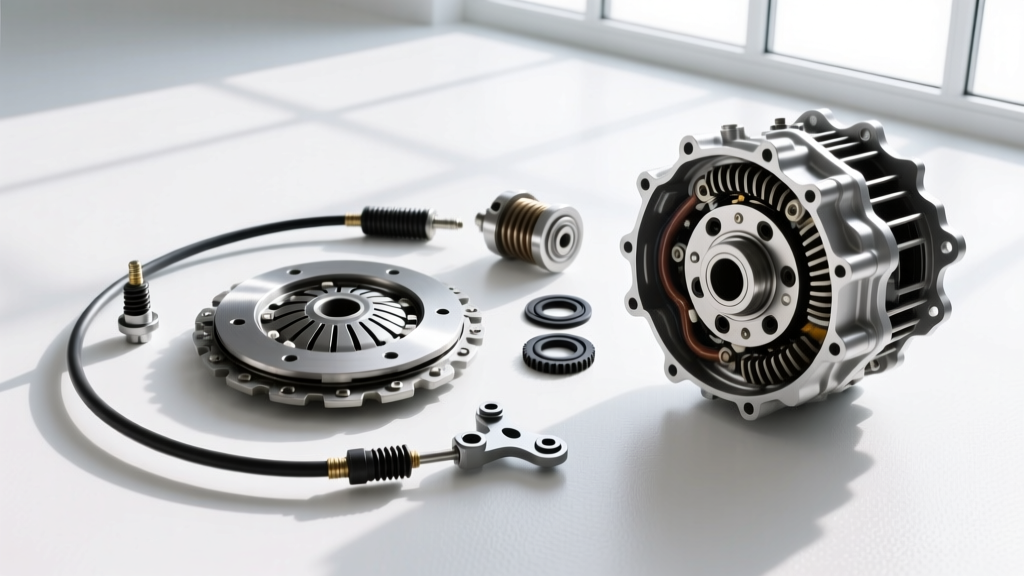
When a manual transmission vehicle begins to vocalize its mechanical distress, the clutch assembly is usually the prime suspect. However, misdiagnosing clutch noise is one of the most common—and expensive—mistakes made in modern drivetrain diagnostics. A grinding noise during gear engagement doesn't automatically mean your synchronizers are destroyed, and a high-pitched squeal doesn't always demand a full transmission drop. In 2026, with the proliferation of complex concentric slave cylinders (CSCs) and high-torque hydraulic master cylinders, understanding the intersection of mechanical wear and hydraulic failure is paramount.
This expert guide breaks down the specific acoustic signatures of clutch failure, isolates the root causes of gear grinding, and provides a masterclass on how to bleed hydraulic clutch circuits to restore proper disengagement stroke.
The Symphony of Failure: Decoding Clutch Noises
Clutch noises generally fall into three distinct acoustic categories: chirping, squealing, and grinding. Pinpointing the exact moment the noise occurs relative to pedal position is the key to an accurate diagnosis.
Chirping and Squealing: Isolating the Bearings
A chirping sound that occurs when the clutch pedal is fully released (foot off the pedal) and disappears when lightly depressed usually points to a failing pilot bearing or wear on the transmission input shaft bearing. The pilot bearing supports the input shaft; when its grease dries out or the needle bearings score, they emit a rhythmic, metallic chirp at idle.
Conversely, a squealing or high-pitched grinding noise that only manifests when the clutch pedal is depressed is the hallmark of a failing throwout bearing (release bearing). Modern SKF clutch release bearings are designed to handle immense axial loads, but when the internal race wears or the lubricant degrades due to excessive heat, the bearing squeals as it contacts the spinning diaphragm spring fingers of the pressure plate. If your vehicle uses a hydraulic Concentric Slave Cylinder (CSC), the bearing and hydraulic actuator are a single unit, meaning a squeal dictates a full CSC replacement.
Grinding: Mechanical Interference vs. Hydraulic Failure
Gear grinding (gear clash) during shifting is widely assumed to be a sign of worn synchronizer rings—such as the carbon-fiber synchros found in a Tremec T56 Magnum transmission. However, if the grinding occurs across all forward gears and is especially violent when engaging Reverse (which typically lacks synchronizers in many manual gearboxes), the issue is rarely internal transmission damage. Instead, it is almost always caused by incomplete clutch disengagement.
If the clutch disc remains partially clamped against the flywheel while you attempt to slide a gear into mesh, the input shaft continues to spin, resulting in violent gear clash. While a warped clutch disc or a broken pressure plate finger can cause this, the most frequent culprit in modern vehicles is a hydraulic system compromised by air or internal master cylinder bypass.
The Hydraulic Link: Why Air Causes Gear Grinding
To understand why hydraulic issues cause mechanical grinding, you must understand the stroke volume of the clutch master cylinder. When you press the pedal, the master cylinder pushes a specific volume of DOT fluid through the hard line and flexible hose to the slave cylinder. The slave cylinder then translates this fluid volume into linear mechanical movement, pushing the clutch fork or CSC to disengage the pressure plate.
If air enters the system—through a micro-leak at the slave cylinder pushrod seal, a degraded flexible hose, or simply via fluid hygroscopy (DOT fluid absorbing moisture over time and boiling under heat)—the hydraulic fluid becomes compressible. When you press the pedal, the master cylinder stroke is wasted compressing the air bubbles rather than moving the slave cylinder. The result? The clutch fork only travels 70% of its required distance. The clutch drags, the input shaft spins, and your gears grind.
Masterclass: How to Bleed Hydraulic Clutch Systems Properly
Knowing how to bleed hydraulic clutch lines is a critical diagnostic and repair skill. Simply 'pumping the pedal' like an old brake system often fails on modern clutch layouts, especially where the slave cylinder is mounted higher than the master cylinder (common in mid-engine or transaxle layouts like the Porsche 911 or Corvette). Air naturally rises; pushing fluid from the top down forces air to fight gravity.
The Reverse-Bleeding Protocol
For stubborn hydraulic clutch systems, reverse bleeding is the industry gold standard. This involves pushing fresh fluid from the slave cylinder bleeder valve UP into the master cylinder reservoir.
- Fluid Selection: Flush the old fluid and prepare a reverse bleeder syringe with fresh, high-boiling-point fluid. We recommend Castrol SRF or Motul RBF 600 (DOT 4) for high-performance applications, or OEM-spec DOT 4 for daily drivers. Never use DOT 5 (silicone), as it is compressible and will ruin pedal feel.
- Reservoir Prep: Use a turkey baster to extract 80% of the old fluid from the master cylinder reservoir to prevent overflow when reverse-bleeding.
- Connect the Syringe: Attach your reverse bleeder hose to the slave cylinder's bleeder nipple.
- Crack the Valve: Using a 6-point flare nut wrench, crack the bleeder valve. Critical Torque Warning: Bleeder valves are notoriously brittle. Apply no more than 7 to 10 Nm (62-88 lb-in) of torque to crack or close them. Snapping a bleeder valve inside a CSC requires a transmission drop to fix.
- Inject Fluid: Slowly push the syringe plunger. You will hear and see bubbles erupting in the master cylinder reservoir. Continue until 100% of the fluid in the reservoir is clear and bubble-free.
- Close and Test: Close the bleeder valve, top off the reservoir to the MAX line, and test the pedal. It should feel like a solid wall of hydraulic pressure with zero sponginess.
Diagnostic Decision Matrix: Noise vs. Pedal Feel
Use this matrix to cross-reference acoustic symptoms with hydraulic pedal feedback before authorizing a transmission removal.
| Noise Type | Pedal Condition | Hydraulic Pedal Feel | Likely Root Cause | Corrective Action |
|---|---|---|---|---|
| Chirping at Idle | Released (Foot off) | Firm / Normal | Pilot Bearing or Input Shaft Wear | Trans Drop: Replace Pilot Bearing |
| Squealing / Grinding | Depressed (Under load) | Firm / Normal | Throwout Bearing / CSC Failure | Trans Drop: Replace CSC / TOB |
| Gear Clash (Grinding) | Depressed (Shifting) | Spongy / Low Engagement | Air in Hydraulic Lines | Reverse Bleed System |
| Gear Clash (Grinding) | Depressed (Shifting) | Pedal Sinks to Floor Slowly | Master Cylinder Internal Bypass | Replace Master Cylinder & Bleed |
| Grinding (Specific Gears) | Depressed (Shifting) | Rock Solid / Normal | Worn Synchronizer Rings | Trans Rebuild / Synchro Replacement |
Hard Data: Replacement Costs and Torque Specifications (2026 Estimates)
When diagnosis confirms that bleeding the system won't resolve the noise or engagement issues, mechanical replacement is required. Below are baseline specifications and current market costs for common rear-wheel-drive manual platforms (e.g., GM LS/Camaro, Ford Mustang GT).
- Concentric Slave Cylinder (CSC) / TOB Assembly: OEM FTE or Sachs units range from $140 to $280. Aftermarket heavy-duty options (like the McLeod or Tilton CSCs) can exceed $450.
- Full Clutch Kit (LuK RepSet / Sachs): Includes pressure plate, disc, and alignment tool. Expect $350 to $650 for OEM-replacement organic kits, and $800 to $1,400 for twin-disc cerametallic setups.
- Master Cylinder Assembly: $90 to $180. Always replace the master if the internal cup seals are bypassing, as rebuilding them is unreliable.
- Labor Rates: With 2026 shop rates averaging $140-$190/hour, a standard R&R (Remove and Replace) for a longitudinal transmission takes 4.5 to 7.0 hours, totaling $630 to $1,330 in labor alone.
Critical Fastener Torque Specs
Improper torque during reassembly leads to catastrophic drivetrain vibration and premature bearing failure. Always reference factory service manuals, but adhere to these common baselines:
- CSC to Bellhousing Bolts (e.g., GM T56): 18 lb-ft (25 Nm)
- Clutch Fork Pivot Ball Stud: 28 lb-ft (38 Nm)
- Pressure Plate to Flywheel (Standard M8 Bolts): 25 lb-ft (34 Nm) in a star pattern
- Flywheel to Crankshaft (e.g., Ford 5.0L Coyote): 59 lb-ft + 90-degree turn (Yield bolts must be replaced; ARP aftermarket bolts torque to 85 lb-ft with ARP lube).
Summary
Clutch noise diagnosis requires a methodical approach that separates acoustic mechanical wear from hydraulic inefficiencies. By understanding the distinct differences between pilot bearing chirps, throwout bearing squeals, and hydraulic-induced gear grinding, you can save thousands in unnecessary transmission teardowns. Furthermore, mastering how to bleed hydraulic clutch systems using the reverse-bleed method ensures that when you do perform a clutch replacement, the hydraulic actuation is as flawless as the mechanical components you installed.