Introduction: The Hidden Variables in Clutch Replacement
When your manual transmission begins to slip, chatter, or fail to disengage, the immediate question is often financial. However, understanding the true cost to replace clutch assemblies requires looking far beyond the hourly labor rate of your local shop. The final bill is heavily dictated by the specific clutch kit you select, the condition of your flywheel, and the hardware required for your specific transmission model. As of 2026, while OEM parts pricing has stabilized, the influx of high-torque turbocharged platforms has made proper kit selection more critical than ever. This step-by-step guide will walk you through choosing the exact friction assembly for your vehicle and break down the real-world costs associated with the job.
Step 1: Define Your Torque Capacity and Driving Profile
Before browsing catalogs, you must calculate your required torque capacity. A common mistake is purchasing a clutch rated for peak wheel torque rather than peak crank torque, or ignoring the safety margin required for high-traction scenarios. Automotive engineers generally recommend a clutch kit rated for 20% to 30% above your engine's peak crank torque output.
- Daily Commuter / Light Duty: Focus on OEM-equivalent organic kits (e.g., LuK RepSet or Sachs OE). These prioritize smooth engagement and low pedal effort.
- Heavy Towing / Diesel (e.g., Ram Cummins G56): Require high-clamp-load pressure plates and multi-puck ceramic or Kevlar discs to prevent slip under heavy load at low RPMs.
- Track / High-Performance (e.g., Mustang GT MT82, Subaru WRX): Demand aggressive friction materials and often upgraded hydraulic throwout bearings to handle rapid, high-RPM shifts.
Step 2: Select the Right Friction Material
The friction material on the clutch disc dictates not only the holding power but also the drivability, noise, vibration, and harshness (NVH) characteristics of your vehicle. According to performance manufacturing data from Exedy, matching the material to the thermal limits of your driving style is essential to prevent premature glazing or catastrophic failure.
| Friction Material | Torque Capacity | Drivability & NVH | Typical Application |
|---|---|---|---|
| Organic (Full Face) | OEM to +15% | Smooth, linear engagement. Low chatter. | Daily drivers, light towing, highway cruising. |
| Kevlar / Aramid | +30% to +50% | Requires 500+ mile break-in. Slight low-speed chatter. | Modified street cars, rally, heavy towing. |
| Ceramic (4-Puck / 6-Puck) | +50% to +100% | Aggressive, on/off engagement. High gear rattle. | Dedicated track cars, drag racing, drifting. |
| Carbon / Sintered Iron | +100%+ | Extreme chatter, requires high heat to bite. | Purpose-built race applications only. |
Step 3: The Flywheel Dilemma — DMF vs. SMF Conversions
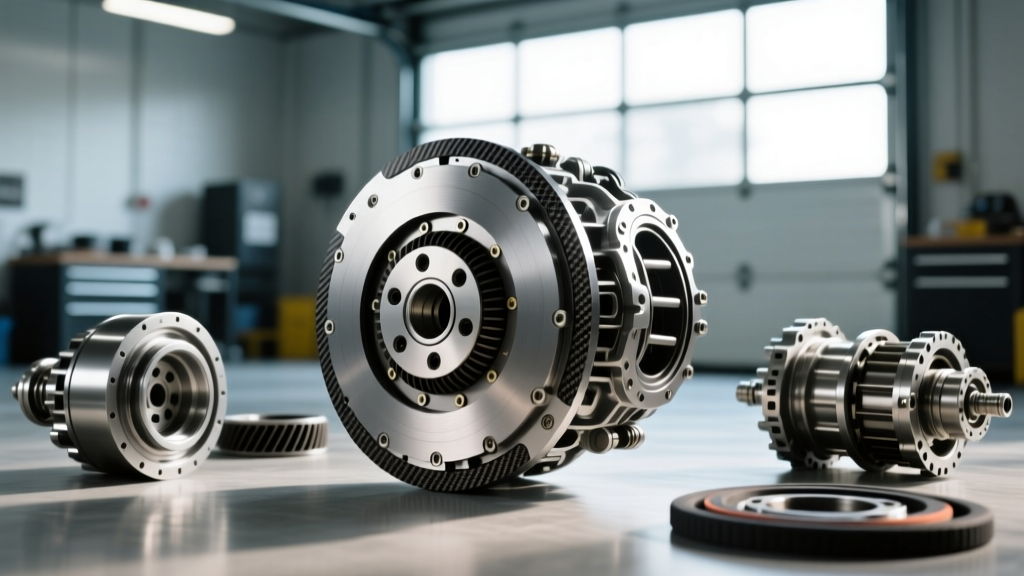
One of the most significant variables impacting the overall cost to replace clutch systems is the flywheel. Many modern manual vehicles (such as the Ford Mustang, Chevy Corvette, and most European turbo-diesels) utilize a Dual Mass Flywheel (DMF). A DMF contains internal springs designed to absorb torsional vibrations from the crankshaft, protecting the transmission input shaft and reducing gear rattle.
The DMF Replacement Route
If you stick with OEM specifications, you will likely need to replace the DMF alongside the clutch disc and pressure plate. DMFs cannot be resurfaced. A new OEM DMF typically costs between $400 and $900, significantly inflating the parts cost.
The SMF Conversion Route
Many enthusiasts and heavy-duty truck owners opt for a Single Mass Flywheel (SMF) conversion. Companies like South Bend Clutch offer SMF conversion kits that replace the complex DMF with a solid, resurfacing-friendly steel or chromoly wheel. While this reduces the initial parts cost and increases clutch longevity, it introduces drivetrain gear rattle at idle and increases NVH transfer to the chassis. You must weigh the long-term savings against the compromise in daily driving comfort.
Step 4: Calculating the True Cost to Replace Clutch in 2026
When budgeting for a clutch replacement, you must account for the complete kit (disc, pressure plate, release bearing, and alignment tool), the flywheel, ancillary hardware, and labor. Based on current aftermarket pricing baselines from RockAuto and national shop averages, here is what you can expect to pay.
Parts Cost Breakdown by Vehicle Class
- FWD Compacts (e.g., Honda Civic Si, VW GTI): OEM organic kits range from $250 to $450. Flywheels are typically solid and can be resurfaced for $50-$80. Total parts: $300 - $550.
- RWD Sports Cars (e.g., Ford Mustang, Nissan 370Z): Performance Stage 1/2 kits range from $400 to $800. DMF replacements or Concentric Slave Cylinder (CSC) replacements add $200-$500. Total parts: $600 - $1,300.
- Heavy Duty Diesels (e.g., Ram 2500 Cummins, Ford Powerstroke): High-clamp-load multi-disc or Kevlar kits with heavy-duty hydraulics range from $800 to $1,800. Total parts: $900 - $2,200.
Labor Cost Variables
Labor is where the final cost to replace clutch truly diverges. Dropping a transmission requires lifting the vehicle, removing driveshafts, exhaust components, and starter motors.
- FWD Vehicles: Requires removing axles and often the subframe. Labor: 5-7 hours ($600 - $1,050).
- RWD / AWD Vehicles: Requires dropping the exhaust, driveshaft, and transfer case (if AWD). Labor: 6-9 hours ($750 - $1,400).
- Heavy Duty Trucks: The sheer weight of the transmission (e.g., the Aisin or G56 can weigh over 150 lbs) requires specialized jacks and extensive skid plate removal. Labor: 8-12 hours ($1,000 - $1,800).
Grand Total Estimate: Expect to pay between $900 and $1,500 for a standard commuter car, and $1,800 to $3,500+ for heavy-duty trucks or complex AWD performance cars.
Step 5: Essential Hardware and Torque Specifications
If you are tackling this as a DIY project to save on labor costs, precision is non-negotiable. A misaligned clutch or improperly torqued flywheel will result in catastrophic drivetrain failure.
Flywheel Resurfacing and Step Height
If reusing a solid mass flywheel, it must be machined flat. More importantly, you must verify the step height (the distance between the friction surface and the pressure plate mounting pad). For most diaphragm-style clutches, a positive step of 0.010 to 0.020 inches is required. If the machine shop removes too much material, the pressure plate will not apply adequate clamping force, leading to immediate slip.
Critical Torque Specs (General Guidelines)
Always verify with your specific factory service manual, but common benchmarks include:
- GM LS-Series Flywheel Bolts: 15 lb-ft, plus 50 degrees of rotation (Torque-to-Yield). Must use new bolts and thread locker.
- Pressure Plate Bolts (M8 x 1.25): Typically 22 to 25 lb-ft, tightened in a crisscross star pattern to prevent warping the diaphragm springs.
- Bellhousing Alignment: Before bolting the transmission to the engine, use a dial indicator to check bellhousing runout. If runout exceeds 0.005 inches, the input shaft will bind, causing premature wear on the disc hub and pilot bearing. Use offset dowel pins to correct misalignment.
Conclusion
Calculating the true cost to replace clutch components is an exercise in matching engineering requirements with your budget. By carefully selecting the appropriate friction material, making an informed decision regarding DMF versus SMF flywheels, and adhering to strict torque and alignment specifications, you ensure that your investment delivers reliable power transfer for tens of thousands of miles. Whether you are wrenching in your home garage or paying a professional, understanding these variables guarantees you get exactly what you pay for.