The Golden Rule: When Checking Transmission Fluid, Should the Car Be On?
One of the most frequently debated questions in automotive maintenance is: when checking transmission fluid, should the car be on? The short answer for 95% of modern automatic transmissions is yes. Unlike engine oil, which pools in the oil pan when the engine is off, automatic transmission fluid (ATF) must circulate through the torque converter, valve body, and cooler lines to provide an accurate level reading. If you check the fluid with the engine off, the fluid drains back into the pan, yielding a false 'high' reading and preventing you from pulling a fresh, representative sample from the torque converter.
However, simply knowing if the car should be running is only half the battle. Once the engine is on and the fluid is circulating, you have a prime opportunity to perform a critical diagnostic: inspecting for transmission fluid contamination signs. In this step-by-step how-to guide, we will walk you through the exact procedures to safely extract, evaluate, and diagnose ATF contamination in popular modern transmissions like the GM 6L80 and the ZF 8HP.
Phase 1: Preparation and Temperature Targeting
Before you can check for contamination, the fluid must be at the correct operating temperature. Modern transmissions rely on highly specific thermal expansion parameters. Checking fluid that is too cold or too hot will not only give you a false volume reading but can also mask certain contamination signs, such as suspended metallic particles or degraded friction modifiers.
Step 1: Secure the Vehicle and Connect OBD2 Diagnostics
Park the vehicle on a perfectly level surface. Engage the parking brake and place wheel chocks behind the rear tires. Connect a bi-directional OBD2 scanner capable of reading the Transmission Fluid Temperature (TFT) sensor. Safety Warning: Never crawl under a vehicle supported only by a jack while the engine is running and the wheels are free to spin.
Step 2: Cycle the Gears and Reach Target TFT
With your foot firmly on the brake, start the engine. Shift the transmission slowly through every gear (P-R-N-D-L), pausing for three seconds in each. This actuates the valve body and fills all clutch apply circuits, ensuring the sample you pull is thoroughly mixed. Allow the engine to idle until the TFT reaches the manufacturer's specified range:
- GM 6L80 / 6L90: Target TFT of 185°F to 200°F (85°C to 93°C) for a 'Hot' check.
- ZF 8HP (BMW/Chrysler/Jaguar): Target TFT of 86°F to 122°F (30°C to 50°C).
- Ford 10R80: Target TFT of 185°F to 205°F (85°C to 96°C).
Phase 2: Step-by-Step Contamination Extraction and Inspection
Now that the car is on, in Park, and at the correct temperature, it is time to extract the fluid and look for transmission fluid contamination signs.
Step 3: The Extraction Method (Dipstick vs. Sealed Overflow)
If your vehicle has a traditional dipstick (common on older models and heavy-duty trucks like the Ram 68RFE), pull the dipstick while the engine is idling. Wipe it clean, reinsert it fully, and pull it again for your sample.
For 'sealed' transmissions (like the ZF 8HP or GM 9G-Tronic), there is no dipstick. You must safely raise the vehicle on a lift or four jack stands while it remains running. Place a clean, white catch pan directly beneath the transmission. Crack the overflow plug (usually an 8mm or 10mm hex bit) on the bottom of the transmission pan. Allow the first few ounces to drain into the white pan. Note: The fluid will be hot. Wear nitrile gloves and safety glasses.
Step 4: The Visual, Olfactory, and Tactile Diagnostics
Once you have your sample in a white pan or on a white paper towel, perform the following three sensory checks to identify contamination:
- The Color Test: Fresh Dexron VI (ACDelco Part # 10-9395) is a translucent, vibrant red. Fresh ZF LifeguardFluid 8 is a clear, pale amber/green. If the fluid is dark brown or opaque black, the friction modifiers have broken down, and the fluid is heavily oxidized.
- The Smell Test: Bring the sample close to your nose. Healthy ATF has a slightly sweet, petroleum-like odor. If it smells like burnt toast or acrid smoke, the transmission has experienced severe thermal runaway, likely due to a slipping torque converter clutch (TCC) or burnt clutch packs.
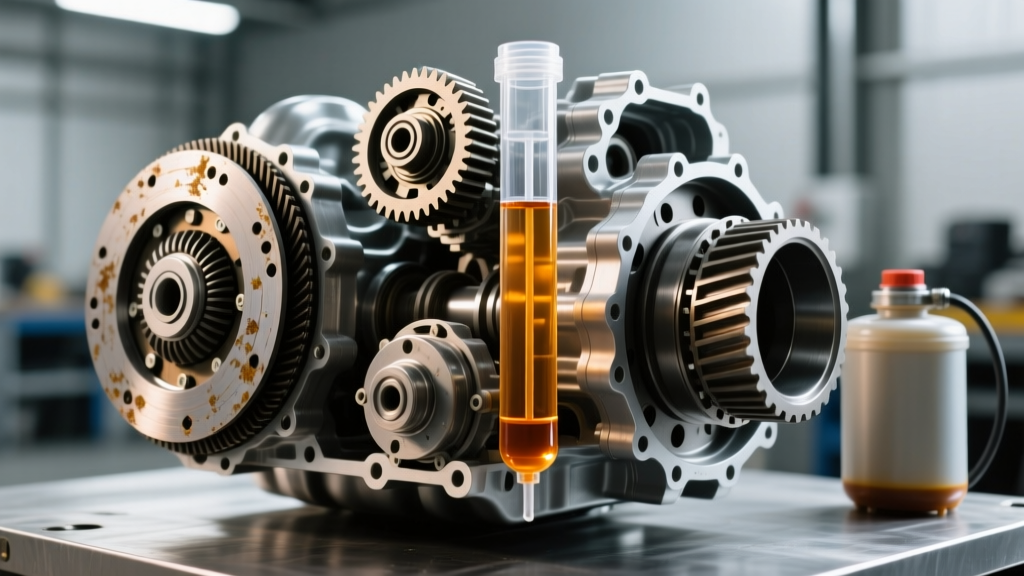
- The Wipe Test: Rub a drop of the fluid between your thumb and index finger. You should feel smooth, slippery oil. If you feel a gritty texture, like fine sandpaper, you have metallic or clutch material contamination. If you see 'glitter' or metallic flakes suspended in the fluid when held to the light, internal hard-part failure (bearings, planetary gears) is actively occurring.
Contamination Matrix: Diagnosing the Root Cause
Use the table below to cross-reference your findings with the likely mechanical failure and estimated 2026 repair costs.
| Contamination Sign | Visual / Sensory Clue | Root Cause | Estimated 2026 Repair Cost |
|---|---|---|---|
| Oxidized / Burnt | Dark brown/black, smells burnt | Overheating, clogged TOC (Transmission Oil Cooler), slipped TCC | $250 - $450 (Flush & Filter) to $1,200+ (Torque Converter Replacement) |
| Metallic Glitter | Sparkles in light, gritty feel | Bearing failure, planetary gear wear, thrust washer degradation | $3,500 - $6,500 (Complete Tear-Down Rebuild) |
| Milky Emulsion | Pink/strawberry milkshake appearance | Internal radiator breach; engine coolant mixing with ATF via TOC | $1,800 - $3,000 (Radiator, Flush, potential TCM replacement) |
| Clutch Material | Opaque black, fine silt, no glitter | Friction material shearing off clutch discs due to low line pressure | $2,500 - $4,500 (Clutch pack rebuild & valve body service) |
OEM-Specific Inspection Quirks and Torque Specs
When performing these checks, adhering to OEM specifications is critical to avoid damaging the transmission casing or introducing new contaminants.
GM 6L80 / 6L90 (Silverado, Tahoe, Camaro)
These units are notorious for TEHCM (Transmission Control Module) issues if the fluid degrades, as the TEHCM is mounted inside the hot fluid environment of the transmission case. When checking for contamination, pay special attention to the magnet inside the plastic transmission pan. A small amount of fine black paste is normal wear from clutch plates. However, if you find chunky metal shards on the magnet, the 4-5-6 clutch hub or the reaction sun gear is failing. Service Spec: If you remove the pan to inspect the magnets, the plastic pan bolts are torque-to-yield and must be replaced. Torque the new bolts to 9 Nm (80 lb-in) in a crisscross pattern. Service fill capacity is approximately 6.0 quarts of Dexron VI.
ZF 8HP (BMW F/G Series, Dodge Charger, Jaguar F-Type)
The ZF 8HP is a masterpiece of engineering but highly sensitive to fluid degradation. ZF claims the fluid is 'lifetime,' but industry experts at Sonnax and Transmission Digest universally recommend servicing it every 60,000 miles to prevent mechatronic sleeve leaks and bridge seal failures. Because it is sealed, checking for contamination requires cracking the side fill plug (8mm hex) on the passenger side of the case to ensure fluid is at the correct level before dropping the plastic pan to inspect the integrated filter and magnets. Service Spec: The side fill plug requires a new crush washer and must be torqued to exactly 35 Nm (26 lb-ft). Over-torquing will crack the aluminum case. Use only ZF LifeguardFluid 8 (Part # 1071.298.926).
What About the Milky Emulsion Scenario?
If your visual inspection reveals a milky, strawberry-milkshake consistency, stop the engine immediately. This indicates that the barrier between the engine coolant and the transmission fluid inside the radiator's Transmission Oil Cooler (TOC) has ruptured. Coolant contains water and ethylene glycol, which will destroy the paper-based friction linings inside an automatic transmission in less than 50 miles of driving. According to AAA automotive guidelines, driving with coolant-contaminated ATF will result in total catastrophic failure, escalating a simple $400 radiator replacement into a $5,000+ transmission and cooling system overhaul.
Final Verdict: Engine On, Eyes Open
To summarize, when checking transmission fluid, should the car be on? Yes. Keeping the engine running and the transmission at operating temperature is the only way to get an accurate level reading and pull a homogenous fluid sample. By combining the 'engine-on' rule with the step-by-step sensory diagnostics outlined above, you can catch transmission fluid contamination signs early. Whether it is the burnt smell of a failing torque converter in a GM 6L80 or the metallic glitter of a dying bearing in a ZF 8HP, early detection is the difference between a $200 fluid service and a $5,000 rebuild.