The Reality of the Cadillac ATS Rear Differential Recall
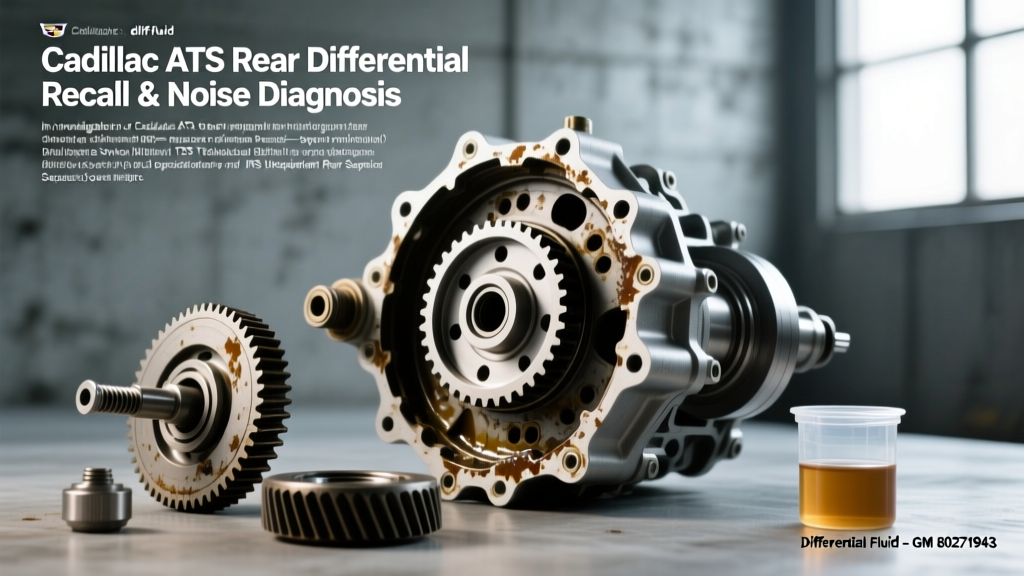
When owners begin searching for a Cadillac ATS rear differential recall, they are typically experiencing the notorious whine, howl, or clunk emanating from the rear of their 2013-2019 Alpha-platform vehicles. It is critical to clarify a common misconception right out of the gate: the National Highway Traffic Safety Administration (NHTSA) has not issued a formal safety recall for the ATS rear differential assembly. According to the NHTSA Recall Database, safety recalls are reserved for defects that pose an unreasonable risk to motor vehicle safety, such as wheels detaching or brake lines rupturing.
However, the drivetrain noise issues are very real and are heavily documented in General Motors Technical Service Bulletins (TSBs) and Customer Satisfaction Programs. The ATS utilizes an Independent Rear Suspension (IRS) setup with an aluminum-cased differential that is highly sensitive to fluid degradation, hypoid gear mesh anomalies, and pinion bearing wear. If your ATS is whining above 45 MPH, you do not need a recall—you need a precise, methodical diagnosis and immediate fluid intervention.
Acoustic Profiling: Diagnosing IRS Differential Noises
The GM Alpha-platform rear differential (featuring either a 7.5-inch or 8.6-inch ring gear, depending on your 2.0T or 3.6L V6 engine) relies on elastohydrodynamic lubrication to keep the hypoid ring and pinion gears separated under extreme shear loads. When that film breaks down, or when bearing tolerances shift, the differential speaks to you. Expert diagnosis requires isolating the noise based on load and deceleration.
The Coast-Down vs. Load-Bearing Test
To accurately diagnose the internal failure point, perform this controlled road test on a flat, empty stretch of road:
- Load-Bearing (Acceleration): Apply steady throttle between 40 and 60 MPH. If a deep, rhythmic howling or growling occurs, the issue is typically on the drive side of the ring and pinion gear teeth, or a failing pinion bearing struggling under thrust loads.
- Coast-Down (Deceleration): Release the throttle and let the engine brake the vehicle. A high-pitched whine that peaks and changes frequency with vehicle speed points to the coast side of the hypoid gears or a worn pinion shaft bearing lacking proper preload.
- Load Transition (The Clunk): Shift from Reverse to Drive, or abruptly lift off the throttle. A metallic "clunk" indicates excessive backlash (gear play) caused by worn spider gears, a sheared cross-pin, or degraded thrust washers inside the carrier.
Fluid Forensics: Reading the Magnetic Drain Plug
Before tearing into the differential casing, the drain plug offers a window into the mechanical soul of the axle. The ATS differential does not have a traditional removable rear cover; it features a solid aluminum casing with specific drain and fill ports. Draining the fluid is your first true diagnostic step.
| Visual Inspection | Texture / Feel | Diagnosis & Action Plan |
|---|---|---|
| Dark Amber / Brown | Smooth, slight sulfur smell | Normal Wear: Fluid has oxidized from thermal cycling. Perform standard drain and fill. |
| Grey / Silver Paste | Greasy, metallic sheen | Break-in / Mild Wear: Normal ring gear lapping. Clean magnetic plug thoroughly and refill. |
| Black with Glitter | Gritty, catches on rag | Bearing Cage Failure: Needle bearings or pinion bearings are disintegrating. Rebuild required. |
| Chocolate Milk | Emulsified, frothy | Water Intrusion: Compromised axle seal or vent tube blockage. Inspect seals immediately. |
Factory Specifications and Service Procedures
If your diagnostic drive and fluid inspection indicate early-stage wear or thermal breakdown, a meticulous fluid service is mandatory. Using the wrong fluid in the ATS IRS differential will rapidly destroy the limited-slip clutch packs (if equipped) and accelerate gear wear.
Decoding Your RPO Codes
Check the glovebox sticker for your Rear Axle RPO codes to determine your exact gear ratio and differential type:
- GU5: 3.23 Ratio
- GU6: 3.45 Ratio
- G80: Mechanical Locking Limited-Slip Differential
Exact Fluid Specifications & Torque Data
For the Cadillac ATS, GM specifies a high-quality synthetic 75W-90 gear oil. The ACDelco 75W-90 Synthetic Gear Oil (Part # 88862624 / 10-9034) is the OEM standard. It contains the necessary friction modifiers for the G80 locking differential, eliminating the need for aftermarket limited-slip additives that can actually cause clutch pack slippage in modern GM axles.
- Fluid Capacity: Approximately 1.1 Liters (1.16 Quarts)
- Drain Plug Torque: 25 Nm (18 lb-ft)
- Fill Plug Torque: 25 Nm (18 lb-ft)
- Tool Requirement: 8mm Hex bit (Do not use worn bits; aluminum plugs strip easily)
Expert Warning: Never over-torque the drain or fill plugs. The ATS differential casing is cast aluminum. Exceeding 18 lb-ft can crack the casing threading, resulting in a $3,000+ differential replacement or complex helicoil repair.
When Fluid Isn't Enough: Rebuild vs. Replace Economics
If the whine persists after a fluid service with OEM 75W-90, the internal geometry has been compromised. Rebuilding an IRS differential is not a driveway job; it requires a hydraulic press, a dial indicator, and an inch-pound torque wrench to set pinion bearing preload (typically targeting 15-25 in-lbs of rotational drag on new bearings).
2026 Cost Realities for ATS Axle Repair
- Fluid Service (Dealer/Shop): $120 - $180 (Includes OEM fluid and labor).
- Pinion Bearing & Seal Kit: $250 - $400 for parts (Timken or SKF bearings). Labor adds $600 - $900 due to IRS subframe drop requirements.
- Complete Ring & Pinion Rebuild: $1,400 - $2,200. Requires master rebuild kits, new crush sleeves, and precision shim selection.
- Remanufactured Differential Assembly: $2,800 - $3,500 installed. Often the most reliable route if the original casing is scored or warped.
Final Expert Takeaway
While the elusive Cadillac ATS rear differential recall may not exist in the NHTSA archives, the mechanical vulnerabilities of the Alpha-platform IRS axle are well-documented in the professional automotive community. Do not ignore a coast-down whine or a load-bearing howl. By understanding hypoid gear acoustics, strictly adhering to GM's 75W-90 fluid specifications, and respecting the 25 Nm torque limits of the aluminum casing, you can extend the life of your ATS drivetrain well past the 100,000-mile mark.