The Thermal Reality of the Ford C6 in Diesel Applications
The Ford C6 automatic transmission is widely regarded as one of the most robust heavy-duty gearboxes ever engineered. Originally introduced in the 1960s, it found a permanent home in the diesel truck world, most notably bolted behind the legendary 7.3L IDI (Indirect Injection) diesel V8 in the late 1980s and early 1990s. As of 2026, thousands of these classic Ford F-250 and F-350 diesel trucks are still on the road, serving as dedicated tow rigs and farm workhorses. However, the mechanical durability of the C6 is frequently undermined by a single, critical vulnerability: heat.
Unlike modern overdrive transmissions, the C6 is a three-speed unit that lacks a lockup torque converter. In a heavy diesel truck application, the absence of a mechanical lockup means the torque converter is constantly slipping, especially at highway cruising speeds or when pulling heavy loads up a grade. This hydraulic slip generates immense friction and shear, rapidly elevating Automatic Transmission Fluid (ATF) temperatures. If you are pushing a classic diesel truck to its limits, upgrading your C6 transmission cooler is not an optional modification; it is a mandatory intervention to prevent catastrophic clutch burnout and varnish buildup.
Why the 3-Speed Architecture Generates Excess Heat
To understand the necessity of a high-capacity transmission cooler for diesel trucks equipped with the C6, we must look at the final drive ratios. A classic 7.3L IDI truck often features 3.55 or 4.10 rear axle gears. Cruising at 70 MPH with a 4.10 gear and no overdrive forces the engine and transmission to operate at roughly 2,400 RPM. Because the torque converter cannot lock, the impeller and turbine are constantly shearing the ATF. Under these conditions, the factory radiator-integrated cooler is entirely insufficient, often allowing fluid temperatures to exceed 220°F (104°C). At 220°F, conventional Mercon V fluid begins to oxidize and form varnish; at 250°F, the paper-based friction clutches inside the C6 begin to delaminate and burn.
OEM Radiator Loops vs. Auxiliary Stacked-Plate Coolers
The factory C6 cooling setup relies on a tube-and-fin heat exchanger submerged in the engine's radiator coolant tank. While this provides adequate warm-up characteristics in freezing climates, it acts as a thermal bottleneck under heavy towing loads. Furthermore, the plastic end-tanks on 1990s Ford radiators are notorious for cracking as they age, leading to the dreaded cross-contamination of coolant and ATF—a scenario that destroys the C6's internal seals within miles.
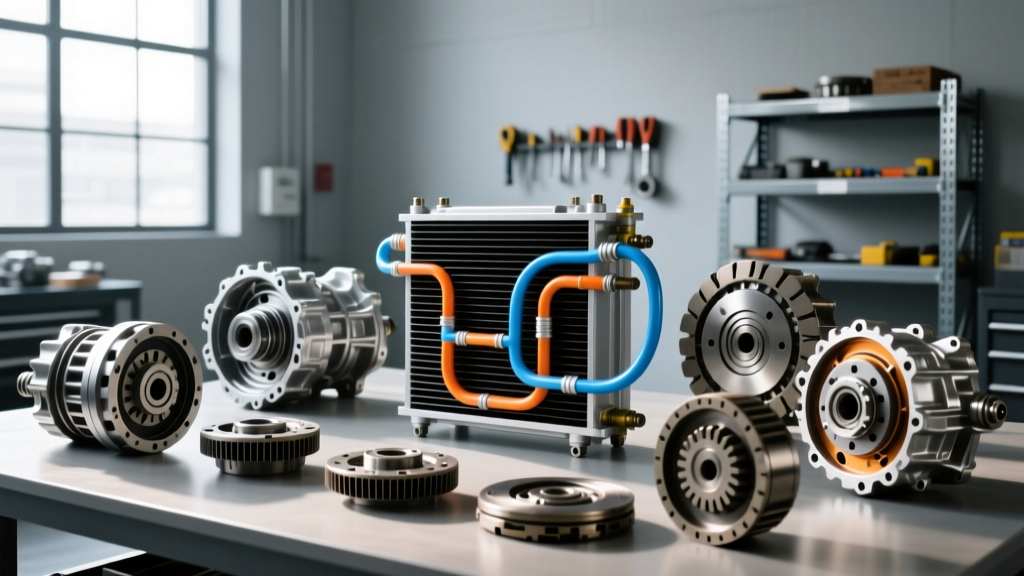
For modern diesel truck towing, the industry standard has shifted to auxiliary stacked-plate coolers. Stacked-plate designs offer a massive increase in surface area and turbulent fluid flow compared to traditional tube-and-fin models, resulting in superior BTU rejection without creating restrictive pressure drops that could starve the C6's lubrication circuits.
| Cooler Architecture | Estimated BTU/hr Rejection | Pressure Drop (at 3 GPM) | Burst Pressure Rating | Best Application |
|---|---|---|---|---|
| OEM Radiator Loop | 12,000 - 15,000 | Low (Integrated) | Dependent on Rad Tank | Light commuting, cold climates |
| Tube-and-Fin (Aftermarket) | 18,000 - 22,000 | Moderate (2-4 PSI) | 150 - 200 PSI | Budget replacements, mild towing |
| Plate-and-Fin | 25,000 - 30,000 | Low (1-2 PSI) | 250+ PSI | Standard diesel truck daily driving |
| Stacked-Plate (Heavy Duty) | 35,000 - 45,000+ | Minimal (<1.5 PSI) | 300+ PSI | Heavy towing, C6 high-RPM cruising |
Engineering the Ideal C6 Transmission Cooler Loop
When installing a dedicated transmission cooler for diesel trucks running the C6, routing and line sizing are just as critical as the cooler itself. The C6 operates with a base line pressure of approximately 130-145 PSI, which can spike to over 190 PSI in manual low gear under heavy throttle. The cooling loop must accommodate these pressures without ballooning or blowing off barbed fittings.
Routing Strategy: The Series-Flow Mandate
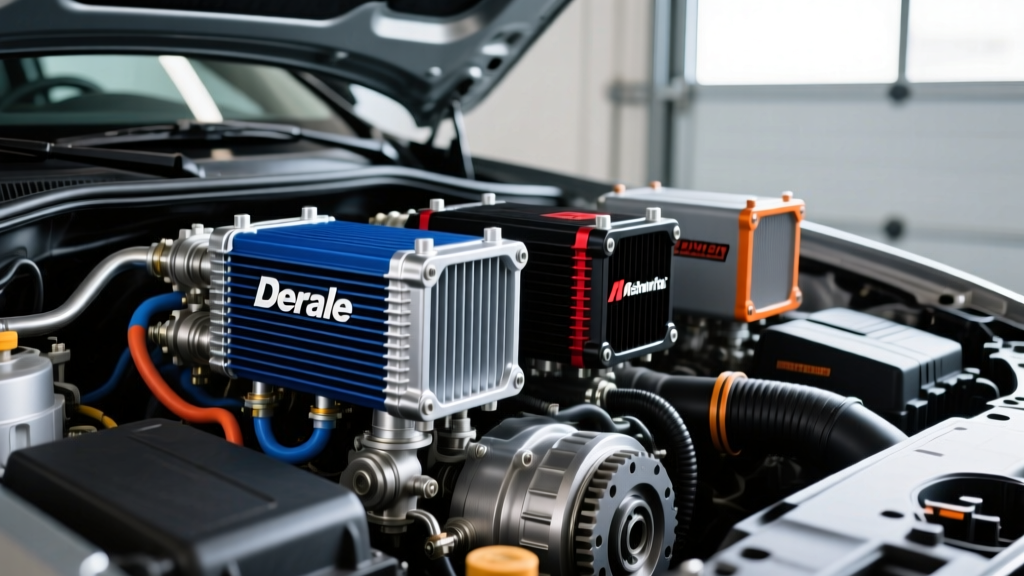
A common mistake among novice diesel truck owners is attempting to run an auxiliary cooler in parallel or bypassing the radiator entirely to 'reduce restriction.' According to thermal management guidelines from Derale Performance, auxiliary coolers should always be plumbed in series with the OEM radiator cooler for optimal thermal regulation. The correct routing sequence is:
- Transmission to Radiator: Hot fluid exits the C6 and enters the OEM radiator cooler. This prevents the fluid from overcooling in winter and helps stabilize engine coolant temps.
- Radiator to Auxiliary Cooler: The pre-cooled fluid exits the radiator and enters the front-mounted stacked-plate cooler, where ambient air strips the remaining heat.
- Auxiliary Cooler to Transmission: Cooled fluid returns to the C6's rear case lube circuit.
Edge Case Exception: If your truck's OEM radiator has failed or you are building a dedicated, off-road-only competition diesel truck where ambient temperatures never drop below 60°F, you may bypass the radiator entirely. In this scenario, install a thermal bypass valve (such as the Hayden 10000 series) set to open at 180°F to ensure the C6 reaches optimal operating temperature quickly, preventing torque converter shudder and clutch glazing.
Line Sizing and Fitting Adapters
The C6 utilizes 1/2-inch cooler lines to ensure adequate volume for the massive torque converter and rear lube circuit. Do not bottleneck this flow by stepping down to 3/8-inch hoses at the auxiliary cooler. Use 1/2-inch ID (Inner Diameter) high-pressure synthetic rubber hose rated for a minimum of 300 PSI. When adapting to the C6 case, the factory fittings are typically 1/2"-20 UNF inverted flare. If your aftermarket cooler uses AN fittings or NPT threads, use high-quality brass or steel adapter fittings. Torque the case adapter fittings to exactly 18-22 ft-lbs. Over-torquing can crack the aluminum or cast-iron case extensions, leading to catastrophic fluid loss.
Recommended Hardware and Fluid Pairings
To build a bulletproof cooling system for a C6-equipped diesel truck, you must pair high-flow hardware with shear-stable synthetic fluids. The lack of a lockup converter means the fluid is subjected to extreme mechanical shearing, which breaks down the viscosity index improvers in conventional petroleum-based ATFs.
- Cooler Core: Derale Series 8000 Stacked-Plate (Part #13504) or Hayden Rapid-Cool Heavy Duty (Part #678). Expect to spend between $85 and $140 USD.
- Thermal Bypass Valve: Hayden 10000 Series (Part #10006). Opens at 180°F to prevent overcooling. (~$45 USD).
- Hose & Clamps: Gates 4362 1/2" High-Pressure Transmission Hose with constant-tension T-bolt clamps. Avoid standard worm-gear clamps, which can slice into the rubber under high-pressure pulses.
- Fluid: Amsoil Signature Series Fuel-Efficient Synthetic ATF or Red Line D4. As noted in Amsoil's technical documentation, modern synthetics resist thermal breakdown up to 250°F and maintain viscosity under severe torque converter shear. A full C6 system with a deep pan holds approximately 14-16 quarts. Budget $160-$220 for a complete fluid swap.
- Deep Pan: Cast aluminum deep pans (like those from PML or B&M) add 4-6 quarts of fluid capacity and feature external cooling fins, acting as a secondary heat sink.
Diagnostics: Identifying Cooler-Induced Failures
Even with an upgraded C6 transmission cooler, diesel truck owners must monitor the system for hydraulic anomalies. The most common cooler-related failure in high-mileage C6s is lube circuit cavitation.
'If you install an auxiliary cooler with excessive internal restriction, or use undersized 3/8-inch return lines, the C6's internal lube regulator valve will starve the rear planetary gearset. You won't see high line pressures on your gauge; instead, you will see a slow, creeping rise in transmission temperature and a whining noise from the rear of the case. Always verify return line flow rates during installation.' — Senior Drivetrain Technician, ATSG Guidelines (Reference: Automatic Transmission Service Group)
To test for restriction, disconnect the return line at the transmission case, route it into a calibrated bucket, and start the engine. The C6 should push roughly 1 to 1.5 quarts of fluid per minute at idle. If the flow is significantly lower, you have a restriction in the cooler core, a crimped hose, or a failing internal front pump.
Final Torque Specs and Installation Checklist
Before putting your classic Ford diesel truck back under a load, run through this critical installation checklist to ensure your C6 transmission cooler upgrade is secure and leak-free:
- Case Fittings: 18-22 ft-lbs (Use Teflon tape or liquid thread sealant ONLY on NPT threads; never on inverted flare or O-ring boss fittings).
- Cooler Mounting Bolts: 10-15 ft-lbs. Ensure the cooler is mounted in front of the A/C condenser and radiator for maximum ambient airflow.
- Fluid Level Verification: Check the dipstick with the engine idling in PARK, at normal operating temperature (160°F-180°F). The C6 dipstick is calibrated for running-level checks, not static.
- Leak Down Test: Cycle the transmission through all forward and reverse gears while suspended on a lift, inspecting all barb fittings and adapter joints for micro-leaks under pressure.
By addressing the inherent thermal limitations of the non-lockup C6 with a properly routed, high-capacity stacked-plate cooler, you effectively future-proof your classic diesel truck. The mechanical bones of the C6 are virtually unbreakable; with modern cooling thermodynamics, it will continue to outlast the trucks it is bolted to.