The Diagnostic Dilemma: Transmission Friction or Front-End Failure?
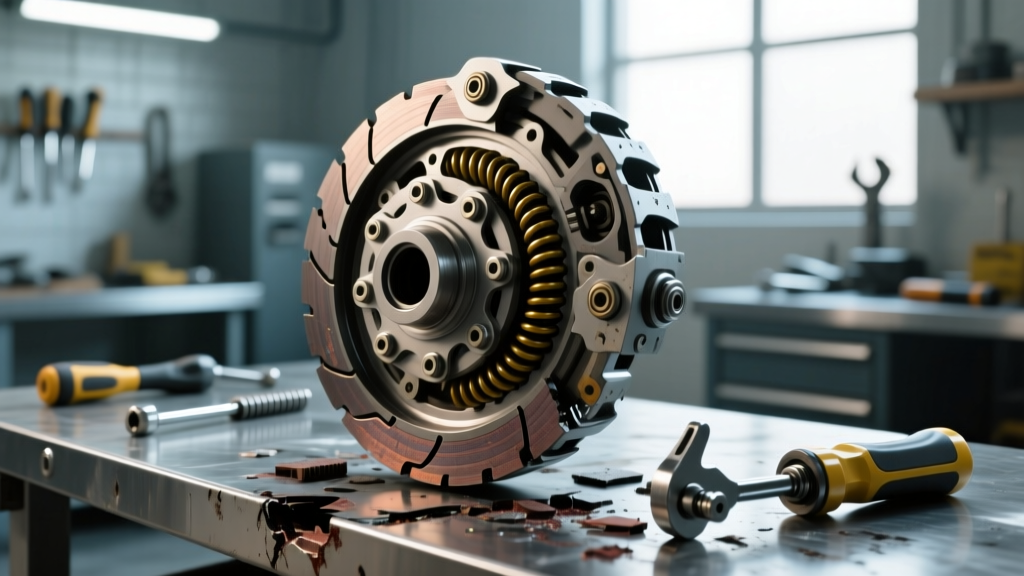
When a driver reports a severe burning smell emanating from their vehicle, the immediate assumption by both owners and novice technicians is a failing transmission or a slipping manual clutch disc. However, in modern longitudinal engine layouts—particularly in trucks, SUVs, and performance sedans—the engine cooling fan clutch sits directly behind the radiator and above or adjacent to hot exhaust manifolds. A failing viscous fan clutch can produce an acrid, friction-like odor that permeates the cabin through the HVAC system, perfectly mimicking a burning transmission clutch. Misdiagnosing this symptom can lead to unnecessary transmission removals, costing thousands of dollars. Accurate symptom diagnosis requires a systematic elimination process, which occasionally necessitates using a specialized tool to remove fan clutch hardware to isolate the front-end accessory drive from the drivetrain.
The Olfactory Differential: Identifying the Source of the Burn
Before reaching for the transmission dipstick or dropping the crossmember, a master diagnostician must rely on olfactory and environmental clues. The chemical composition of burning automatic transmission fluid (ATF), manual friction materials, and engine fan clutch silicone fluid are vastly different.
| Component | Odor Profile | Trigger Conditions | Visual / Physical Evidence |
|---|---|---|---|
| Manual Clutch Disc (Organic/Kevlar) | Harsh sulfur, asbestos, burning brakes | Heavy load, riding the pedal, steep inclines | Glazed flywheel, marcel spring failure, high pedal bite point |
| Automatic Clutch Packs (e.g., 6L80, ZF 8HP) | Sweet, burnt toast, acrid chemical | Towing, low line pressure, prolonged slip | Dark/burnt ATF on dipstick, debris in pan, delayed engagements |
| Viscous Fan Clutch (Silicone Fluid) | Burning hair, melting rubber, hot metal | Stop-and-go traffic, hot idle, AC max | Silicone streaks on shroud, seized bearing, fluid on exhaust |
Why the Fan Clutch Mimics a Slipping Transmission
Viscous fan clutches rely on a precise shear gap filled with high-viscosity silicone fluid to transfer torque from the water pump shaft to the fan blade. When the internal bimetallic strip or external sensor fails, or when the internal bearings seize, two distinct failure modes occur that generate intense heat and odor:
- Silicone Fluid Flash-Off: If the internal seal degrades, silicone fluid is slung outward by centrifugal force. When this fluid lands on exhaust headers or the catalytic converter (which routinely exceed 800°F / 426°C), it instantly vaporizes into a thick, noxious smoke that smells remarkably like burning friction material.
- Bearing Seizure & Shear Pin Failure: A seized front bearing forces the fan to lock up or spin erratically, creating massive metallic friction and snapping the internal shear pin. The resulting metal-on-metal grinding produces a sharp, metallic burning odor easily confused with a slipping torque converter stator or manual release bearing.
Step-by-Step Isolation: Deploying the Removal Tool
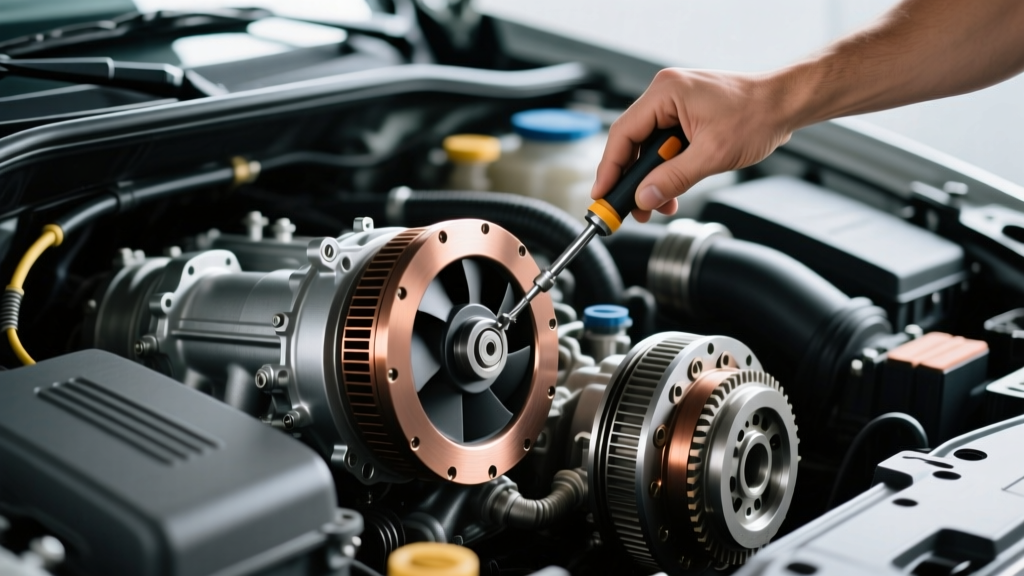
If the transmission fluid (e.g., Dexron VI, ZF Lifeguard 8) is pristine, the manual clutch pedal feels normal, and the smell is most prominent at a standstill with the hood closed, the fan clutch is the prime suspect. To definitively rule it out, you must temporarily remove it. This requires a dedicated tool to remove fan clutch assemblies, as the water pump bearings cannot withstand the torque of a standard wrench without being destroyed.
Selecting the Correct Wrench Set
Fan clutch nuts vary wildly by manufacturer. European and domestic applications utilize different hex sizes and thread directions. The industry standard is the OTC 4521 Fan Clutch Wrench Set, which includes 36mm, 40mm, 47mm, and 58mm wrenches, along with specialized holding tools for the water pump pulley. For Ford and specific GM applications, the Schley Products 67600 heavy-duty set is often required due to the extreme corrosion and torque values found on older longitudinal V8s.
Platform-Specific Removal Procedures & Torque Specs
When using your tool to remove fan clutch hardware, adhere to the following platform-specific parameters to avoid catastrophic water pump damage:
- GM EcoTec3 & LT Series (5.3L L83, 6.2L L86/L87): Typically utilizes a 36mm or 1-1/2 inch hex. Critical Warning: Many GM applications use a Left-Hand (LH) thread. You must turn the wrench clockwise to loosen. Reinstallation torque spec is generally 15-20 lb-ft, but always verify with the factory service manual, as some heavy-duty cooling variants require up to 28 lb-ft.
- Ford Coyote 5.0L & Godzilla 7.3L: Often uses a 47mm or 58mm hex with a standard Right-Hand (RH) thread. Because the belt tension alone is rarely enough to hold the pulley during breakaway torque, you must use a pulley-holding strap or a dedicated Schley holding tool bolted to the pulley face.
- BMW/Chrysler (ZF 8HP / HEMI Applications): Many modern BMWs and Chrysler HEMIs have transitioned to electric viscous or fully electric fan modules, eliminating the traditional mechanical hex nut. If a mechanical clutch is present (e.g., older 5.7L HEMI), a 40mm or 47mm RH thread is standard. Torque to 12-15 lb-ft.
Confirming the Transmission Clutch Fault
Once the fan clutch is removed (and the vehicle is briefly tested without it, or with a temporary electric puller fan rigged for safety), perform a road test under the exact conditions that previously generated the smell. If the odor returns, the diagnosis shifts back to the transmission or drivetrain.
Automatic Transmission Edge Cases (6L80 & ZF 8HP)
If the burning smell is confirmed to be internal to the automatic transmission, you are likely dealing with localized clutch pack slip rather than total fluid degradation. In the GM 6L80, the 3-5-R clutch wave plate (GM Part #24238302) is notorious for fatiguing and snapping, causing a loss of apply pressure and severe slip in 3rd and 5th gears, burning the friction material without immediately turning the entire sump black. In the ZF 8HP family, Mechatronic adapter sleeve leaks (addressed by Sonnax kit 106740-01K) cause a drop in main line pressure, leading to subtle A-clutch or B-clutch slip under heavy throttle, generating a localized burnt-toast odor long before a check engine light is triggered.
Manual Transmission Flywheel Hotspotting
For manual applications, if the clutch disc measures within spec, inspect the dual-mass or single-mass flywheel for blueing and radial cracks. A marcel spring (the wavy cushion plate between the friction facings) that has collapsed will prevent smooth engagement, causing micro-slipping at highway speeds that generates intense heat and smell without drastically altering the pedal feel.
Summary Diagnostic Matrix
Proper clutch system diagnostics in 2026 requires looking beyond the bellhousing. By systematically evaluating the odor profile, inspecting the front-end accessory drive, and utilizing the correct tool to remove fan clutch components for isolation testing, technicians can save customers from catastrophic misdiagnoses. Always verify thread direction before applying torque, and rely on fluid analysis and pressure testing before authorizing a transmission teardown.