The Dual-Purpose Dilemma: Towing the Bass Boat vs. Hitting the Strip
For many automotive enthusiasts, the weekend is a split commitment. Saturday morning involves backing a 2,500-pound Ranger or Skeeter bass boat down a concrete ramp, while Saturday night means unhitching the trailer, bolting on a set of drag radials, and lining up at the local 1/4-mile strip. This dual-purpose lifestyle creates a massive mechanical conflict: the gearing required to tow a heavy bass boat efficiently on the highway is rarely the same gearing that will get your truck or muscle car down the drag strip in the quickest possible elapsed time (ET).
As we navigate the 2026 drag racing season, the trend of running smaller-displacement turbo engines and heavier street trucks means that rear axle gear selection is more critical than ever. If you have ever found yourself wondering what gear ratio for bass fishing and towing is optimal, and how that translates to the drag strip, you are in the right place. This step-by-step guide will walk you through the mathematical formulas, transmission multipliers, and wrenching specs required to bridge the gap between the lake and the launch pad.
Step 1: Calculating the Baseline Towing Ratio (The Bass Fishing Setup)
Before we can optimize for the drag strip, we must establish the baseline requirements for towing a bass boat. A fully loaded bass boat on a tandem-axle trailer typically weighs between 3,500 and 4,500 pounds. To tow this load safely and keep your engine in its optimal torque band at highway speeds (65 to 70 MPH), you need a numerically higher (steeper) gear ratio.
The formula to find your cruising RPM based on gear ratio is:
RPM = (Speed x Gear Ratio x 336) / Tire Diameter
Let us assume you are driving a Silverado with a 5.3L V8, running 33-inch all-terrain tires, and you want to cruise at 65 MPH at roughly 2,200 RPM to maintain engine longevity and adequate towing power.
- Speed: 65 MPH
- Target RPM: 2,200
- Tire Diameter: 33 inches
Rearranging the formula to solve for the Gear Ratio:
Gear Ratio = (RPM x Tire Diameter) / (Speed x 336)
Gear Ratio = (2200 x 33) / (65 x 336)
Gear Ratio = 72600 / 21840 = 3.32
However, this is the bare minimum for cruising. To account for the 4,000-pound bass boat and trailer, you need to multiply that baseline by a towing load factor (typically 1.15 to 1.25). This pushes your ideal towing gear ratio into the 3.73 to 4.10 range. Most factory tow packages for half-ton and three-quarter-ton trucks utilize a 3.73 or 4.10 ring and pinion for exactly this reason.
Step 2: Stripping the Weight: Drag Racing Gear Ratio Math
Once you arrive at the track, the boat is unhitched. Your vehicle is now 4,000 pounds lighter, and you have swapped those 33-inch highway tires for a set of 28-inch Mickey Thompson ET Street R drag radials. The goal on the drag strip is to cross the finish line exactly at your engine's peak horsepower RPM. Leaving RPM on the table at the top end costs you tenths of a second.
To calculate your ideal drag racing gear ratio, we use the trap speed formula:
Ideal Gear Ratio = (Finish Line RPM x Tire Diameter) / (Trap Speed x 336)
Let us assume your engine makes peak power at 6,200 RPM, and your truck's weight and horsepower dictate a target trap speed of 125 MPH in the 1/4 mile. You are running 28-inch tall drag tires.
Gear Ratio = (6200 x 28) / (125 x 336)
Gear Ratio = 173600 / 42000 = 4.13
In this scenario, a 4.10 or 4.11 ring and pinion is the mathematical sweet spot. Notice how the smaller 28-inch drag tire effectively 'steepens' your gearing compared to the 33-inch towing tire, allowing you to use the same 4.10 gear for both the lake and the strip, provided your transmission first-gear ratio cooperates.
Factoring in Transmission First Gear Multipliers
The rear axle gear is only half of the equation. Your transmission's first gear ratio acts as a multiplier. According to Richmond Gear, the final drive ratio off the line is calculated by multiplying the transmission's first gear by the rear axle ratio.
| Transmission | 1st Gear Ratio | Rear Axle (4.10) | Final Drive Ratio (Off the Line) | Best Application |
|---|---|---|---|---|
| Powerglide | 1.80:1 | 4.10 | 7.38:1 | Lightweight cars, high-RPM NA engines |
| TH400 | 2.48:1 | 4.10 | 10.16:1 | Heavy trucks, big block V8s |
| 4L80E | 2.48:1 | 4.10 | 10.16:1 | Street/Strip trucks, towing & racing |
| ZF 8HP (Dodge/Chrysler) | 4.71:1 | 4.10 | 19.31:1 | Too steep! Requires 3.09 or 3.21 rear gear |
If you are running a Powerglide in a lightweight drag car, a 4.10 rear gear will result in a sluggish 7.38 final drive, requiring you to step up to a 5.13 or 5.38 gear. But if you are running a heavy street truck with a 4L80E (2.48 first gear), that same 4.10 gear yields a massive 10.16 final drive, which is perfect for hooking up on a street tire and towing the bass boat the next day.
Step 3: Selecting the Ring and Pinion (Part Numbers & Specs)
For a dual-purpose street/strip truck, the GM 14-bolt 10.5-inch semi-floating axle or the Ford 9-inch with a 31-spline Strange Engineering spool or Detroit Locker are the gold standards. Let us focus on the Ford 9-inch, as it remains the most popular swap for drag racing enthusiasts in 2026.
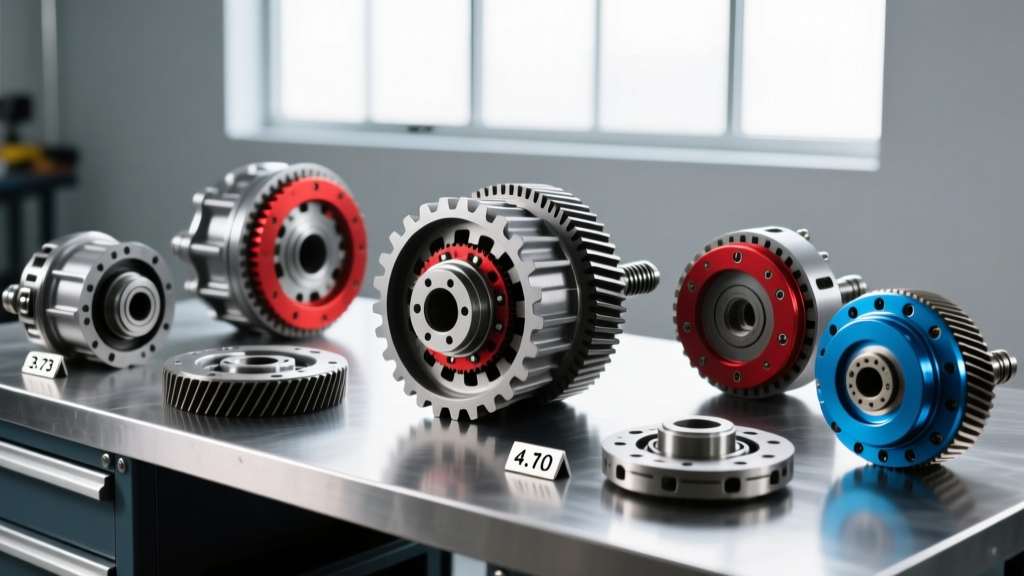
When ordering your gear set, you must specify the application. A 'Pro Gear' (often made from softer, high-nickel steel) is designed for drag racing where shock loads are high, but it will wear out quickly and whine under sustained highway towing speeds. A 'Street Gear' (typically 8620 carburized steel) is mandatory if you plan to tow your bass boat long distances.
- Recommended Brand: Motive Gear or Richmond Gear
- Material: 8620 Steel (Street/Strip application)
- Target Backlash: 0.010 to 0.012 inches
Step 4: The Solid Pinion Spacer Conversion (Crucial for Drag Racing)
If you are setting up a rear end for drag racing, you must eliminate the factory crush sleeve. A crush sleeve is a thin metal tube that deforms as you tighten the pinion nut to set bearing preload. Under the extreme shock load of a drag strip launch (especially with sticky tires and a trans-brake), crush sleeves can collapse further, leading to a loss of pinion bearing preload, catastrophic gear separation, and destroyed ring and pinion teeth.
Step-by-Step Solid Spacer Conversion:
- Measure the Crush Sleeve: Use a micrometer to measure the exact length of your factory crush sleeve.
- Order a Solid Spacer Kit: Companies like Strange Engineering offer solid pinion spacers and a shim kit specifically for the Ford 9-inch and Dana 60.
- Shim to Length: Stack the provided shims with the solid spacer until the total thickness matches your measured crush sleeve plus 0.005 inches.
- Set Rotational Preload: Install the spacer and shims. Tighten the pinion nut while measuring rotational torque with an inch-pound torque wrench. You want 15 to 20 in-lbs of rotational torque for used bearings, or 20 to 25 in-lbs for brand-new bearings.
- Lock it Down: Once the preload is perfect, use a high-strength prevailing torque lock nut (like a Smart Nut) or stake the nut to prevent it from backing off during a 60-foot launch.
Step 5: Installation & Torque Specs for the Rear End
Proper installation is just as important as the math. According to drivetrain specialists, the majority of ring and pinion failures are due to improper torque sequences and inadequate thread locker application. Below are the critical torque specs for a standard Ford 9-inch third member setup:
- Ring Gear to Carrier Bolts: 70 to 85 lb-ft. Pro Tip: Always clean the bolt holes with brake cleaner and compressed air. Apply Red Loctite 271 to the threads. If oil is trapped in the blind holes, hydraulic pressure can crack the cast iron or nodular iron carrier when the bolts are tightened.
- Carrier Bearing Cap Bolts: 80 to 90 lb-ft. Ensure the caps are installed in their original orientation and location, as they are line-bored from the factory.
- Pinion Nut (with Solid Spacer): Torque is not measured in foot-pounds here; it is measured in rotational inch-pounds (15-20 in-lbs) as described in Step 4. The actual nut torque will likely exceed 150 lb-ft to achieve this drag.
- Axle Retainer Nuts (9-inch Ford): 30 to 40 lb-ft.
Conclusion: Dialing in Your 2026 Season
Balancing the demands of the lake and the drag strip requires compromise, but with the right mathematics, you do not have to sacrifice performance in either arena. By utilizing the RPM and Trap Speed formulas, you can identify a rear axle gear (like a 4.10 or 4.30) that keeps your engine happy while towing a heavy bass boat, while simultaneously allowing your transmission's first-gear multiplier to launch you hard off the starting line.
Remember to factor in your tire diameter swaps. Leaving 33-inch all-terrains on the truck at the track will drastically alter your effective gear ratio and trap RPM. Swap to a dedicated set of 28-inch drag radials, verify your pinion preload with a solid spacer, and torque your ring gear bolts with Red Loctite. Follow these steps, and your rig will be just as dominant backing down the boat ramp as it is crossing the finish line.