The Flammability Question: Safety in the Performance Bay
When building a high-horsepower street car or a dedicated track weapon, the transmission is subjected to extreme thermal and mechanical loads. Upgrading to a billet input shaft, a high-stall torque converter, or an auxiliary 40-row transmission cooler fundamentally alters the thermal dynamics and fluid expansion rates of your drivetrain. Before pushing a built GM 6L80 or ZF 8HP70 to its limits, verifying the exact fluid level at operating temperature is non-negotiable. However, with long-tube exhaust headers glowing and underhood temperatures soaring, a critical safety question frequently arises in the performance community: is automatic transmission fluid flammable?
To answer this accurately for the 2026 performance shop environment, we must differentiate between 'flammable' and 'combustible' liquids as defined by OSHA and the NFPA. Gasoline is highly flammable, possessing a flash point of roughly -45°F (-43°C), meaning it can ignite at normal ambient temperatures. Automatic Transmission Fluid (ATF), conversely, is classified as a combustible liquid. It requires significant heat to vaporize and ignite, but under the wrong conditions in a modified engine bay, it poses a severe fire hazard.
Flash Point vs. Autoignition: What the Data Shows
The flash point is the lowest temperature at which a liquid can form an ignitable mixture in air near its surface. The autoignition temperature is the point at which the fluid will spontaneously combust without a spark or flame. Performance builders running high-horsepower setups must understand these thresholds, especially when routing custom exhaust systems near the transmission bellhousing and pan.
| ATF Brand / Type | Formulation | Flash Point | Autoignition Temp |
|---|---|---|---|
| Mobil 1 Synthetic ATF | Full Synthetic | 428°F (220°C) | ~650°F (343°C) |
| AMSOIL Signature Series | Full Synthetic PAO | 410°F (210°C) | ~620°F (326°C) |
| Red Line D4 ATF | Ester-Based Synthetic | 435°F (224°C) | ~680°F (360°C) |
| OEM Dexron VI | Synthetic Blend | 390°F (199°C) | ~600°F (315°C) |
According to the AMSOIL Safety Data Sheets, premium synthetic ATFs maintain flash points well above 400°F. However, if a pressurized leak from a faulty transmission cooler line or an aftermarket dipstick tube sprays a fine mist of ATF onto exhaust headers that are operating at 1,200°F+, the fluid will instantly vaporize and ignite. The misting effect drastically lowers the effective ignition threshold, turning a combustible liquid into an immediate blowtorch hazard.
Why Performance Builds Demand Precision Hot-Checks
In a stock vehicle, checking the transmission fluid is a routine maintenance item. In a performance application, it is a critical tuning parameter. When you install a high-stall torque converter (such as a Vigilante 3200 or Circle D 6X), the internal fluid friction generates exponentially more heat during street driving and staging. Furthermore, adding an external cooler like the Derale 13740 Hyper-Cool remote mount system increases the total fluid capacity and alters the thermal expansion curve.
'Fluid expansion in a built 6L80 with an upgraded valve body and external cooler can vary by up to 1.5 quarts between cold and hot operating temperatures. Guessing the level based on cold markings is a guaranteed way to aerate the fluid or starve the pickup tube under hard cornering.' — Drivetrain Engineering Consensus, 2026
Aerated fluid leads to catastrophic drops in line pressure, causing clutch pack slippage and immediate friction material failure. Therefore, a precise hot-check procedure is mandatory.
Step-by-Step: Hot-Checking Built Transmissions
Modern performance transmissions often lack traditional dipsticks, requiring specialized procedures to verify fluid levels at operating temperature. Below are the definitive methods for the two most popular performance platforms.
GM 6L80 / 6L90: Bypassing the Sealed Pan Limitation
The GM 6L80 and 6L90 transmissions were designed with 'sealed' pans, meaning the factory level check requires removing the pan and observing the fluid level at the internal standpipe while the fluid is between 185°F and 203°F (85°C–95°C). In a performance car with a full exhaust system and skid plates, dropping the hot pan is dangerous and impractical.
The Performance Solution:
Install an aftermarket dipstick kit, such as the Dorman 921-325 or a braided stainless unit from Lokar (approx. $45–$85). This allows you to check the fluid safely from the engine bay.
- Connect a bi-directional scan tool (e.g., Autel MaxiPRO MP808) to monitor the Transmission Fluid Temperature (TFT) sensor data.
- Drive the vehicle until the TFT reads exactly 190°F (88°C). Ensure the vehicle is on a perfectly level surface.
- With the engine idling and the brake pedal depressed, cycle the gear selector through P-R-N-D, pausing for 3 seconds in each gear to fill the clutch apply circuits.
- Return to Park, leave the engine running, and pull the aftermarket dipstick.
- The fluid should be at the 'HOT' crosshatch mark. If using Red Line D4 or Amsoil, note that synthetic fluids may expand slightly more than OEM Dexron VI; aim for the upper-middle of the hot hash marks.
ZF 8HP70: The Overflow Plug Method
The ZF 8HP transmission (found in Dodge Hellcats, BMWs, and modern Jaguars) is highly sensitive to fluid levels. Overfilling causes the rotating assembly to whip the fluid into a foam, while underfilling causes immediate pump cavitation.
- The ZF 8HP requires a lift. The fill/level plug is located on the bottom of the transmission pan (which is made of plastic and integrated with the filter).
- Start the engine. Never check a ZF 8HP with the engine off, as the torque converter will drain back, giving a false high reading.
- Monitor the TFT via OBD2. ZF specifies a check temperature between 86°F and 122°F (30°C–50°C) for standard service, but performance builders running high-stall converters often target 140°F (60°C) to account for track-day operating temps.
- With the engine idling and the vehicle level, crack the 8mm hex fill plug on the pan.
- If a steady stream of fluid flows out and slows to a drip, the level is correct. If nothing comes out, pump in fluid (ZF LifeguardFluid 8 or Shell M-1375.4 equivalent) until it drips.
- Torque the fill plug to exactly 35 Nm (26 lb-ft). Do not overtighten, as the plastic pan threads will strip, requiring a $350+ pan replacement.
Aftermarket Deep Pans and Fluid Expansion
Many enthusiasts install deep transmission pans from manufacturers like PPE, Moroso, or Summit Racing to increase fluid capacity and lower operating temperatures. These pans typically add 2 to 4 quarts of capacity. However, you cannot simply add the advertised extra volume and assume the level is correct.
Internal transmission components, cooler line routing, and torque converter drain-back all affect the final static volume. When utilizing a deep pan, always perform the initial fill to the manufacturer's base specification, then add fluid in half-quart increments during the hot-check procedure. Additionally, abandon the cheap cork gaskets included with some budget pans. Upgrade to a Cometic Fiber or Fel-Pro PermaBlue gasket, and torque the pan bolts to 10-12 Nm (89-106 lb-in) in a crisscross pattern to prevent warping and leaks near hot exhaust components.
Fire Safety Protocols Near Exhaust Headers
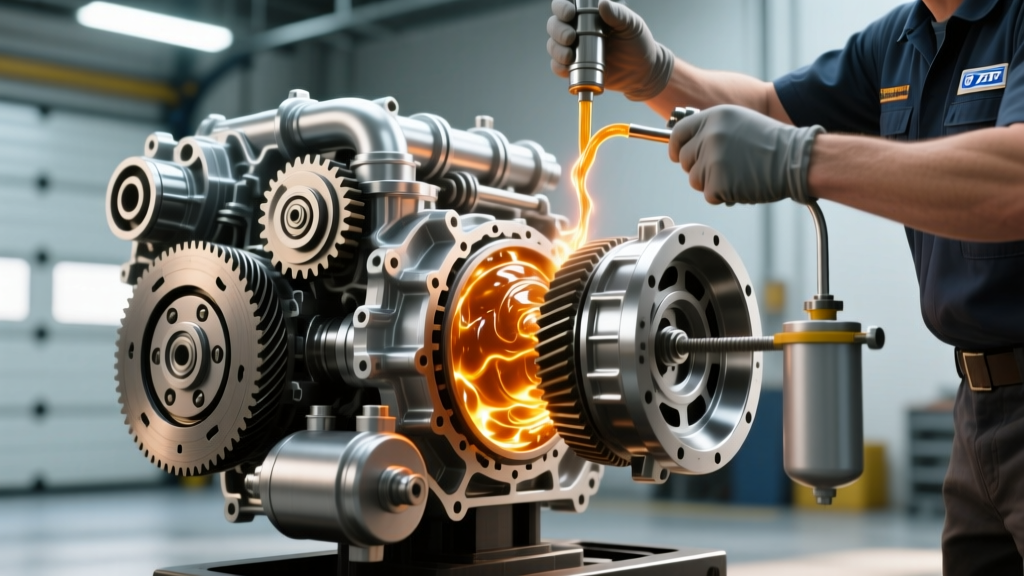
Returning to the core safety question: while ATF is not flammable like racing fuel, it is highly combustible when aerosolized. When performing hot-checks on vehicles with aftermarket long-tube headers (e.g., American Racing Headers or Kooks), adhere to these strict protocols:
- Shield the Exhaust: Use heat shields or header wraps near the transmission bellhousing and dipstick tube routing.
- Use a Fender Cover: Spilled ATF on a hot catalytic converter or exhaust pipe will smoke heavily and can ignite if the converter is glowing from a rich tune.
- Inspect Cooler Lines: Performance builds often utilize braided stainless AN-6 lines for transmission coolers. Ensure all AN fittings are torqued to spec (typically 15-20 lb-ft for aluminum AN-6) and that lines are routed away from exhaust primaries.
- Keep a Class B Extinguisher Nearby: Water will only spread an ATF fire. Keep a properly rated dry chemical or clean agent fire extinguisher within arm's reach of the engine bay during hot-checks.
Final Torque Specs and Cleanup
Precision in the performance bay extends beyond the fluid level. After verifying the hot level and reinstalling any check plugs or dipstick tubes, ensure all fasteners are secured to factory or aftermarket specifications. For the GM 6L80 side fill plug, the torque spec is 27 Nm (20 lb-ft). Always use a new crush washer or O-ring to prevent slow weeping.
Finally, thoroughly degrease the transmission pan, bellhousing, and exhaust components using a dedicated automotive brake cleaner or degreaser. Leftover ATF residue will smoke and burn off hot exhaust components, creating a false alarm for an active fire and masking the scent of a genuine leak. For more advanced diagnostics on pressure fluctuations and line pressure management during these checks, refer to the technical resources at Sonnax Tech Resources. Mastering the hot-check procedure ensures your drivetrain survives the first pass on the track, keeping your fluid exactly where it belongs: inside the transmission, not on the headers.