The Core Question: Do You Add Transmission Fluid While the Car Is Running?
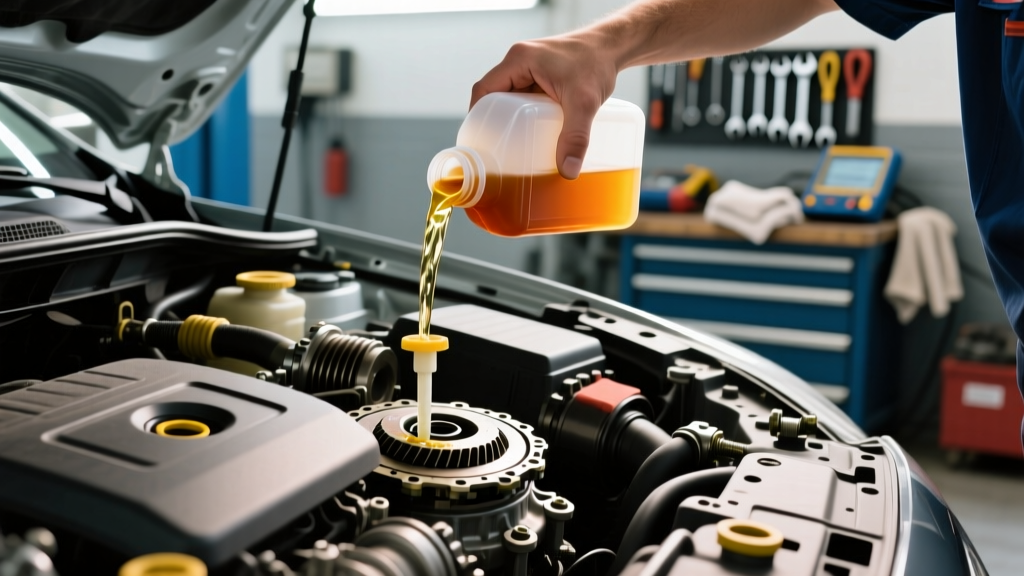
When maintaining an automatic transmission, one of the most common questions DIYers and novice technicians ask is: do you add transmission fluid while the car is running? The short answer for the vast majority of traditional, dipstick-equipped automatic transmissions (such as the venerable GM 4L60E, Ford 4R70W, or Toyota A750E) is yes. However, simply pouring fluid into the tube without understanding the hydraulic physics at play is a fast track to severe transmission fluid level problems.
In 2026, with the proliferation of 8-speed, 9-speed, and 10-speed automatic transmissions, the traditional dipstick is becoming a relic. Modern sealed units require highly specific temperature-dependent procedures. This step-by-step guide will walk you through the correct methodology for checking and adding fluid, while deeply exploring the mechanical consequences of fluid level anomalies—specifically foaming, cavitation, and torque converter drain-back.
The Physics of Fluid Expansion and Torque Converter Fill
To understand why the engine must be running during a fluid check, you must understand the internal architecture of an automatic transmission. When a vehicle sits overnight, the torque converter and cooler lines drain back into the transmission pan. If you check the fluid level with the engine off, the pan will appear dangerously overfilled.
Once the engine is started, the front transmission pump engages, pressurizing the hydraulic circuit, filling the torque converter, and routing fluid through the external cooler lines. This drops the fluid level in the pan to its true operating height. Furthermore, Automatic Transmission Fluid (ATF) is highly susceptible to thermal expansion. ATF can expand by 5% to 7% in volume as it moves from an ambient 60°F (15°C) to a normal operating temperature of 180°F to 200°F (82°C to 93°C). Checking the fluid cold and filling it to the 'Hot' mark guarantees a catastrophic overfill once the vehicle reaches operating temperature.
Step-by-Step: Checking and Adding Fluid While Running
Follow this precise procedure for traditional dipstick-equipped automatics to avoid introducing air into the valve body or overfilling the sump.
Step 1: Achieve True Operating Temperature
Do not rely on the engine coolant temperature gauge. You must monitor the Transmission Fluid Temperature (TFT) sensor via an OBD2 bi-directional scanner. The fluid must be between 160°F and 200°F (71°C to 93°C). If the fluid is too cold, it will read low; if it is too hot (e.g., after towing or track use), it will read high due to extreme thermal expansion.
Step 2: The Gear Cycling Procedure
With the vehicle on a perfectly level surface, the engine idling, and your foot firmly on the brake, shift the transmission through every gear position (P-R-N-D-L). Pause for exactly 3 to 5 seconds in each gear. This critical step allows the hydraulic circuits to fill the respective clutch apply pistons, accumulator bores, and servo assemblies. If you skip this, the fluid remains trapped in the pan, yielding a false-high reading.
Step 3: Reading and Adding
Return the shifter to Park (note: some older Honda and Acura models require the engine to be running but the transmission in Neutral for an accurate reading—always consult the factory service manual). Pull the dipstick, wipe it with a lint-free shop towel, reinsert it fully, and pull it again. If the level is in the crosshatch 'HOT' zone, no fluid is needed. If it is low, add fluid in half-quart increments through the dipstick tube using a long-neck funnel, rechecking after each addition.
Diagnosing Transmission Fluid Level Problems
Incorrect fluid levels are not merely a maintenance oversight; they are active mechanical failures waiting to happen. The hydraulic pressure required to apply clutch packs and bands relies on the incompressibility of liquid ATF. When level problems alter the fluid's state, shifting performance degrades immediately.
| Condition | Primary Symptoms | Mechanical Failure Mode |
|---|---|---|
| Low Fluid Level | Delayed engagement, RPM flaring, slipping, whining noise from bell housing. | Front pump cavitation; air ingestion starves clutch apply circuits, causing friction material burn-up. |
| High Fluid Level | Erratic shifting, delayed upshifts, fluid venting from breather cap. | Planetary gearset whips fluid into aerated foam; foam is compressible, leading to soft shifts and overheating. |
| False Low (Drain-Back) | Fluid reads low cold, but is overfilled when hot. Harsh engagements on startup. | Worn torque converter seal or faulty check ball allows siphoning; adding fluid based on cold reading causes overfill. |
The Danger of Cavitation and Foaming
According to Sonnax Technical Resources, aeration and foaming are among the most misdiagnosed transmission fluid level problems. If you overfill the transmission, the rotating planetary gearsets and clutch drums submerge into the fluid sump. This violent agitation whips the ATF into a pink, milky foam. Because the transmission pump cannot distinguish between liquid and air, it sends this compressible foam into the valve body. The result is a severe drop in line pressure, causing clutches to slip and overheat, often destroying the transmission long before the fluid itself breaks down chemically.
Torque Converter Drain-Back and the 'False Low' Trap
Conversely, if your vehicle sits for 48 hours and the dipstick reads empty, do not immediately add two quarts of fluid. Many high-mileage transmissions suffer from torque converter drain-back, where the one-way check valve in the cooler line fails, allowing the converter to empty into the pan over time. If you add fluid to reach the 'Cold' mark on the dipstick, the moment the engine starts and the converter refills, the pan level will drop below the pickup tube, causing immediate pump cavitation and vehicle immobility. Always verify the running, hot fluid level before adding a single drop.
Exceptions: Sealed Transmissions and Overflow Plugs
The rule of 'checking while running' takes on a highly technical dimension with modern sealed transmissions like the GM 6L80, 8L90, and the ubiquitous ZF 8HP (found in BMW, Audi, Chrysler, and Ford applications). These units lack a traditional dipstick and rely on a precision-machined overflow tube inside the pan.
The ZF 8HP Level Check Procedure
The ZF 8HP transmission is notoriously sensitive to fluid volume. A deviation of just 0.3 liters can cause adaptive shift pressure errors and torque converter shudder. To check and add fluid to a ZF 8HP:
- Temperature Window: The TFT must be strictly between 30°C and 50°C (86°F to 122°F). If the fluid is hotter than 50°C, the expansion will cause the overflow tube to vent too early, resulting in an underfilled transmission.
- The Process: With the vehicle perfectly level and the engine running, remove the 17mm hex fill plug on the side of the pan. Next, remove the 8mm hex overflow/level plug at the bottom of the fill port.
- Adding Fluid: If no fluid drips out, use a transfer pump to inject ZF LifeguardFluid 8 into the fill hole until a steady stream drips out of the overflow tube.
- Torque Specs: Reinstall the overflow plug and torque to 15 Nm (11 lb-ft). Reinstall the main fill plug and torque to 35 Nm (26 lb-ft). Always use new O-rings.
For detailed specifications on OEM fluid requirements and pan torque sequences, the ZF Aftermarket Portal remains the definitive authority for European transmission architectures.
Real-World Costs and Fluid Specifications
Using the incorrect fluid to top off a low transmission is a common catalyst for shifting problems. 'Universal' multi-vehicle ATFs often lack the specific friction modifiers required for modern lock-up torque converters and precision solenoids.
- GM Dexron VI (ACDelco Part # 10-9395): Required for GM 4L60E, 6L80, and 8L90 applications. Expect to pay $8 to $11 per quart. Sourced via ACDelco Lubricants.
- ZF LifeguardFluid 8 (Part # S671.090.312): Mandatory for ZF 8HP applications. Pricing is steep, typically ranging from $32 to $45 per quart.
- Overfill Damage Costs: If an overfilled transmission blows the front pump seal or output shaft seal due to aeration and hydrostatic pressure, expect a labor bill ranging from $600 to $1,200 to drop the transmission or remove the transfer case to replace a $15 seal.
Expert Insight: Never use a funnel that has previously held motor oil or gear oil to add transmission fluid. Even a few drops of cross-contaminated lubricant can alter the friction coefficient of the ATF, leading to torque converter shudder and check-engine codes (such as P0741 for TCC slip) within a few hundred miles.
Final Thoughts on Fluid Level Integrity
Ultimately, answering the question 'do you add transmission fluid while the car is running' requires understanding the specific architecture of your vehicle's drivetrain. For legacy dipstick systems, the running engine is mandatory to fill the hydraulic circuits and torque converter. For modern sealed units, the running engine is paired with strict OBD2 temperature monitoring to ensure the overflow tube meters the exact volume required. By respecting the physics of thermal expansion and hydraulic aeration, you can diagnose fluid level problems accurately and extend the service life of your transmission well past the 150,000-mile mark.