The 4R70W Torque Converter: A Masterclass in Fluid Sensitivity
The Ford 4R70W (and its later evolution, the 4R75W) is widely regarded as one of the most robust automatic transmissions ever produced by the Blue Oval. Found in everything from the F-150 and Mustang to the Crown Victoria and Expedition, its gear train and planetary sets are virtually bulletproof. However, the Achilles heel of this otherwise legendary transmission lies in its hydraulic control system and, more specifically, the torque converter clutch (TCC) operation. As we navigate the automotive landscape in 2026, many of these transmissions are accumulating massive mileage, making torque converter fluid issues a primary culprit for drivability complaints, shudder, and eventual mechanical failure.
Unlike older, non-lockup transmissions where fluid merely acted as a hydraulic coupling medium, the 4R70W utilizes a sophisticated Pulse Width Modulated (PWM) TCC solenoid. This allows the Powertrain Control Module (PCM) to command a controlled slip—typically between 20 and 40 RPM—during TCC apply in third and fourth gears. While this slip-control strategy vastly improves NVH (Noise, Vibration, and Harshness) and fuel economy, it generates immense localized heat and shears the fluid's friction modifiers at an accelerated rate. Understanding the intricate relationship between fluid chemistry, hydraulic pressure, and mechanical wear is critical for any transmission specialist diagnosing a 4R70W torque converter issue.
Hydraulic Routing and TCC Apply Dynamics
To diagnose fluid-related failures, one must first understand how fluid reaches the torque converter. In the 4R70W, transmission fluid is pressurized by the front pump and routed through the valve body. The Electronic Pressure Control (EPC) solenoid modulates mainline pressure, which feeds the TCC regulator valve. When the PCM commands TCC apply, the TCC PWM solenoid pulses, allowing regulated fluid to pass through the stator support tube and into the torque converter's input shaft.
This fluid pressure pushes the TCC piston forward, clamping the friction-lined disc against the converter's front cover. Because the 4R70W relies on precise fluid volume and pressure to maintain that micro-slip, any degradation in fluid viscosity, contamination from clutch material, or aeration will immediately manifest as a slip-stick condition. This is universally felt by the driver as the infamous '4R70W shudder'—a rhythmic, 5-to-10 Hz vibration typically occurring between 40 and 50 mph under light throttle application (around 20-30% TPS).
Fluid Chemistry: The Death of Friction Modifiers
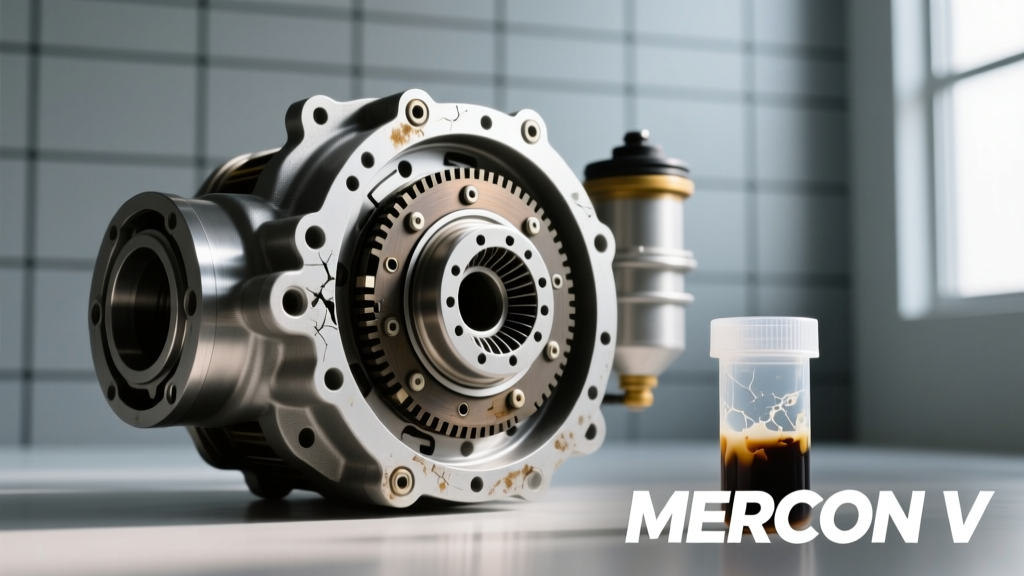
The original specification for the 4R70W was MERCON, which was later superseded by MERCON V. MERCON V was specifically engineered with a unique friction modifier package designed to handle the continuous slip of Ford's PWM torque converters. However, friction modifiers are sacrificial additives. Under sustained thermal loads—especially if the factory radiator cooler is restricted or the auxiliary cooler is bypassed—fluid temperatures can easily exceed 210°F (99°C).
At these temperatures, two destructive processes occur:
- Viscosity Index Improver (VII) Shearing: The long-chain polymers that maintain the fluid's thickness under heat are physically torn apart by the TCC friction surface. The fluid thins out, reducing the hydraulic volume available to hold the TCC piston firmly against the cover.
- Friction Modifier Depletion: As the additives burn off, the fluid loses its ability to facilitate a smooth transition between kinetic and static friction. The paper or carbon-based TCC lining grabs, releases, grabs, and releases in rapid succession, creating the shudder and eventually glazing the friction surface beyond repair.
Diagnostic Matrix: Fluid Condition vs. Torque Converter Symptoms
Before condemning the torque converter or tearing down the valve body, a thorough fluid analysis is mandatory. Use the following matrix to correlate fluid condition with specific 4R70W torque converter symptoms.
| Fluid Condition | Primary Symptom | Probable Root Cause | Expert Action Plan |
|---|---|---|---|
| Dark Red, Slight Burnt Smell | Light shudder at 45 mph, delayed TCC engage | Depleted friction modifiers, normal thermal aging | Perform cooler-line fluid exchange; add one tube of high-quality friction modifier (e.g., Lubegard Dr. Tranny). |
| Opaque Black, Heavy Burnt Odor | Severe shudder, TCC slip codes (P0741, P1744) | Glazed TCC lining, heavy clutch material contamination | Drop pan, inspect for excessive friction material. Torque converter replacement and complete system flush required. |
| Cloudy or Foamy (Aerated) | Erratic TCC apply, harsh shifts, pump whine | Low fluid level, suction side air leak, or clogged filter | Check fluid level at operating temp. Inspect pump O-ring and stator support seals for vacuum leaks. |
| Cherry Red, Normal Smell | Shudder persists despite clean fluid | Mechanical valve body wear, failing PWM solenoid, or bad stator O-rings | Test TCC solenoid resistance (10-14 ohms). Inspect TCC regulator valve bore for wear. |
The Danger of Machine Flushing on High-Mileage 4R70W Units
One of the most common mistakes made by quick-lube shops and inexperienced technicians is connecting a pressurized power-flush machine to a high-mileage 4R70W. The 4R70W torque converter acts as a massive settling tank for clutch debris, metallic particles, and varnish. When a machine forces fluid backward or uses aggressive chemical detergents under high pressure, it dislodges large particulates from the converter's interior fins.
This debris is then pushed directly into the transmission's cooler lines and valve body. In the 4R70W, the TCC solenoid features a small inlet screen, and the valve body separator plate contains precisely metered orifices for TCC apply and release. Dislodged debris will inevitably clog the TCC solenoid screen or lodge in the TCC regulator valve, causing a permanent TCC apply failure or a locked-up torque converter that will stall the engine at a stop. According to technical bulletins from ATRA (Automatic Transmission Rebuilders Association), pressurized flushing is strictly prohibited on high-mileage units exhibiting early signs of degradation.
Expert Protocol: The Cooler-Line Fluid Exchange
To safely replace the fluid in a 4R70W without disturbing settled debris, the industry best practice is the 'Cooler-Line Flush' method. This utilizes the transmission's own internal pump to gently push old fluid out while drawing new fluid in, maintaining the correct flow direction through the torque converter and cooler circuit.
- Preparation: Elevate the vehicle safely and ensure the transmission is at normal operating temperature (180°F - 200°F). The 4R70W total system capacity is approximately 13.9 quarts, but the torque converter alone holds roughly 4.5 to 5 quarts, and the cooler lines hold another 1.5 quarts.
- Disconnect: Locate the transmission cooler return line (usually the rear fitting on the transmission case). Disconnect this line and route it into a clear, graduated collection jug.
- Exchange: Start the engine and let it idle in Park. The transmission pump will push old fluid into the jug. As fluid exits, immediately pour an equal amount of fresh, high-quality synthetic ATF (such as Mobil 1 Synthetic ATF or Valvoline MaxLife Multi-Vehicle, both of which exceed the obsolete MERCON V spec) into the transmission dipstick/fill tube using a long-neck funnel.
- Observation: Watch the fluid in the collection jug. Once the fluid transitions from dark red/black to a bright, translucent cherry red (typically after 10 to 12 quarts have been exchanged), shut off the engine immediately.
- Reconnect and Level: Reconnect the cooler line. Start the engine, cycle the gear shifter through all ranges, and check the dipstick. Add fluid incrementally until it reaches the correct cross-hatch mark on the dipstick with the engine idling and the transmission at operating temperature.
When Fluid Isn't Enough: Mechanical Wear and Upgrades
If a complete fluid exchange and the addition of a friction modifier additive fail to eliminate the 4R70W torque converter shudder, the issue has crossed from a chemical failure to a mechanical one. The most common mechanical failure point related to TCC fluid pressure is the TCC regulator valve bore in the aluminum valve body.
The constant oscillation of the steel TCC regulator valve against the soft aluminum bore causes severe wear over time. This wear allows pressurized TCC apply fluid to cross-leak and exhaust back into the pan, resulting in insufficient clamping force against the torque converter cover. As detailed in Sonnax technical resources, this bore wear cannot be fixed with thicker fluid or additives. The only permanent repair is to remove the valve body, ream the worn bore, and install a sleeved, oversized TCC regulator valve kit (such as the Sonnax 76948-05K). This restores the precise hydraulic sealing required for PWM slip-control.
Additionally, technicians must inspect the stator support tube. The 4R70W utilizes two Teflon or rubber sealing rings on the stator support to separate the TCC apply fluid from the converter charge fluid. If these rings are cut or worn, apply pressure drops drastically. Upgrading to solid Teflon rings (requiring specialized installation tools) or utilizing an upgraded stator support tube from TransGo is highly recommended during any teardown or rebuild.
2026 Reassembly Data and Torque Specifications
When replacing a failed 4R70W torque converter due to severe internal fluid contamination or catastrophic lining failure, precision during reassembly is non-negotiable. An improperly seated torque converter will destroy the front pump upon engine startup.
- Converter Seating: Ensure the torque converter is fully engaged into the transmission. You must feel three distinct 'drops' or clicks as the converter hub passes through the input shaft splines, the stator support splines, and finally seats into the front pump drive gear. Measure the distance from the bellhousing mounting surface to the torque converter pilot pad; it should be at least 5/8-inch (approx. 15mm) recessed.
- TC-to-Flexplate Bolts: The 4R70W uses a 3-bolt or 4-bolt flexplate pattern depending on the engine application. Use only OEM-style flanged bolts or high-grade (Grade 8 equivalent) aftermarket bolts. Torque spec: 26 to 34 lb-ft. Apply a medium-strength threadlocker (blue) to the threads to prevent backing out under harmonic vibration.
- Bellhousing-to-Engine Block: Torque the M12 bellhousing bolts to 40 to 50 lb-ft in a star pattern to ensure the transmission is perfectly square to the engine block, preventing bind on the torque converter pilot.
By respecting the intricate hydraulic demands of the 4R70W and adhering to strict fluid exchange protocols, technicians and enthusiasts can preserve the longevity of these iconic transmissions well into the future. Ignoring the early signs of fluid degradation, however, will inevitably turn a simple maintenance procedure into a costly torque converter and valve body overhaul.