The Hidden Financial Drain of Torque Converter Bearing and Seal Failures
Torque converter bearing and seal issues are among the most deceptive and financially draining failures in modern automatic transmissions. A seemingly minor $12 front pump seal leak or a failing internal Torrington bearing can easily mimic catastrophic internal transmission damage, often leading to unnecessary full rebuilds. In 2026, with independent shop labor rates averaging $145 to $195 per hour and dealer rates pushing past $210, accurately diagnosing and pricing these specific torque converter (TC) faults is critical for your wallet. According to data from the Automatic Transmission Rebuilders Association (ATRA), misdiagnosed torque converter seal and bearing failures account for a significant percentage of customer comebacks and warranty disputes. This guide breaks down the true costs, mechanical realities, and precise reassembly specifications required to fix these issues correctly the first time.
Diagnostic Framework: Isolating Bearings vs. Seals vs. Flexplate
Before discussing costs, we must isolate the failure. Torque converter symptoms often overlap with engine or drivetrain issues. A failing TC bearing and a cracked flexplate can produce nearly identical noises at idle, while a leaking front pump seal is frequently misblamed on a porous transmission case.
Auditory Diagnostics: The RPM Test
- Stator/Turbine Bearing Whine: A failing internal bearing produces a continuous growl or high-pitched whine that is strictly proportional to engine RPM. It does not change when the vehicle is shifted from Park to Drive, nor does it change with vehicle speed.
- Flexplate Cracks: A cracked flexplate (often near the TC bolt holes) produces a rhythmic clicking or knocking at idle. Unlike a bearing whine, this noise will often change pitch or disappear entirely when the transmission is loaded (shifting into Drive or Reverse) due to the change in rotational mass and stress.
- Front Pump Seal Noise: Seals do not typically make noise unless they are completely dry and scoring the converter hub, which results in a metallic scraping sound accompanied by massive fluid loss.
Visual and Physical Diagnostics
Inspect the transmission pan. If you find fine, glitter-like metallic particles mixed with brass-colored shavings, you are likely looking at internal TC bearing failure combined with stator support tube wear. If the fluid is clean but the bellhousing is soaked in Dexron VI, your front pump seal or converter O-ring has failed.
The Economics of Front Pump Seal and Converter Neck Wear
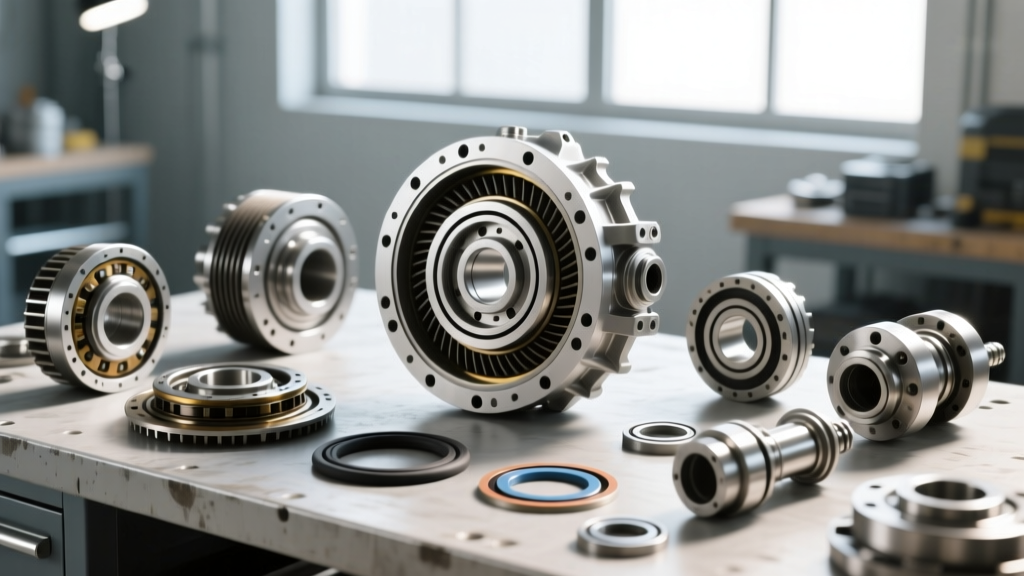
The front pump seal is the most common casualty of torque converter issues. For the ubiquitous GM 4L60E, the front pump seal (commonly replaced with National 710483 or SKF 22368) costs between $8 and $15. However, the seal is rarely the root cause of the leak. The true culprit is usually wear on the torque converter hub (neck) or the stator support tube.
If the converter hub is scored or exhibits more than 0.002 inches of radial runout, a new seal will begin leaking within 500 miles. According to Sonnax Technical Resources, installing a standard lip seal on a worn converter hub is a guaranteed comeback. The proper repair involves either replacing the torque converter entirely or installing a hardened steel sleeve (such as the Sonnax SureSeal kit) over the worn hub. While the sleeve kit costs around $35, it requires a machine shop or specialized bench tools to install properly, adding to the overall labor cost of a transmission R&R (Remove and Replace) job.
Internal Bearing Failures: Stator and Turbine Economics
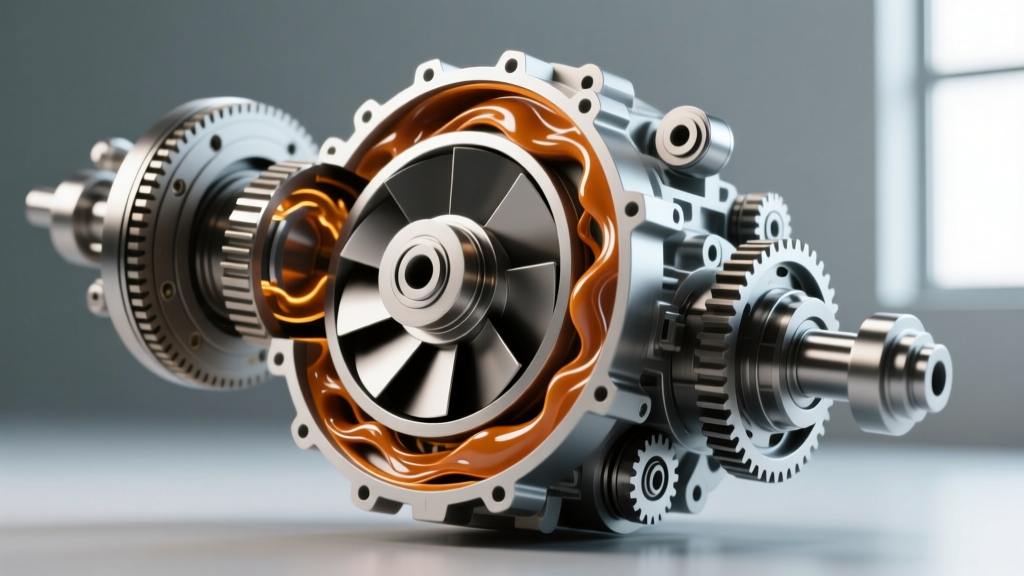
Inside the torque converter, the stator assembly rides on a one-way clutch and a set of needle or Torrington bearings. When these bearings fail, the stator can wobble, scoring the transmission's stator support tube. If the support tube is deeply grooved, the front pump assembly must be replaced. A new OEM or high-quality aftermarket front pump for a 4L60E or 6L80 ranges from $180 to $350. If the damage is caught early, a stator support tube sleeve can be installed for roughly $25 in parts, saving hundreds in hard parts replacement. Transmission Digest frequently highlights that ignoring early-stage bearing whine inevitably turns a $300 torque converter replacement into a $2,500 transmission rebuild due to metal contamination destroying the valve body and clutch packs.
2026 Cost Analysis & Price Breakdown Table
The following table outlines the realistic costs associated with torque converter seal and bearing repairs in 2026, assuming a standard 5.5-hour R&R labor time at an average independent shop rate of $155/hour.
| Repair Strategy | Parts Cost | Labor Cost (5.5 hrs) | Total Estimated Cost | Warranty Expectation |
|---|---|---|---|---|
| Front Pump Seal Only (DIY R&R) | $15 | $0 | $15 | None (High Risk) |
| Seal & Hub Sleeve (Shop R&R) | $65 | $852 | $917 | 12 Mo / 12,000 Mi |
| Remanufactured TC + Seal + Fluid | $320 | $950 | $1,270 | 3 Yr / 100,000 Mi |
| OEM Dealer TC Assembly + Fluid | $680 | $1,150 | $1,830 | 2 Yr / Unlimited |
Note: Labor costs vary wildly by region. Dealerships will easily push the Remanufactured TC total past $2,200 due to higher hourly rates and OEM parts mandates.
Crucial Reassembly: 4L60E Torque Converter Bolts Torque Specs
One of the most critical, yet frequently botched, aspects of torque converter reinstallation is the fastening to the flexplate. Improper torque leads to flexplate warping, which pushes the torque converter forward against the front pump seal, causing immediate seal failure and premature bearing wear. When consulting service manuals or online forums for the 4l60e torque converter bolts torque specs, the factory specification is exactly 35 lb-ft (47 Nm).
The Reassembly Protocol
- Verify Converter Seating: Before mating the transmission to the engine block, ensure the torque converter is fully seated into the front pump. You must measure the gap between the flexplate mounting pad and the torque converter mounting pad. For the 4L60E, this gap should be between 1/8' and 3/16'. If the converter is flush or protruding, it is not seated on the stator support splines, and bolting it down will instantly destroy the front pump gear.
- Hardware Selection: Never reuse stretched or yield-style TC bolts. Use new OEM-style M10x1.5 bolts (GM Part # 14097013 or equivalent aftermarket).
- Thread Locker Application: Apply a medium-strength blue threadlocker to the bolt threads. The rotational mass and harmonic vibrations of the drivetrain will back out dry bolts over time.
- Torquing Sequence: Use a flywheel holding tool to prevent the engine from turning. Tighten the bolts in a star pattern to the final 35 lb-ft specification. Never use an impact wrench to run these bolts down, as the shock loading can crack the flexplate or strip the threads on the converter pad.
Collateral Costs: Fluids, Filtration, and Cooler Flushing
A torque converter R&R is never just about the converter itself. The collateral costs must be factored into your total budget. The 4L60E transmission requires approximately 11.2 quarts of fluid for a completely dry fill (including the new torque converter and cooler lines). In 2026, a case of high-quality synthetic Dexron VI or equivalent multi-vehicle ATF will cost between $85 and $120. Additionally, a deep-pan filter kit and gasket will add $25 to $40.
Furthermore, if your torque converter failed internally (bearing disintegration or clutch material shedding), a mandatory cooler line flush is required. Flushing the radiator-integrated transmission cooler and auxiliary lines typically costs $120 to $180 at a shop. Skipping this step will result in the new torque converter ingesting trapped debris, leading to a repeat failure within a few thousand miles.
Summary and Preventative Action
Torque converter bearing and seal issues require a methodical, evidence-based approach to repair. By understanding the true cost breakdown—from the $15 front pump seal to the $350 front pump replacement necessitated by stator scoring—you can make informed decisions rather than falling victim to upsells. Adhering strictly to the 35 lb-ft torque spec on the flexplate bolts and ensuring proper converter seating will prevent the vast majority of post-repair seal leaks. Ultimately, investing in a high-quality remanufactured torque converter with a reinforced hub and upgraded internal bearings remains the most cost-effective long-term solution for high-mileage vehicles.