The 48RE Transmission: Bench Building for the 5.9L Cummins
The Chrysler 48RE transmission, found in 2003–2007 Dodge Ram 2500 and 3500 trucks equipped with the legendary 5.9L Cummins turbodiesel, is a workhorse that suffers from a few critical weak points when subjected to modern towing demands and aftermarket tuning. While the 48RE is fundamentally a robust four-speed automatic based on the A727 architecture, its intermediate shaft, overdrive clutch pack, and stock valve body line pressure are notorious failure points. Performing a complete 48RE transmission rebuild on your own bench is not only a rite of passage for Cummins owners but also a massive cost-saver compared to professional shop rates. This guide details the exact bench build procedures, critical clearances, and a comprehensive cost breakdown to help you decide between a DIY rebuild and a professional remanufactured unit.
2026 48RE Transmission Rebuild Cost Breakdown
Before tearing down your transmission, it is vital to understand the financial landscape. Professional shops often quote between $3,800 and $4,800 for a heavy-duty 48RE rebuild, factoring in labor, machine shop work, and liability. By sourcing your own components and performing the bench build, you can cut this cost by more than half while retaining total control over the quality of the internal upgrades.
| Component / Service | DIY Bench Build Cost | Professional Shop Cost |
|---|---|---|
| Master Rebuild Kit (Fricions, Steels, Seals, Bands) | $350 – $450 | Included in Labor/Parts |
| Billet Intermediate Shaft (e.g., Sonnax) | $180 – $220 | $250+ (Markup) |
| 6-Clutch Overdrive Drum Upgrade | $250 – $320 | $350+ |
| Valve Body Shift Kit (TransGo) | $80 – $110 | $150+ |
| Heavy-Duty Billet Torque Converter | $550 – $750 | $800 – $1,100 |
| Mopar ATF+4 Fluid (17 Quarts) | $120 – $150 | $180+ |
| Labor (Bench Build vs. Shop Rate) | $0 (Your Time) | $1,500 – $2,200 |
| Total Estimated Cost | $1,530 – $2,000 | $3,800 – $4,800+ |
Note: Prices reflect early 2026 market averages for heavy-duty diesel components. Core charges and machine shop services (e.g., case boring, pump resurfacing) may add $150–$300 to the DIY total if your original hard parts are scored.
Essential Bench Setup and Specialty Tools
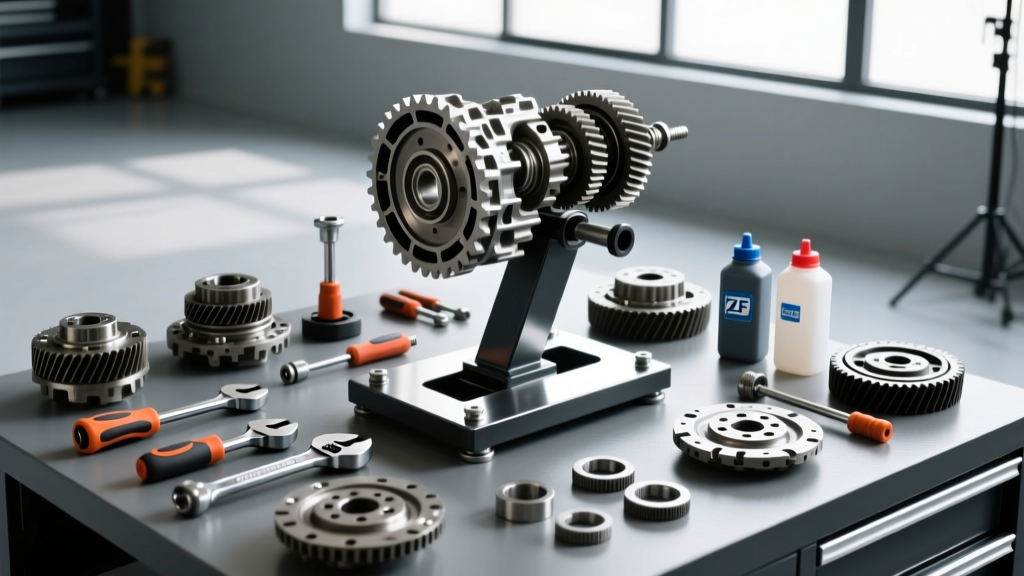
You cannot successfully rebuild a 48RE with a standard mechanic’s socket set. The bench build requires precision measuring instruments to ensure clutch pack clearances and geartrain endplay are within Chrysler’s exacting specifications.
- Transmission Holding Fixture: A bench-mounted or floor-standing bellhousing adapter to rotate the case freely.
- Dial Indicator and Magnetic Base: Mandatory for measuring geartrain endplay and clutch pack travel.
- Inch-Pound Torque Wrench: Valve body and pump bolts require precise, low-torque settings to prevent case warping or bolt shearing.
- Snap Ring Pliers: Heavy-duty internal and external sets (specifically angled tips for the overdrive drum snap rings).
- Clutch Spring Compressor: Essential for safely disassembling and reassembling the direct and overdrive clutch packs.
Step-by-Step 48RE Bench Build Procedures
Step 1: Pump, Stator Support, and Intermediate Shaft Assembly
The front oil pump and stator support dictate the life of your transmission. Begin by inspecting the pump gear pocket. If you can feel a fingernail catch on scoring inside the pump bore, the pump half must be machined or replaced. Install new bushings and a new gear set if clearances exceed 0.004 inches. Next, address the intermediate shaft. The stock shaft is prone to twisting and snapping under the torque of a modified 5.9L Cummins. Install a hardened billet intermediate shaft from a reputable manufacturer like Sonnax Industries. When mating the stator support to the pump, use a new O-ring and ensure the sealing rings are perfectly seated and lubricated with assembly gel to prevent dry-start scoring.
Step 2: Overdrive and Direct Clutch Pack Stacking
The overdrive (OD) section is the most abused component in the 48RE, as it handles all the torque during highway cruising and overdrive gears. The factory 5-clutch setup is inadequate for tuned diesels. Upgrade to a 6-clutch OD drum assembly. When stacking the frictions and steels, soak all paper-based friction discs in genuine Mopar ATF+4 for at least 30 minutes prior to assembly.
Overdrive Clutch Clearance: Use your dial indicator to measure the travel between the snap ring and the backing plate. The target clearance is 0.040" to 0.060". If the clearance is too tight, the clutches will drag and burn; if too loose, you will experience delayed shifts and flare. Use selective thickness backing plates to dial in this measurement perfectly. Repeat this process for the Direct clutch pack, targeting a slightly tighter clearance of 0.035" to 0.055".
Step 3: Valve Body Upgrades and Line Pressure Calibration
The stock 48RE valve body suffers from pressure leaks and accumulator blow-offs under heavy load. Installing a shift kit, such as those offered by TransGo, is non-negotiable for a diesel application. This procedure involves drilling specific orifices in the separator plate to increase feed rates to the clutch packs and modifying the pressure regulator valve to raise base line pressure.
Expert Tip: When installing the separator plate, do not use a standard cork or rubber gasket. Use a high-quality steel-core gasket or apply a thin bead of anaerobic sealant (like Loctite 518) to the mating surfaces to prevent cross-leaking between the valve body casting and the separator plate.Ensure the manual valve linkage aligns perfectly with the rooster comb. A misaligned manual valve will result in the transmission engaging in two gears simultaneously, causing immediate catastrophic failure upon engine start.
Step 4: Final Geartrain Assembly and Endplay Check
As you stack the planetary gearsets, output shaft, and clutch drums into the case, you must verify the total geartrain endplay. Excessive endplay causes the input shaft to wobble, destroying the front pump bushing and seal. Insufficient endplay leads to thrust washer binding and overheating.
Mount your dial indicator to the bellhousing face, resting the plunger on the input shaft. Push the shaft fully rearward, zero the indicator, and pull the shaft forward. The acceptable endplay specification for the 48RE is 0.010" to 0.025". Adjust this by swapping the selective thrust washer located between the front planetary and the direct clutch hub. Keep a kit of selective washers (ranging from 0.060" to 0.120" in thickness) on your bench to achieve the perfect preload.
Critical Torque Specifications
Over-torquing aluminum case components is a common DIY mistake that leads to warped valve bodies and cracked pump housings. Always use a calibrated inch-pound torque wrench for internal components.
- Oil Pump to Case Bolts (M8): 10 – 12 ft-lbs (120 – 144 in-lbs)
- Valve Body to Case Bolts (M6): 75 – 85 in-lbs
- Accumulator Cover Bolts: 10 – 12 ft-lbs
- Bellhousing to Engine Block: 35 ft-lbs
- Torque Converter to Flexplate: 23 – 25 ft-lbs (Use new Grade 8 or OEM Mopar bolts with threadlocker)
- Transmission Pan Bolts: 15 – 18 ft-lbs (Do not overtighten, or the pan rail will warp and leak)
Common 48RE Failure Modes to Avoid During Rebuild
Even with upgraded parts, builder error can doom a 48RE. The most common bench-build errors include:
- Forgetting the Front Band Adjustment: The 48RE requires manual band adjustments via the external locknuts on the case. The front band must be tightened to 72 in-lbs, then backed off exactly 2-7/8 turns. The rear band is tightened to 72 in-lbs and backed off 3 turns. Failing to do this will result in burnt bands or no engine braking in manual low.
- Using the Wrong Fluid: The 48RE clutch materials are specifically designed for the friction modifiers in Mopar ATF+4. Using generic Dexron or multi-vehicle synthetic fluids will cause immediate shudder in the torque converter lockup clutch and premature friction wear.
- Ignoring the Cooler Flow: The 48RE relies on massive cooler flow to survive diesel towing. If your bench build is perfect but your external cooler lines are restricted or the stock radiator cooler is clogged, the transmission will overheat and cook the new frictions within 500 miles. Always perform a cooler flow test (minimum 1 gallon per minute) before installing the transmission.
Conclusion
Executing a 48RE transmission rebuild on your own bench requires patience, precision measuring tools, and a commitment to using heavy-duty aftermarket upgrades. By addressing the intermediate shaft, upgrading the overdrive clutch capacity, and recalibrating the valve body, you transform the 48RE from a fragile liability into a robust drivetrain component capable of handling the immense torque of the 5.9L Cummins. Furthermore, with DIY costs hovering around $1,800 compared to shop quotes exceeding $4,000, the bench build remains one of the most financially rewarding projects a diesel truck owner can undertake.