The 'Center Differential' Misconception in the 2018 F-150
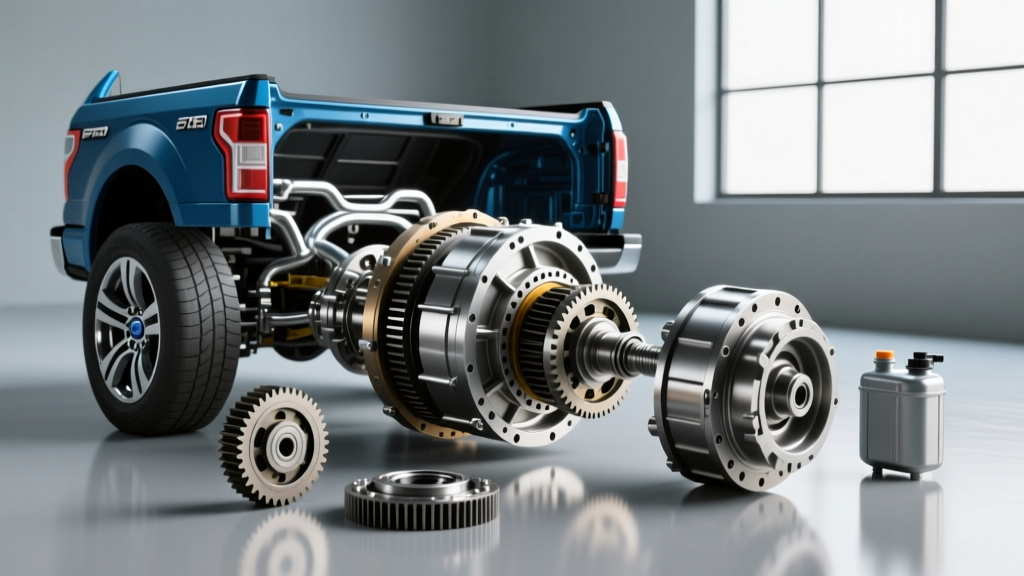
When truck owners begin researching 2018 f150 differential fluid, the immediate focus is almost entirely on the front and rear axles. However, diagnosing drivetrain binding, AWD shudder, and low-speed clunking requires a broader understanding of the vehicle's torque distribution network. Unlike traditional all-wheel-drive (AWD) crossovers that utilize a planetary center differential to allow front and rear axle speed differentiation, the 2018 Ford F-150 relies on a BorgWarner 4417 transfer case to manage front-to-rear torque split.
In the context of 4WD and part-time AWD systems, the transfer case acts as the functional equivalent of a center differential. When this unit is improperly serviced, or when drivers misuse the 4H (4-High) mode on high-traction surfaces, the resulting drivetrain wind-up mimics a catastrophic center differential failure. Proper symptom diagnosis requires isolating whether the binding is a result of operator error, degraded friction modifiers in the transfer case fluid, or internal clutch pack wear.
Symptom Diagnosis: Drivetrain Wind-Up vs. Internal Failure
Differentiating between normal 4WD characteristics and actual mechanical failure is the first step in troubleshooting. The 2018 F-150's Electronic Shift-On-The-Fly (ESOF) system locks the front and rear driveshafts together in 4H. Because there is no open center differential to absorb the rotational speed differences between the front and rear axles during cornering, the drivetrain must absorb this energy.
The Dry Pavement Bind Test
If you experience severe steering bind, hopping, or a 'locked' feeling while making tight turns at low speeds, perform the Dry Pavement Bind Test. This is not a mechanical failure; it is physics.
- Symptom: Front tires skip or hop during low-speed turns on dry asphalt.
- Cause: Drivetrain wind-up due to the locked center distribution unit (transfer case) in 4H.
- Resolution: Shift the vehicle into 2H. Drive forward in a straight line for a few feet, then reverse slightly. This relieves the torsional stress stored in the driveshafts and ring-and-pinion gears.
Clutch Pack Shudder and TCCM Codes
If the shudder occurs while the vehicle is in 2H or during the exact moment of engagement into 4A (4-Auto, if equipped with the TOD clutch pack), the issue lies within the internal wet clutch pack of the BorgWarner transfer case. This is where the specific 2018 f150 differential fluid and transfer case fluid specifications become critical. Using standard 75W-90 gear oil in the transfer case instead of the specified friction-modified fluid will cause immediate clutch chatter, overheating, and eventual failure of the Transfer Case Control Module (TCCM) to modulate torque.
2018 F150 Differential Fluid & Transfer Case Specifications
Using the correct fluid chemistry is non-negotiable. The hypoid gears in the axles require extreme pressure (EP) additives, while the transfer case clutch packs require specific friction modifiers to prevent shudder. Below is the definitive specification chart for the 2018 F-150 4WD drivetrain.
| Component | Fluid Specification | Motorcraft Part Number | Capacity | Plug Torque Spec |
|---|---|---|---|---|
| Rear Axle (9.75-inch) | SAE 75W-140 Synthetic Gear Oil | XY-75W140-QL | 3.3 Pints (1.56L) | 35 lb-ft (47 Nm) |
| Front Axle (8.8-inch IFS) | SAE 80W-90 Premium Gear Oil | XY-80W90-QL | 1.7 Pints (0.8L) | 35 lb-ft (47 Nm) |
| Transfer Case (BW 4417) | Motorcraft XL-12 or MERCON LV | XO-12-QT / XT-10-QLVC | 2.0 Pints (0.95L) | 21 lb-ft (28 Nm) |
Expert Note on E-Lockers: A common myth in the F-150 community is that the electronic locking rear differential (e-locker) requires a friction modifier additive (like XL-3). This is false. Ford's e-locker uses a mechanical dog-clutch mechanism, not a clutch-type limited-slip differential (LSD). Adding friction modifier to an e-locker axle reduces the protective film strength of the 75W-140 gear oil and can lead to premature ring and pinion wear. Always check your axle tag; if it says 'LS', add the modifier. If it's an e-locker, use straight synthetic 75W-140.
Step-by-Step Troubleshooting & Fluid Inspection
When diagnosing AWD/4WD binding or drivetrain noise, a visual and olfactory inspection of the fluids will reveal the exact point of failure. You will need a 3/8-inch drive socket set, a fluid extraction pump, and a magnetic drain plug.
Evaluating the Transfer Case Fluid (The 'Center Diff')
The transfer case is the most vulnerable component in the F-150's torque distribution system. To inspect it:
- Locate the Fill and Drain Plugs: Positioned on the rear output housing of the transfer case. Always remove the fill plug first to ensure you can refill the unit before draining it.
- Inspect the Fluid Color and Smell: Fresh XL-12 or MERCON LV fluid is red or amber. If the fluid is dark grey, smells distinctly burnt, or contains a fine metallic paste, the internal wet clutch pack is slipping and wearing away. This friction material contaminates the fluid, leading to erratic TCCM behavior and AWD engagement shudder.
- Check for Water Intrusion: If the fluid looks like a 'strawberry milkshake', the rear output shaft seal has failed, allowing water to emulsify the transmission-style fluid. This destroys the clutch pack friction surfaces.
Rear and Front Axle Fluid Degradation
While the axles do not contain clutch packs (unless equipped with an aftermarket LSD), the hypoid ring and pinion gears generate immense shearing forces. If you hear a whining noise that changes pitch on deceleration (coast-side whine), the rear differential fluid has likely broken down, or the pinion bearing preload has shifted. According to Motorcraft's technical bulletins, severe towing duty cycles require 75W-140 rear differential fluid changes every 150,000 miles, but many fleet mechanics recommend a 60,000-mile interval for trucks regularly towing over 8,000 lbs.
The Hidden Killer: Tire Circumference Mismatch
No discussion of center differential and AWD system troubleshooting is complete without addressing tire sizing. The BorgWarner transfer case in the 2018 F-150 is highly sensitive to rotational speed differences between the front and rear axles.
If you replace only two tires due to a blowout, or if your front and rear tires wear at different rates, the resulting circumference mismatch forces the transfer case clutch pack to continuously slip, even when driving in 2H (if the system is in an active monitoring state) or definitely in 4A/4H. A tread depth difference of just 3/32 of an inch between the front and rear axles can generate enough rotational variance to overheat the transfer case fluid, triggering the TCCM to throw a P0836 (Four Wheel Drive Switch Circuit) or P1815 code and default the truck into a safe-mode 2WD lock.
The Diagnostic Fix: Measure the rolling circumference of all four tires using a tailor's tape measure around the center tread. If the variance between the front and rear axle average exceeds 1/4 inch, you must rotate the tires, shave the new tires to match the old ones, or replace all four to prevent catastrophic center diff/transfer case failure.
Advanced TCCM and Encoder Motor Diagnostics
If the fluids are clean, the tires are matched, and the truck still exhibits binding or refuses to engage 4WD, the issue is likely electronic. The shift motor (encoder motor) mounted on the exterior of the transfer case uses potentiometers to tell the TCCM the exact position of the internal shift fork.
- Symptom: Flashing 4WD dashboard lights, grinding noise from the transfer case, failure to disengage 4L.
- Diagnosis: Use a bi-directional OBD2 scanner capable of reading Ford-specific TCCM PID data. Monitor the 'Encoder Motor Voltage' and 'Shift Fork Position'. If the voltage drops out or the position reads 'Between Gears' while driving, the encoder motor is failing, causing the shift fork to partially engage the dog clutch, resulting in severe grinding and drivetrain bind.
For deeper engineering insights into how torque-on-demand systems manage these clutch packs, BorgWarner's technical documentation outlines the precise hydraulic and electronic modulation required to maintain seamless AWD operation without inducing the bind commonly mistaken for differential failure.
Summary: A Holistic Approach to Drivetrain Health
Troubleshooting the 2018 F-150's 4WD and AWD-equivalent systems requires looking beyond the simple front and rear differential fluid changes. By treating the transfer case as the critical center torque distributor, adhering strictly to Motorcraft fluid specifications, maintaining exact tire circumference tolerances, and monitoring TCCM data, you can accurately diagnose drivetrain bind and prevent thousands of dollars in internal clutch and gear damage.