Decoding the 2017 F-150 Rear Differential: 8.8-Inch vs. 9.75-Inch
The 2017 Ford F-150 represents a benchmark in modern truck drivetrain engineering, utilizing high-strength steel and aluminum to reduce weight while maintaining massive torque capacity. At the rear axle, Ford primarily deployed two distinct differential platforms: the venerable 8.8-inch and the heavy-duty 9.75-inch semi-floating axles. Understanding which housing sits under your truck is the critical first step in performing accurate limited slip differential (LSD) maintenance.
Unlike an open differential that routes power to the path of least resistance, the 2017 F-150 rear differential equipped with a Limited Slip mechanism actively manages torque biasing to maintain traction. However, the maintenance requirements, fluid capacities, and internal wear characteristics vary drastically between the 8.8-inch and 9.75-inch variants, as well as between the specific LSD technologies Ford utilized for this model year.
Axle Code Identification
Before purchasing gear oil or rebuild components, locate the certification label on the driver-side B-pillar door jamb. Look for the 'AXLE' code:
- 8.8-Inch LSD Codes: Code 27 (3.55 ratio) or Code 26 (3.31 ratio). These are standard clutch-type Trac-Lok units.
- 9.75-Inch LSD Codes: Code B6 (3.55 ratio) or Code B5 (3.31 ratio). These feature larger ring gears, 34-spline axle shafts, and heavy-duty clutch packs designed for the EcoBoost V6 towing packages.
- Electronic Locker (eLocker): Code X4 (3.55 ratio). Note that the eLocker is an on-demand locking differential, not a traditional clutch-based LSD. It operates as an open differential until electrically engaged, meaning it does not require the same friction modifier maintenance as the Trac-Lok.
Internal Mechanics: How Ford's Limited Slip Differentials Operate
To properly maintain the 2017 F-150 rear differential, one must understand the physical forces governing its internal components. Ford utilized two primary LSD architectures during this generation.
The Trac-Lok Clutch-Pack System
The standard Trac-Lok unit relies on a series of alternating steel and composite friction plates clamped between the side gears and the differential carrier. An internal S-spring (or preload springs in heavier 9.75-inch variants) applies baseline pressure to these clutch packs. When one wheel begins to slip, the internal thrust forces generated by the spider gears push the side gears outward against the clutch packs. This friction resists the slip, transferring torque to the wheel with traction.
Over time, the composite friction material degrades, and the S-springs lose their metallurgical tension. This results in a loss of breakaway torque—the exact measurement of how much rotational force is required to differentiate the wheels. When breakaway torque drops below 40 lb-ft, the LSD effectively operates as an open differential.
The Torsen Helical Gear System
Found in specific off-road and performance packages (often associated with the FX4 or Raptor lineage, though adapted for standard F-150 applications), the Torsen (Torque Sensing) differential operates entirely without friction clutches. Instead, it uses complex helical gear sets and worm gear principles to create a mechanical torque bias. A typical Torsen T-3 unit in a Ford application offers a 2.5:1 or 3:1 bias ratio. Because it relies on gear binding rather than friction material, the Torsen does not require specialized friction modifiers, making its long-term maintenance significantly more straightforward.
Fluid Specifications, Capacities, and the Friction Modifier Mandate
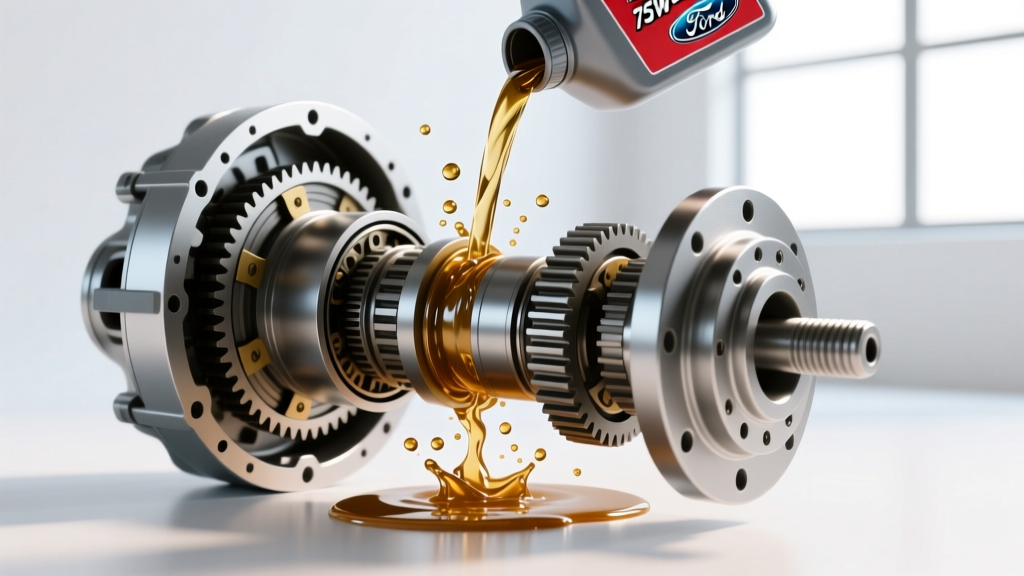
Using the correct fluid viscosity and additive package is non-negotiable for clutch-type LSDs. Standard gear oil lacks the frictional characteristics required to allow the clutch packs to slip smoothly during low-speed cornering. Without the proper modifier, the clutches will aggressively grab and release, causing the notorious 'differential chatter' that can shatter axle shafts over time.
| Axle Type | Ring Gear Size | Fluid Capacity | OEM Fluid Specification | Friction Modifier Required? |
|---|---|---|---|---|
| Standard Duty | 8.8-Inch | 2.25 - 2.5 Quarts | SAE 75W-90 Premium (XY-75W90-QL) | Yes (4 oz XL-3) |
| Heavy Duty / Tow | 9.75-Inch | 2.75 - 3.0 Quarts | SAE 75W-140 Synthetic (XY-75W140-QL) | Yes (4-8 oz XL-3) |
| Torsen Equipped | 8.8 / 9.75 | Varies by Housing | SAE 75W-90 or 75W-140 | No |
Note: The Motorcraft XL-3 Friction Modifier Additive (Part # C8AZ-19B546-A) is specifically engineered for Ford's Trac-Lok carbon-fiber clutch materials. Using generic aftermarket modifiers often results in persistent chatter due to incompatible friction coefficients.
Step-by-Step LSD Service and Torque Specifications
Performing a fluid service on the 2017 F-150 rear differential requires precision. The aluminum differential covers on the 2017 models are prone to thread stripping if over-torqued, and the RTV sealant requires meticulous surface preparation.
Removal and Preparation
- Remove the fill plug first (located on the upper quadrant of the differential cover). If the fill plug is seized or stripped, you must resolve it before draining the fluid.
- Remove the 12mm or 13mm cover bolts. Use a plastic scraper to separate the aluminum cover from the steel axle housing. Never use a steel pry bar, as scoring the mating surface will guarantee permanent fluid leaks.
- Clean the housing interior with a lint-free shop towel. Inspect the magnetic drain plug (if equipped) or the bottom of the housing. A fine, glitter-like metallic paste is normal wear. Chunky metal shards or brass-colored debris indicates catastrophic spider gear or clutch pack failure.
Reassembly and Torque Specs
- Cover Bolt Torque: 28 to 33 lb-ft (38 to 45 Nm). Use a calibrated inch-pound or low-range foot-pound torque wrench. Tighten in a crisscross pattern.
- Fill Plug Torque: 22 to 33 lb-ft (30 to 45 Nm).
- RTV Sealant: If your 2017 model does not use a reusable silicone gasket, apply a 3mm continuous bead of Motorcraft Silicone Gasket Remover and Maker (TA-32) to the cover. Allow 30 minutes of skinning time before filling.
The Figure-8 Calibration Procedure
After refilling with the correct synthetic gear oil and the XL-3 friction modifier, the clutch packs must be conditioned. Drive the truck to a large, empty, paved lot. Perform 10 to 15 tight, continuous figure-8 maneuvers at idle speed. This specific maneuver forces the differential to slip the clutch packs continuously, distributing the friction modifier evenly across the composite surfaces and burnishing them to prevent low-speed chatter.
Advanced Diagnostics: Curing LSD Chatter and Identifying Failure
If your 2017 F-150 rear differential exhibits chatter during tight turns even after a fluid and modifier service, the issue has likely progressed beyond simple maintenance.
Clutch Pack Burnout and Rebuild Metrics
When clutch packs overheat from sustained wheel slip (e.g., rocking the truck in snow or mud), the composite material glazes or burns, rendering the friction modifier useless. At this stage, a rebuild is mandatory. A standard Ford Performance 8.8-inch LSD clutch kit (Part # M-4204-88) or a Yukon Gear & Axle master rebuild kit (Part # YK D8.8) costs between $85 and $150. However, the labor to pull the axle shafts, remove the carrier, and rebuild the clutch pack preload with specialized shims typically pushes shop bills to $600 - $900.
Ring and Pinion Wear Patterns
While servicing the LSD, inspect the ring and pinion gear teeth. The 2017 F-150's high torque output—especially from the 3.5L EcoBoost V6 (generating up to 470 lb-ft)—places immense shear stress on the hypoid gears. Look for pitting on the drive side of the teeth or excessive backlash noise (a coast-down whine). Ring gear bolts must be torqued to 70-85 lb-ft with red threadlocker; if you find loose ring gear bolts, the carrier must be replaced, as the bolt holes will be elongated.
Proper maintenance of your 2017 F-150 rear differential ensures that torque reaches the pavement efficiently, preserving the lifespan of your axle shafts and maintaining the truck's legendary towing and off-road capabilities. Always consult the Ford Owner Manuals for your specific VIN configuration, and source OEM-grade lubricants directly from Motorcraft Fluids & Chemicals or reputable drivetrain specialists like Yukon Gear & Axle for rebuild components.