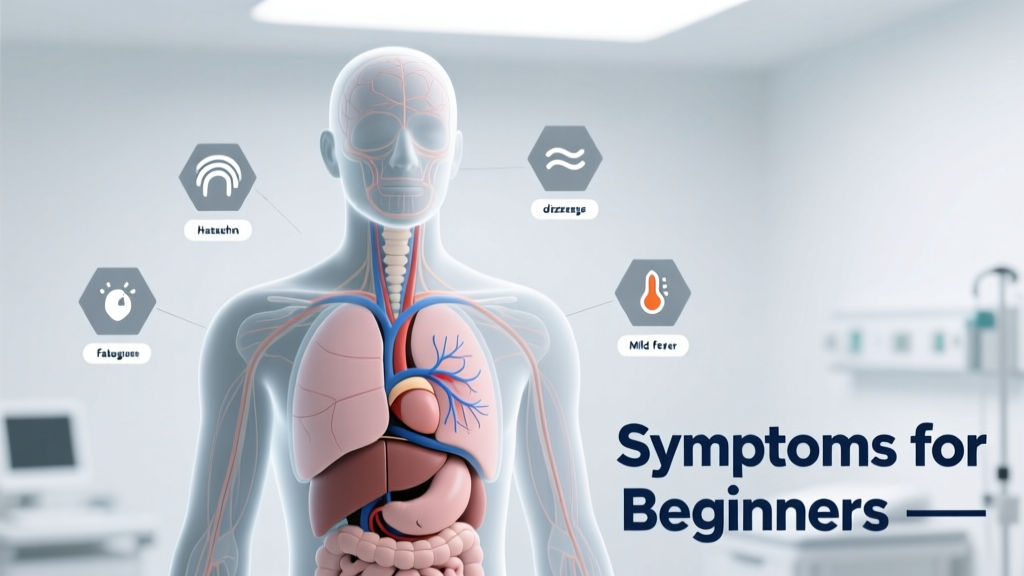
Recognizing symptoms early is one of the most practical health skills anyone can develop—but it’s rarely taught in schools or workplaces. This guide cuts through medical jargon to explain what symptoms actually are (physiological signals, not diagnoses), how they differ from signs, and why context matters more than isolated checklists. We cover fatigue that lasts >2 weeks despite adequate sleep, unexplained weight loss of ≥5% body weight in 6 months (e.g., 12 lbs in a 240-lb adult), persistent fever ≥100.4°F (38°C) for >3 days, and other evidence-based red flags. Drawing on CDC surveillance data, WHO symptom classification frameworks, and clinical guidelines from the American College of Physicians, this article helps beginners interpret bodily cues without alarmism or dismissal.
What Is a Symptom—Really?
A symptom is a subjective experience reported by a person—something they feel or notice, like headache, nausea, or shortness of breath. It differs fundamentally from a sign, which is objective and measurable by others: elevated blood pressure, rash, or abnormal lung sounds heard with a stethoscope. Symptoms cannot be directly observed; they rely on accurate self-reporting and skilled clinical interpretation. For example, ‘fatigue’ may reflect iron deficiency (ferritin <30 ng/mL), untreated hypothyroidism (TSH >4.5 mIU/L), depression (PHQ-9 score ≥10), or chronic sleep restriction (<6 hours/night consistently). Without context, the word alone tells little.
The World Health Organization defines symptoms as "any deviation from normal feeling or function," emphasizing that normality varies widely across age, sex, activity level, and environment. A resting heart rate of 92 bpm may be normal for a 17-year-old athlete but warrants evaluation in a sedentary 68-year-old. Likewise, nocturia (waking ≥2 times/night to urinate) affects 65% of adults over 70 per NIH data—but in someone aged 32, it may signal uncontrolled diabetes (fasting glucose ≥126 mg/dL) or obstructive sleep apnea.
Why Context Changes Everything
Timing, pattern, and triggers transform vague complaints into meaningful clues. Consider chest discomfort: pressure-like pain worsening with exertion and relieved by rest suggests angina; sharp, fleeting pain worsened by breathing or twisting points to musculoskeletal origin; burning behind the sternum after meals aligns with gastroesophageal reflux. The American Heart Association notes that 43% of women experiencing myocardial infarction report atypical symptoms—like profound fatigue or jaw pain—without classic chest pressure. Ignoring context risks both under- and over-reacting.
Fatigue: Beyond Just Being Tired
Fatigue is the most commonly reported symptom in primary care—accounting for 10–20% of all office visits, according to the National Ambulatory Medical Care Survey. But not all fatigue is equal. Clinical fatigue is characterized by:
- Reduced capacity to initiate or sustain physical or mental activity
- Persistence beyond recovery time (e.g., no improvement after 2 nights of 8+ hours’ sleep)
- Interference with daily responsibilities (work, caregiving, social engagement)
- Association with other features like brain fog, unrefreshing sleep, or post-exertional malaise
When fatigue lasts ≥6 weeks and meets ≥4 of the CDC’s criteria for chronic fatigue syndrome (now called Systemic Exertion Intolerance Disease or SEID), further workup is indicated. Real-world benchmarks help: if a previously active person now needs >2 hours of rest after a 15-minute walk, or struggles to read a single page without losing focus, that crosses into clinically significant territory.
Laboratory thresholds anchor evaluation. Ferritin <20 ng/mL strongly suggests iron deficiency—even without anemia (hemoglobin >12 g/dL in women, >13.5 g/dL in men). Vitamin D <20 ng/mL correlates with muscle weakness and fatigue in 78% of cases per a 2022 JAMA Internal Medicine meta-analysis. Thyroid-stimulating hormone (TSH) >10 mIU/L almost always indicates primary hypothyroidism requiring treatment, while values between 4.5–10 mIU/L warrant checking free T4 and thyroid antibodies.
Common Fatigue Triggers You Can Check Yourself
Before lab testing, rule out reversible contributors:
- Sleep hygiene: Screen using the Pittsburgh Sleep Quality Index (PSQI). A score >5 indicates poor sleep quality—common in shift workers, people using phones in bed, or those consuming caffeine after 2 p.m.
- Hydration: Urine color chart (from pale yellow to amber) is a validated proxy. Dark yellow (Level 4–8 on the Bristol Urine Color Scale) suggests dehydration—especially if paired with orthostatic dizziness (≥20 mmHg systolic BP drop on standing).
- Nutrition gaps: Skipping breakfast or eating <1,200 kcal/day consistently lowers metabolic rate and cortisol rhythm—measurable via salivary cortisol testing.
- Medication side effects: Common culprits include beta-blockers (e.g., metoprolol), antihistamines (e.g., diphenhydramine), and statins (e.g., atorvastatin)—all linked to fatigue in ≥12% of users per FDA Adverse Event Reporting System (FAERS) data.
Fever: When Temperature Tells a Story
Fever is defined as a core body temperature ≥100.4°F (38°C) measured rectally, orally, or via tympanic thermometer. Axillary readings run ~1°F lower and require adjustment. Fever isn’t inherently dangerous—it’s a regulated immune response. But its pattern provides diagnostic clues. The Infectious Diseases Society of America classifies fevers as:
- Sustained: Constant elevation >101°F for ≥3 days (e.g., bacterial pneumonia, typhoid)
- Intermittent: Spikes returning to normal daily (e.g., malaria, lymphoma)
- Remittent: Fluctuates but never reaches baseline (e.g., infective endocarditis)
- Relapsing: Febrile episodes separated by afebrile intervals of days (e.g., Borrelia recurrentis infection)
In adults, fever lasting >3 days without localizing symptoms (cough, dysuria, rash) warrants evaluation. CDC data shows 22% of undiagnosed fevers in outpatient settings stem from occult urinary tract infections—often asymptomatic in older adults. A urinalysis showing >10 white blood cells/μL or nitrite positivity should prompt urine culture, even without burning or frequency.
When to Measure—and How Accurately
Accuracy depends on device and technique. Digital oral thermometers (e.g., Braun ThermoScan 7) have ±0.2°F error margin when used per instructions: placed under tongue for 40 seconds, no hot/cold drinks 15 minutes prior. Temporal artery thermometers (e.g., Exergen TAT-5000) show 92% agreement with rectal readings in hospitalized adults but underestimate by 0.5–0.9°F in ambient temperatures <68°F. Forehead strips and smartphone apps lack clinical validation and are not recommended for medical decision-making.
Unintended Weight Change: A Silent Signal
Weight loss or gain exceeding 5% of baseline body weight within 6–12 months is clinically significant—even without obvious cause. For a 180-lb person, that’s 9 lbs; for a 120-lb person, just 6 lbs. The American Gastroenterological Association reports unintentional weight loss occurs in 15–20% of older adults annually and predicts 1-year mortality risk up to 2.7× higher when combined with low albumin (<3.5 g/dL).
Causes fall into three buckets:
- Reduced intake: Dysphagia (difficulty swallowing), depression (PHQ-9 ≥15), dental pain (e.g., cracked molar causing chewing avoidance)
- Malabsorption: Celiac disease (tTG-IgA >10 U/mL), chronic pancreatitis (fecal elastase <200 μg/g stool)
- Hypermetabolism: Uncontrolled hyperthyroidism (free T4 >1.8 ng/dL), malignancy (elevated LDH >250 U/L), HIV (CD4 <200 cells/μL)
Conversely, unintentional weight gain ≥5% in 3 months may indicate medication effects (e.g., olanzapine causes +8.2 lbs avg in 12 weeks per NEJM 2021 trial), heart failure (BNP >400 pg/mL), or Cushing’s syndrome (24-hour urinary free cortisol >100 mcg).
| Cause | Key Lab/Imaging Finding | Prevalence in Unintended Weight Loss Cohorts |
|---|---|---|
| Depression | PHQ-9 ≥10 | 34% |
| Gastrointestinal malignancy | Fecal immunochemical test (FIT) positive + colonoscopy finding | 12% |
| Hyperthyroidism | TSH <0.1 mIU/L + elevated free T4 | 9% |
| Chronic infection (e.g., TB) | Positive interferon-gamma release assay (e.g., QuantiFERON-TB Gold) | 7% |
| Heart failure | NT-proBNP >1,800 pg/mL | 5% |
Pain: Location, Quality, and Duration Matter
Pain is personal—but patterns aren’t random. The McGill Pain Questionnaire categorizes descriptors into sensory (throbbing, stabbing), affective (fearful, punishing), and evaluative (annoying, intense) domains. Clinicians use this to distinguish neuropathic pain (burning, electric shocks—often from diabetic neuropathy or shingles) from nociceptive pain (aching, cramping—like osteoarthritis or appendicitis).
Red-flag pain features demand urgent attention:
- New-onset headache after age 50 — 12% link to giant cell arteritis (ESR >50 mm/hr)
- Back pain with bowel/bladder incontinence or saddle anesthesia — cauda equina syndrome (requires MRI within 24 hours)
- Chest pain radiating to left arm/jaw + diaphoresis — STEMI (ST-elevation myocardial infarction); aspirin 162 mg chewed immediately improves survival by 23% (per TIMI 2B trial)
- Abdominal pain with rebound tenderness + fever — peritonitis; WBC >15,000/μL increases likelihood ratio to 4.2
Duration refines suspicion. Acute pain lasts <4 weeks (e.g., sprained ankle), subacute 4–12 weeks (post-surgical healing), and chronic >12 weeks (e.g., fibromyalgia, chronic low back pain). The CDC’s 2022 opioid prescribing guideline states that for acute non-cancer pain, ≤3 days of opioids is sufficient for 90% of patients—and >7 days confers no added benefit while increasing addiction risk 2.5×.
Pain Tracking: A Beginner’s Tool
Keep a simple log for 7 days:
- Time: Note exact onset and duration (e.g., “left knee ache starts at 4 p.m., lasts 90 minutes”)
- Intensity: Use 0–10 scale (0 = no pain, 10 = worst imaginable)
- Triggers/relievers: “Worse going downstairs; better after ibuprofen 400 mg”
- Associated symptoms: Swelling? Numbness? Fatigue? Fever?
This log often reveals patterns invisible in memory—like migraines tied to menstrual cycle (estrogen withdrawal phase) or joint pain worsening after gluten-containing meals in undiagnosed celiac disease.
Respiratory Symptoms: Cough, Shortness of Breath, and Wheeze
Cough lasting >8 weeks is classified as chronic and requires systematic evaluation. The American College of Chest Physicians estimates 25% of chronic coughs stem from upper airway cough syndrome (postnasal drip), 24% from asthma, 21% from gastroesophageal reflux, and 10% from ACE inhibitor use (e.g., lisinopril). A dry, tickling cough starting 1 week after beginning lisinopril has 94% positive predictive value for drug-induced cough per a Mayo Clinic cohort study.
Shortness of breath (dyspnea) is assessed using the modified Medical Research Council (mMRC) scale:
- Grade 0: Only breathless with strenuous exercise
- Grade 1: Breathless when hurrying or walking up a slight hill
- Grade 2: Walks slower than contemporaries on level ground due to breathlessness
- Grade 3: Stops for breath after walking 100 meters or after a few minutes
- Grade 4: Too breathless to leave the house—or breathless when dressing
Grade ≥2 warrants spirometry. FEV1/FVC ratio <0.7 confirms obstructive pattern (e.g., COPD); <0.8 with reduced FVC suggests restrictive disease (e.g., pulmonary fibrosis). Peak flow meters (e.g., Philips PersonalBest) offer home tracking: variability >20% between morning and evening readings suggests poorly controlled asthma.
Wheezing—a high-pitched whistling sound during expiration—is caused by narrowed airways. While classic in asthma, it also occurs in heart failure (crackles + wheeze = ‘cardiac asthma’) and anaphylaxis (onset <1 hour post-exposure, with hives or lip swelling). Epinephrine 0.3 mg IM is first-line for anaphylaxis—delivered via auto-injector (e.g., EpiPen 0.3 mg) within minutes to reduce hospitalization risk by 68%.
Next Steps: When and How to Seek Help
Don’t wait for ‘all symptoms to line up.’ Evidence shows acting on one red-flag symptom improves outcomes. Contact a clinician if you experience:
- Unexplained weight loss ≥5% in 6 months
- Fever ≥100.4°F for >3 days without cold/flu symptoms
- Shortness of breath limiting walking pace on level ground (mMRC Grade 2)
- New-onset seizure, confusion, or slurred speech (call 911 immediately)
- Blood in stool or urine (visible or FIT-positive)
- Severe headache with stiff neck or photophobia (meningitis concern)
Prepare for your visit: bring your symptom log, medication list (including supplements like St. John’s wort, which interacts with 50% of prescription drugs), and recent vitals (BP, HR, weight). Avoid Googling diagnoses—studies show 72% of online symptom checkers overestimate serious disease, increasing anxiety without improving accuracy. Instead, use trusted resources: CDC.gov/symptoms, MayoClinic.org, or UpToDate Patient Education (free via many public libraries).
Remember: symptoms are data—not destiny. A persistent cough may be allergies, not lung cancer. Fatigue may reflect burnout, not leukemia. What matters is consistent observation, calibrated concern, and timely partnership with care providers. Your body speaks constantly. Learning its language—precisely, patiently, and without panic—is the first step toward lasting health literacy.