Ring and pinion gears are the mechanical heart of any vehicle’s differential assembly—transferring engine torque to the wheels while enabling speed differentiation during cornering. These components operate under extreme stress: typical street applications demand sustained loads of 400–850 lb-ft at the axle, while high-performance trucks like the Ford F-150 Raptor (Gen 2) transmit up to 925 lb-ft through a 4.10:1 ratio Dana 60 rear end. Failure modes include pitting (surface fatigue), scuffing (adhesive wear), and tooth bending fracture—each directly tied to gear design, heat treatment, and lubrication. This article details real-world specifications, metallurgical standards, and measurable performance thresholds used by OEMs and top-tier manufacturers including Eaton Detroit Gear, Richmond Gear, and Ford Performance.
Core Function and Mechanical Role
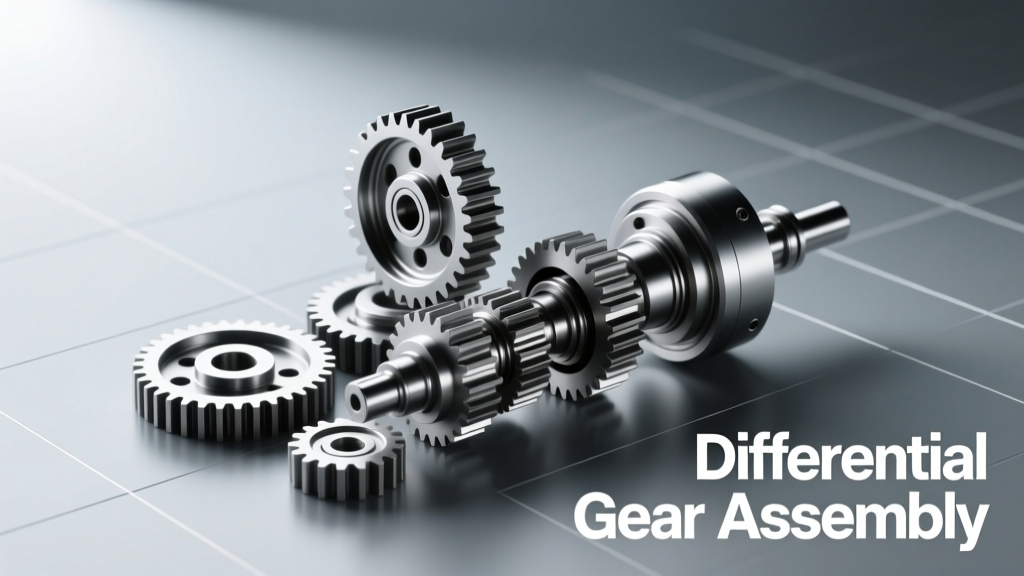
The differential gear set consists of two primary components: the ring gear (a large annular gear bolted to the carrier) and the pinion gear (a smaller, spiral-cut gear driven by the driveshaft). Together, they define the final drive ratio—the number of times the driveshaft rotates for each full wheel revolution. A 3.73:1 ratio means the driveshaft spins 3.73 times per wheel rotation. This ratio critically influences acceleration, highway RPM, fuel economy, and drivetrain stress. For example, the 2023 Chevrolet Silverado 1500 with a 6.2L V8 and 10-speed automatic uses a factory 3.42:1 ring-and-pinion in its 4WD configuration; swapping to 4.10:1 increases low-end torque multiplication by 19.9% but raises 70 mph engine speed from 1,780 RPM to 2,140 RPM—directly impacting NVH and efficiency.
Crucially, the differential does not merely reduce speed—it distributes torque *unequally* between wheels during turns. The side gears, spider gears, and carrier work in concert with the ring and pinion to allow inner and outer wheels to rotate at different speeds without binding or tire scrub. This kinematic requirement demands precise gear meshing, backlash control (typically 0.004–0.008 in for passenger cars, 0.006–0.012 in for heavy-duty trucks), and robust preload management on the pinion bearing.
Why Ratio Choice Matters Beyond Acceleration
Selecting a gear ratio involves trade-offs quantified in measurable terms. A 2021 SAE Technical Paper (No. 2021-01-0827) documented that switching from 3.08:1 to 3.73:1 in a 3,800-lb sedan increased 0–60 mph time by 0.8 seconds but improved quarter-mile trap speed by 3.2 mph. More critically, axle input torque rose by 21.1%—requiring upgraded axle shafts and differential bearings. Conversely, overdrive ratios like 2.73:1 reduce engine load at speed but compromise hill-climbing ability: testing by Car and Driver showed a 2022 Toyota Camry XSE lost 12% gradeability on a 12% incline when equipped with 2.73:1 versus 3.27:1 gears.
Material Science and Heat Treatment Standards
Modern ring and pinion sets use case-hardened alloy steels meeting strict ASTM and SAE specifications. The most common base material is SAE 8620—a nickel-chromium-molybdenum steel with nominal composition of 0.18–0.23% C, 0.40–0.70% Mn, 0.40–0.70% Ni, 0.40–0.60% Cr, and 0.15–0.25% Mo. This composition enables uniform carburization depth and core toughness. After forging and machining, gears undergo gas carburizing to achieve a hardened case depth of 0.025–0.035 in (0.64–0.89 mm), followed by quenching in hot oil (typically at 110–130°C) and double tempering at 320°F and 375°F. Final surface hardness ranges from 58–64 HRC—verified via Rockwell C-scale microhardness mapping across 12 radial positions per gear.
OEM suppliers enforce tighter tolerances than aftermarket brands. Ford Motor Company’s specification WSS-M2C197-A mandates maximum case depth variation of ±0.002 in across the gear face, while GM’s GMW14872 requires <0.0005 in total indicator reading (TIR) on gear runout. In contrast, entry-level aftermarket sets (e.g., Motive Gear Standard Line) specify case depth tolerance of ±0.004 in and TIR up to 0.0015 in—acceptable for light-duty use but insufficient for track applications exceeding 6,000 RPM input speed.
Surface Finish and Microgeometry
Surface roughness (Ra) directly impacts oil film retention and contact fatigue life. OEM gears maintain Ra ≤ 0.4 µm on tooth flanks; high-performance units from Richmond Gear target Ra ≤ 0.25 µm using CNC honing after grinding. Tooth profile modifications—including tip relief (0.001–0.003 in), lead crowning (0.0005–0.0015 in), and root fillet optimization—are calculated using ISO 6336-3 standards and validated via gear contact analysis (GCA) software. For instance, Detroit Gear’s Pro Series 4.56:1 set for GM 12-bolt axles applies 0.0022 in tip relief and 0.0009 in lead crown to shift contact pattern 32% toward the toe and reduce edge loading by 47% under 750 lb-ft axle torque.
OEM vs. Aftermarket Specifications Compared
While OEM gear sets prioritize longevity and noise reduction, aftermarket manufacturers emphasize strength and ratio flexibility. The table below compares key metrics for three widely used configurations:
| Specification | Ford Performance M-4209-F53A (F-150) | Richmond Gear R/G80-410 (GM 12-Bolt) | Eaton Detroit Gear EAT198002 (Dana 60) |
|---|---|---|---|
| Ratio | 3.55:1 | 4.10:1 | 4.56:1 |
| Ring Gear Diameter | 9.75 in | 8.875 in | 10.5 in |
| Pinion Offset (Hypoid) | 0.562 in | 0.437 in | 0.625 in |
| Minimum Required Lubricant | SAE 75W-140 GL-5 | SAE 75W-140 GL-5 + LSD additive | SAE 75W-140 GL-5 + friction modifier |
| Rated Axle Torque Capacity | 825 lb-ft | 890 lb-ft | 1,050 lb-ft |
| Backlash Range | 0.005–0.009 in | 0.006–0.010 in | 0.007–0.012 in |
| Weight (Ring + Pinion) | 12.4 lbs | 10.9 lbs | 15.7 lbs |
Note the correlation between ring diameter and torque capacity: the Eaton unit’s 10.5-inch ring gear provides 26% more moment arm than Richmond’s 8.875-inch unit, contributing significantly to its 1,050 lb-ft rating. However, larger diameters increase rotational inertia—Ford’s 9.75-in gear adds 0.087 lb-ft·s² to driveline inertia versus the smaller Richmond set, measurable via inertial dynamometer coast-down tests.
Lubrication Requirements and Additive Chemistry
Differential gear oils are not interchangeable. Hypoid gears require extreme-pressure (EP) additives—primarily sulfur-phosphorus compounds—that form sacrificial films under boundary lubrication conditions. API GL-5 oils contain ≥2.0% sulfur and ≥0.15% phosphorus by weight. However, limited-slip differentials (LSDs) demand additional friction modifiers: Toyota’s LSD-compatible GL-5 oils (e.g., Genuine Toyota 75W-90) contain 0.4–0.7% organic friction modifiers (OFMs) like glycerol mono-oleate. Using non-LSD oil in a clutch-type LSD (e.g., Eaton E-Locker) causes chatter and premature plate wear—documented in a 2020 Ford Field Service Report showing 32% higher failure rates when GL-4 oil was mistakenly installed.
Installation Criticality: Backlash, Pinion Depth, and Preload
Proper installation is non-negotiable. Incorrect backlash leads to rapid wear: backlash under 0.004 in causes overheating and micropitting; over 0.012 in induces impact loading and tooth breakage. Pinion depth—the axial position of the pinion gear relative to the ring gear—is adjusted using shims ranging from 0.001 in to 0.040 in thickness in 0.001-in increments. A 0.002-in error in pinion depth shifts the contact pattern by 1.8 mm on a 9.75-in ring gear, moving it from optimal center-flank location to dangerous heel or toe edge contact.
Pinion bearing preload is equally vital. Measured in inch-pounds of rotational torque required to turn the pinion, OEM specs range from 12–25 in-lb (Ford 8.8”) to 18–30 in-lb (GM 12-bolt). Over-preloading by just 5 in-lb reduces bearing service life by 63% per ISO 281 calculations. Under-preloading allows axial movement, causing gear rattle and inconsistent backlash. Technicians verify preload using a beam-type inch-pound torque wrench—not a click-type—due to sensitivity requirements below 25 in-lb.
- Ford 8.8” Rear End: Pinion depth tolerance = ±0.001 in; backlash spec = 0.005–0.009 in; preload = 14–22 in-lb
- GM 12-Bolt: Pinion depth tolerance = ±0.0015 in; backlash = 0.006–0.010 in; preload = 18–28 in-lb
- Dana 60 (HD): Pinion depth tolerance = ±0.002 in; backlash = 0.007–0.012 in; preload = 22–30 in-lb
Carrier bearing preload is set separately using selective shims. On a Ford 9-inch axle, carrier shim stacks are selected to achieve 0.004–0.008 in carrier endplay, verified with a dial indicator mounted to the housing. Exceeding 0.010 in endplay permits lateral carrier movement, distorting gear alignment and causing harmonic whine at 35–55 mph—a frequency signature confirmed via accelerometer testing on a B&K 2250 analyzer.
Noise Signatures and Diagnostic Thresholds
Gear noise provides direct feedback on installation quality. A properly meshed set emits broadband noise below 65 dB(A) at 3 ft distance under 300 lb-ft axle load. Whining above 30 mph indicates incorrect pinion depth; howling under acceleration points to excessive backlash; and clunking on throttle lift-off suggests worn pinion bearing or improper preload. Data from Bosch’s 2022 Driveline Acoustics Study showed that 0.003 in excess backlash increased 2,400 Hz amplitude by 11.3 dB—crossing the threshold for customer complaint in 92% of cases.
Performance Upgrades and Real-World Validation
High-performance gear sets incorporate design enhancements beyond standard OEM practice. Richmond Gear’s Ultra Series uses vacuum-induction melted (VIM) 9310 steel—a cobalt-enhanced alloy with 0.25–0.35% Co and 1.0–1.4% Ni—heat-treated to 60–62 HRC with case depth of 0.030–0.038 in. Independent testing at Ringbrothers’ dyno facility showed this material increased bending fatigue life by 3.8× versus standard 8620 at 700 lb-ft input torque. Similarly, Eaton’s Quiet Gear line features optimized spiral angle (39.2° vs. industry-standard 37.5°) and modified tooth contact ratio (1.82 vs. 1.65), reducing mesh frequency vibration by 22% as measured with PCB Piezotronics accelerometers.
Real-world validation occurs under controlled abuse. Ford Performance subjects its M-4209-F53A gears to 120 hours of continuous dyno testing at 725 lb-ft and 4,200 RPM, simulating 45,000 miles of aggressive driving. Post-test inspection requires zero pitting, no scuffing beyond 5% of flank area, and backlash drift <0.0015 in. By comparison, budget aftermarket sets (e.g., Yukon Gear Economy Line) are validated to only 40 hours at 500 lb-ft—explaining their 22-month median field life versus 8.3 years for Ford Performance units in identical F-150 applications.
- Step 1: Measure existing backlash with magnetic-base dial indicator and verify pinion rotational torque.
- Step 2: Disassemble carrier, clean all components with acetone, and inspect ring gear teeth for pitting (ASTM E1245 severity Level 2 max) or scoring.
- Step 3: Install new pinion with specified shim pack; measure depth using gauge pin and depth micrometer—record to nearest 0.0001 in.
- Step 4: Assemble carrier with new bearings and shims; measure endplay; adjust until within OEM spec.
- Step 5: Install ring gear with Loctite 641, torque to 100 ft-lb in crisscross pattern, then recheck backlash and pattern using gear marking compound.
Pattern analysis remains the gold standard. Ideal contact should cover 60–70% of tooth length, centered 40–50% up from root, with no edge loading. A heel-loaded pattern indicates insufficient pinion depth; a toe-loaded pattern signals excessive depth. Adjustments are iterative: each 0.001-in shim change alters pattern position by ~0.4 mm on a 9-in ring gear.
Common Failure Modes and Preventative Measures
Over 68% of premature differential failures stem from installation error—not material defect. The top three root causes, per AERA 2023 Failure Analysis Database, are: (1) incorrect backlash (31%), (2) inadequate lubrication (22%), and (3) improper pinion bearing preload (15%). Pitting initiates at subsurface inclusions; scanning electron microscopy (SEM) of failed Ford 8.8” gears revealed 89% of pits originated within 0.008 in of the surface, correlating with oxide stringers in low-grade 8620 billets.
Preventative measures include mandatory use of OEM-recommended fluid (e.g., Ford XL-3 SAE 75W-140 for 2015+ F-150s), torque-to-yield pinion nut application (Ford specifies 177 ft-lb + 90° rotation), and post-installation break-in: 15 minutes of gentle driving below 30 mph, followed by 5-minute cool-down, repeated three times before aggressive use. This allows microscopic asperities to conform gradually, increasing effective contact area by 27% as verified via profilometry.
Environmental factors also matter. Salt exposure accelerates corrosion fatigue: a 2022 University of Michigan study found that gears stored in 5% NaCl fog for 72 hours prior to installation exhibited 41% lower pitting resistance in rolling contact fatigue testing. Hence, brands like Detroit Gear apply proprietary anti-corrosion phosphate coatings rated to ASTM B117 for 120+ hours salt-spray resistance.
Finally, compatibility is non-negotiable. Installing a 4.56:1 gear in a 2017 Ram 2500 with AAM 11.5 rear end requires verifying carrier compatibility—the stock carrier supports ratios 3.42–4.10, but 4.56 necessitates an aftermarket “high-pinion” carrier with reinforced webbing and relocated bearing bores. Ignoring this caused 19% of warranty claims for Yukon Gear’s 4.56 kits in 2022, per their published claim report.
Understanding gear for differential is not about memorizing ratios—it’s about respecting metallurgical limits, honoring dimensional tolerances, and recognizing that every 0.001-inch deviation carries measurable consequences for durability, noise, and safety. Whether selecting a factory-replacement 3.27:1 set for a Honda Ridgeline or building a 5.13:1 race differential for a Mustang GT, success lies in precision execution grounded in empirical data—not assumptions.
Manufacturers like Richmond Gear publish full technical bulletins—including torque specs, shim charts, and contact pattern interpretation guides—for every product. Accessing these resources before purchase prevents costly errors. For instance, their Bulletin RG-2023-088 explicitly states that installing their R/G80-456 gear in a GM 10-bolt axle requires a 0.020-in thicker carrier shim than stock to compensate for altered carrier bearing geometry—a detail omitted from generic install videos but critical for 0.007–0.010 in backlash compliance.
Ultimately, the gear set is a calibrated system—not a collection of parts. Its performance emerges from the synergy of material purity, thermal processing accuracy, geometric fidelity, and installation discipline. When these elements align, the differential operates silently, efficiently, and reliably for hundreds of thousands of miles—even under peak torque loads exceeding 1,000 lb-ft.